Facts
The respondents, parents of the deceased Sachidanand Dube, filed a claim petition under the Railway Act before the Railway Claims Tribunal, Ahmedabad, seeking compensation for their son’s death in a railway accident.
Source reference: p. 2, para. 3The deceased was allegedly travelling from Nar Town to Sayma Station in a passenger train and fell from the train near Tarapur Station, sustaining fatal injuries.
Source reference: p. 2, para. 3The Railway Administration denied liability, relying on a DRM report which stated that the deceased had attempted to alight from a running train while trying to retrieve his mobile phone, and therefore had died due to his own negligence.
Source reference: p. 2, para. 4The Tribunal allowed the claim and awarded Rs. 8 lakhs with interest at 9% per annum. The Railway Administration challenged that decision under Section 23 of the Railway Claims Tribunal Act.
Source reference: p. 2, para. 2Issues
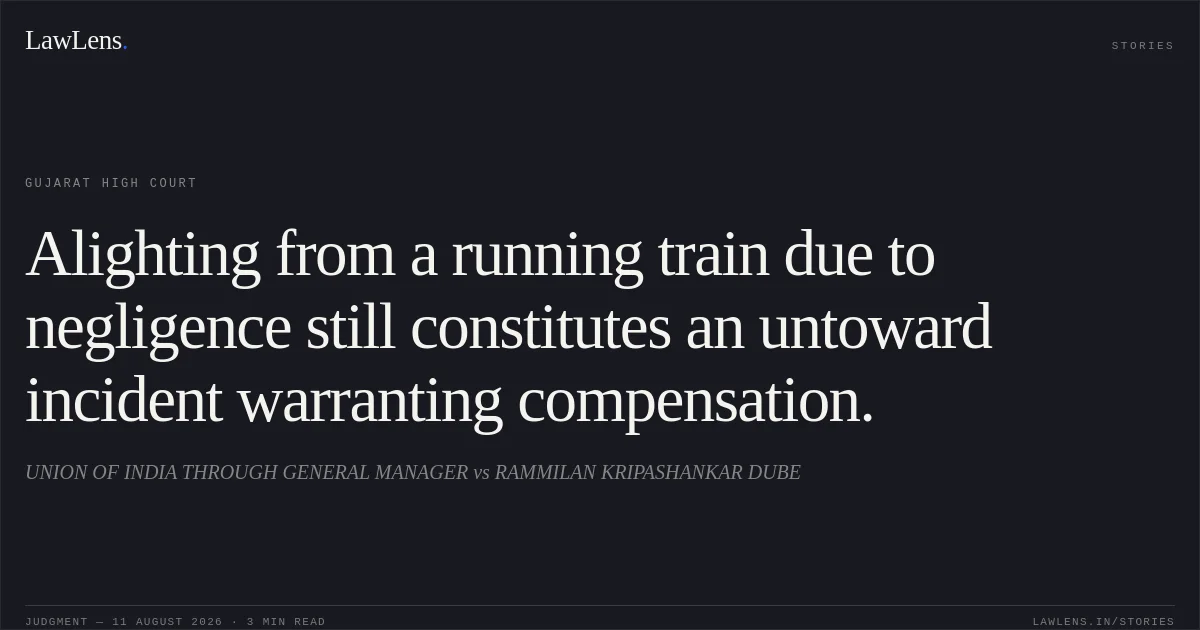
Whether the deceased’s alleged act of alighting from a running train due to his own negligence excluded the incident from the statutory concept of an “untoward incident” and absolved the Railway Administration from liability.
Source reference: p. 2, paras. 4–5Whether the deceased was a bona fide passenger, notwithstanding the Railway Administration’s challenge to the existence or validity of his railway ticket.
Source reference: p. 4, para. 8; p. 5, para. 8.1Whether the DRM report, prepared after the claim petition was filed and beyond the prescribed period, could be relied upon to defeat the claim.
Source reference: p. 5, para. 9Law Applied
The Court applied Section 23 of the Railway Claims Tribunal Act governing appeals to the High Court and the no-fault compensation framework under Section 124A of the Railways Act for death or injury arising from an “untoward incident.”
Source reference: pp. 2–4, paras. 5–7It relied on Shrikumar Gupta v. Union of India, 2025 LiveLaw (SC) 1115, for the principle that an allegation that a passenger negligently alighted from a running train does not, without proof, exclude railway liability under Section 124A.
Source reference: pp. 2–4, paras. 5–7It further relied on Union of India v. Rina Devi, 2018 AIR (SC) 2362, and Dolly Rani Saha v. Union of India, (2024) 9 SCC 656, which establish that the initial burden to show bona fide passenger status may be discharged by the claimant’s affidavit; thereafter, the burden shifts to the Railways, and mere absence of a ticket is not conclusive against the claim.
Source reference: p. 4, para. 8The Railway Administration must prove any statutory defence based on the passenger’s alleged self-negligence.
Source reference: pp. 3–4, para. 6Reasoning
The Court held that the occurrence of a fatal accident on the railway track was undisputed. Even assuming the Railway Administration’s version that the deceased attempted to alight from the running train, such conduct did not by itself take the case outside the scope of an untoward incident.
Source reference: pp. 2–4, paras. 5–7Applying Shrikumar Gupta, the Court found that the Railway Administration had not proved the alleged act of jumping or alighting from the train; the DRM report did not adequately establish that defence.
Source reference: pp. 2–4, paras. 5–7On passenger status, the claimant’s affidavit asserting that the deceased was travelling with a valid ticket shifted the evidentiary burden to the Railways. Since no railway witness entered the witness box to disprove that assertion, the challenge to bona fide passenger status failed.
Source reference: p. 5, para. 8.1The Court also found the DRM report unreliable for the purpose of defeating the claim because it was prepared on 25 August 2017, after the claim petition had been filed on 6 February 2017, although the incident occurred on 20 November 2015 and the statutory requirement contemplated submission within 60 days.
Source reference: p. 5, para. 9Holding
The Court answered the issues against the Railway Administration. It held that the deceased was a bona fide passenger who died in an untoward railway incident and that the Railways had failed to establish either self-negligence or the absence of a valid passenger status.
The first appeal was dismissed, the interim relief, if any, was discontinued, and the Tribunal was directed to disburse the awarded compensation of Rs. 8 lakhs together with applicable interest to the claimants after due verification and identification.
Source reference: p. 6, paras. 11–12The connected civil application for withdrawal/disbursement was disposed of.
Source reference: p. 6, para. 12Acts & Sections Cited
1 provisions across 1 statute referred to in this judgment. Each provision opens on LawLens.
Railway Claims Tribunal Act, 19871
Original Court PDF
UNION OF INDIA THROUGH GENERAL MANAGERvsRAMMILAN KRIPASHANKAR DUBE
Click to open original judgment
Original judgment, available to read, download and summarize on LawLens.in