01Facts
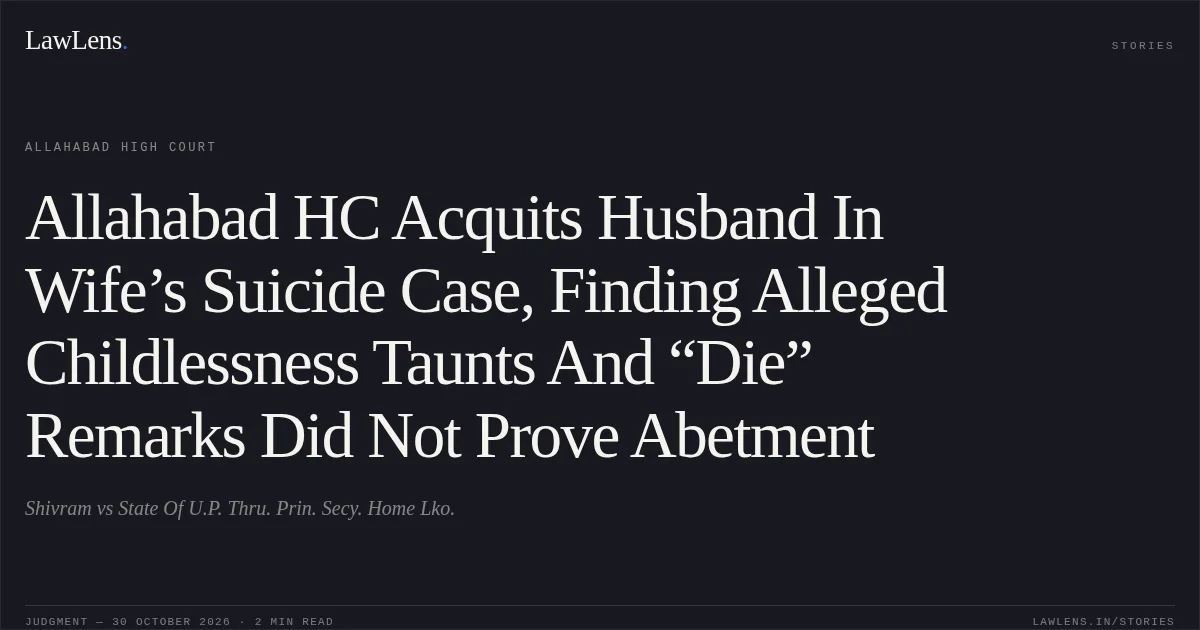
The appellant was convicted by the Sessions Judge, Barabanki, under Section 306 IPC and sentenced to seven years’ rigorous imprisonment and a fine.
¶ 2–7The prosecution alleged that his wife, Ramdasa, died by suicide after he harassed and taunted her over their childlessness and told her to die. Her brother and other relatives testified to her complaints of harassment; the appellant said she had suffered from tuberculosis and depression. The post-mortem established death by hanging.
¶ 2–702Issues
i.Whether the prosecution proved beyond reasonable doubt that the appellant harassed the deceased as alleged?
¶ 24–34ii.Whether the appellant’s proved conduct amounted to abetment of suicide under Sections 306 and 107 IPC, including the required intent and proximate nexus?
¶ 40–5303Law Applied
Section 306 IPC requires proof both that the deceased died by suicide and that the accused abetted it; abetment must fall within one of the modes in Section 107 IPC: instigation, participation in a qualifying conspiracy, or intentional aid.
¶ 40–42Ramesh Kumar v. State of Chhattisgarh, (2001) 9 SCC 618, explains that instigation involves goading, urging, provoking, inciting or encouraging, and that an utterance does not automatically amount to instigation.
¶ 43S.S. Chheena v. Vijay Kumar Mahajan, (2010) 12 SCC 190, requires a positive act and mens rea; suicide or strained relations alone do not establish abetment.
¶ 44The alleged act must also be sufficiently proximate to the suicide. State of W.B. v. Orilal Jaiswal, (1994) 1 SCC 73, cautions that ordinary domestic discord, without more, cannot sustain a Section 306 conviction.
¶ 45, 47Provisions in the judgment · 6 · Linked ones open on LawLens
Bharatiya Nagarik Suraksha Sanhita, 2023 Section 415
Code of Criminal Procedure, 1973 Section 374Section 313Section 437
Indian Penal Code, 1860 Section 306Section 107
04Reasoning
The Court found the harassment allegations unsafe to rely on: the relatives were not present for the alleged conduct, the brother’s claimed disclosure of immediate harassment was omitted from his police statement, no contemporaneous complaint was produced, and the Investigating Officer said no one alleged harassment at the inquest.
¶ 25–28The post-mortem showed no injuries apart from the ligature mark, and the evidence about the deceased’s illness and treatment was inconsistent. The unexplained delay in lodging the FIR and omissions from the earliest account further weakened the prosecution case.
¶ 29–30, 35–39In any event, the evidence did not establish a specific intentional act of instigation or aid, the requisite mens rea, or a proximate nexus between the appellant’s conduct and the suicide; the trial court had not adequately identified or reasoned through those statutory elements.
¶ 46–5305Holding
The Court held that the prosecution had not proved either the alleged harassment beyond reasonable doubt or the foundational requirements of abetment under Sections 306 and 107 IPC.
¶ 54–55It allowed the appeal, set aside the conviction and sentence, and acquitted the appellant. It directed his release if not required in another case, subject to bonds under Section 437-A CrPC.
¶ 56–57Original Court PDF
ShivramvsState Of U.P. Thru. Prin. Secy. Home Lko.
Click to open original judgment
Original judgment, available to read, download and summarize on LawLens.in