01Facts
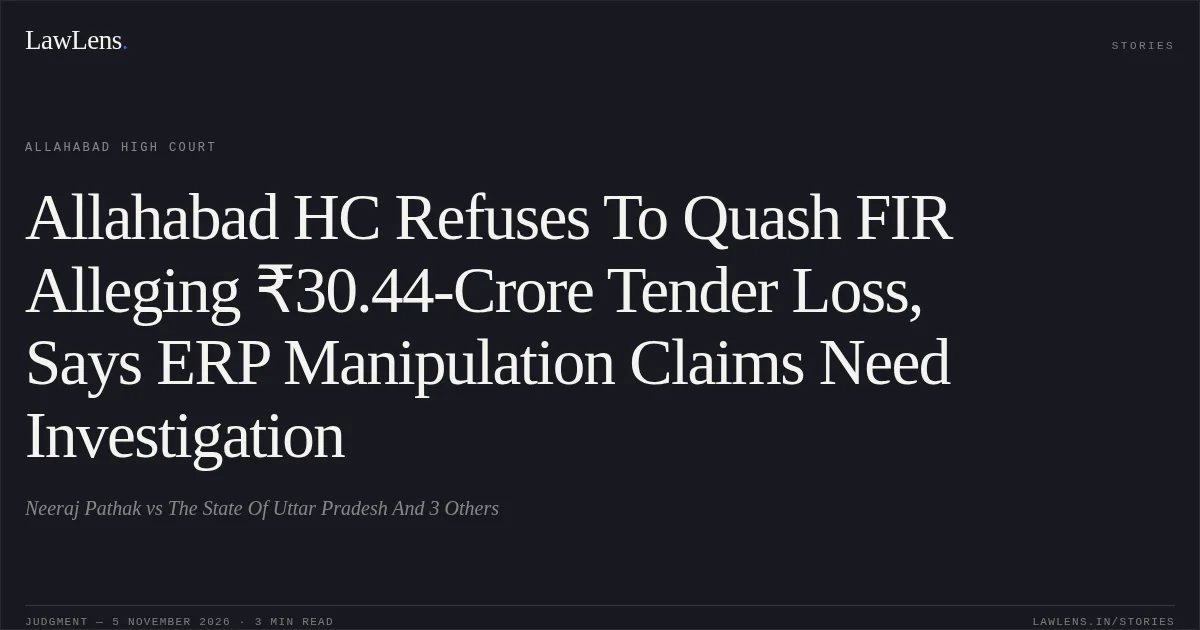
The petitions arose from Case Crime No. 0014 of 2026, registered on 10 January 2026, concerning alleged irregularities in electrical tenders handled by the Electricity Distribution Division, Fatehabad, during financial years 2023–24 to 2025–26.
¶ 2–8A three-member departmental committee’s report dated 31 December 2025 alleged, among other matters, collusion between bidders, tender-process manipulation, contracts issued against cancelled or unpublished tenders, purchase orders in favour of non-participants, and an aggregate loss of approximately Rs. 30.44 crore.
¶ 2–8The accused included departmental employees and contractors, who sought to quash the FIR, disputing their roles and alleging, among other things, delay, lack of criminal intent, defects in the departmental inquiry, and absence of a hearing.
¶ 9–2802Issues
i.1. Whether the FIR, read on its face, disclosed cognizable offences warranting investigation, or should be quashed under Article 226 of the Constitution.
¶ 40–42ii.2. Whether the alleged delay, absence of prior approval under Section 17-A of the Prevention of Corruption Act, lack of authority or personal benefit, and alleged defects in the inquiry justified quashing the FIR.
¶ 33–37iii.3. Whether the contractors’ explanations concerning emergency works, minor tender discrepancies, shared IP addresses, and internal tender procedures displaced the allegations of collusion and manipulation at the FIR stage.
¶ 38iv.4. Whether alleged bias in the departmental inquiry, including the committee chairman’s involvement in some tender decisions, rendered the FIR liable to be quashed.
¶ 3903Law Applied
The Court applied Section 17-A of the Prevention of Corruption Act, 1988, concerning prior approval for inquiry or investigation into decisions or recommendations made by public servants in the discharge of official functions; it held that the provision does not provide blanket immunity for alleged acts of manipulation or for private contractors.
¶ 33It considered Sections 316 and 318 of the Bharatiya Nyaya Sanhita, 2023, concerning criminal breach of trust and cheating, and Section 61(2) concerning criminal conspiracy, in the context of allegations of dishonest conduct and loss to the corporation.
¶ 36The Court also relied on State of Haryana v. Bhajan Lal, 1992 Supp (1) SCC 335, and Neeharika Infrastructure Pvt. Ltd. v. State of Maharashtra, AIR 2021 SC 1918, for the principle that the High Court’s power to quash an FIR is to be exercised sparingly, and that it should not assess the truth of allegations or conduct a mini-trial where the FIR, on its face, discloses cognizable offences.
¶ 40A departmental inquiry report may form the basis for lodging an FIR, and natural justice does not require a hearing at the preliminary stage preceding registration of the FIR.
¶ 37Provisions in the judgment · 3 · Linked ones open on LawLens
Bharatiya Nyaya Sanhita, 2023 Section 61Section 316Section 318
04Reasoning
The Court found that prior approval under Section 17-A had been obtained and that the alleged acts—such as agreements against cancelled tenders and purchase orders for non-bidders—did not prima facie fall within protected official decision-making.
¶ 33It considered the approximately 70-day interval before registration of the FIR explained by the departmental inquiry and collection of material, and not fatal at this stage.
¶ 34The report attributed specific acts to the petitioners by name, role, tender and amount; whether clerical employees acted on instructions or their system credentials were misused, and whether contractors participated in collusion, were factual questions for investigation.
¶ 35–36, 38The Court further held that the inquiry report could support registration of the FIR, while alleged bias in the inquiry could be raised to challenge the report and did not, by itself, warrant quashing.
¶ 37, 39As the FIR alleged tender and ERP manipulation, the Court declined to evaluate the petitioners’ defences at the writ stage.
¶ 40–4105Holding
The Court held that the FIR disclosed cognizable offences and that the petitioners’ objections raised matters for investigation rather than grounds for quashing.
¶ 41–42It dismissed all connected writ petitions seeking to quash the FIR.
¶ 43Original Court PDF
Neeraj PathakvsThe State Of Uttar Pradesh And 3 Others
Click to open original judgment
Original judgment, available to read, download and summarize on LawLens.in