01Facts
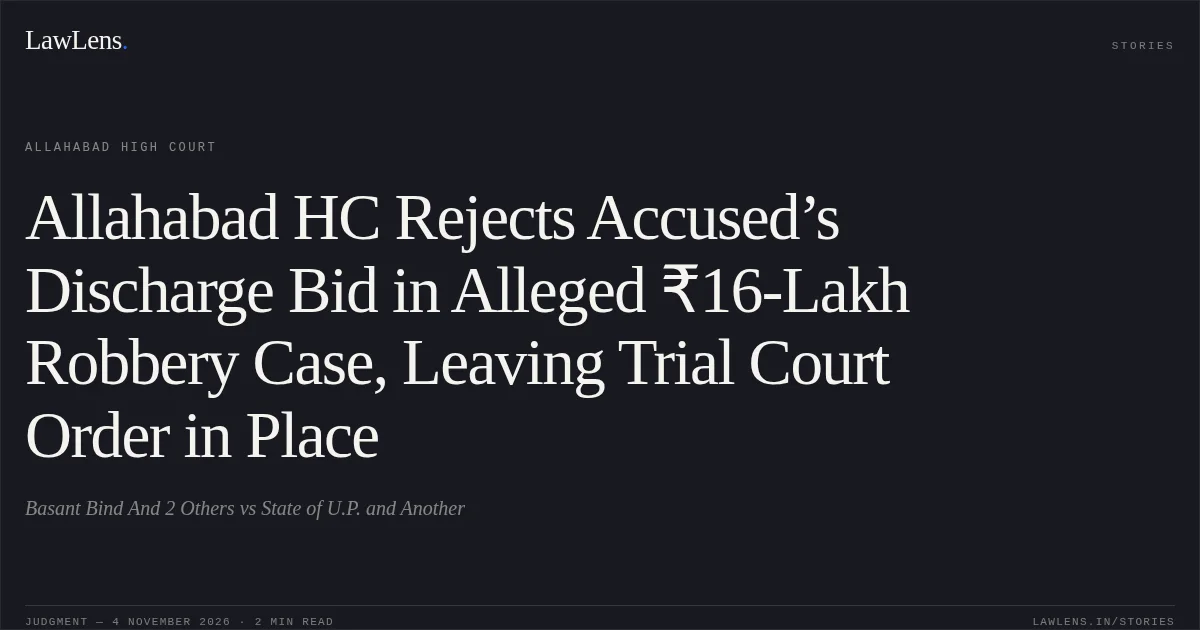
The prosecution arose from an FIR alleging that Pintoo Nishad and three accomplices took a bag containing ₹16 lakh from one of the complainant’s companions
¶ 3 · p. 1During the investigation, police apprehended Arvind Bind and Sikandar; the prosecution alleged that they identified the revisionists among the other participants and that ₹14 lakh was recovered from a motorcycle
¶ 4 · p. 2A charge-sheet was filed against Sikandar, Arvind and Basant Bind
¶ 5 · p. 2The revisionists sought discharge, relying, among other things, on the alleged delay in lodging the FIR and their explanation for possessing the money
¶ 7 · p. 2The Sessions Court rejected the application on 8 September 2025, and the revisionists challenged that order
¶ 2 · p. 102Issues
i.Whether the material on record disclosed sufficient ground to proceed against the revisionists, such that their discharge under Section 227 CrPC was properly refused
¶ 8–13 · pp. 2–4ii.Whether the Sessions Court’s refusal to discharge the revisionists disclosed an error or illegality warranting interference in revision
¶ 15–16 · p. 503Law Applied
Section 227 CrPC requires discharge where, after considering the record and hearing the parties, the judge finds no sufficient ground to proceed; the relevant ground is for putting the accused on trial, not for conviction
¶ 8 · p. 2 · Stree Atyachar Virodhi Parishad v. Dilip Nathumal Chordia · ¶ 9 · p. 2At the charge stage, the court may sift the material to determine whether the alleged facts, taken at face value, support a presumption that the accused committed an offence, but it need not decide whether conviction is likely
Chitresh Kumar Chopra v. State (NCT of Delhi) · ¶ 11 · pp. 2–3 · Amit Kapoor v. Ramesh Chander · ¶ 12 · pp. 3–4The court distinguished the definite assessment for discharge under Section 227 from the tentative assessment for framing a charge under Section 228 CrPC; where the alleged facts and offence ingredients support proceeding, the truth is to be tested at trial
¶ 13 · p. 4The judgment also referred to Rajbir Singh v. State of U.P. and State of M.P. v. Deepak on the threshold inquiry at the charge stage
¶ 10, 14 · p. 2, 4Provisions in the judgment · 5 · Linked ones open on LawLens
Indian Penal Code, 1860 Section 395Section 412
Code of Criminal Procedure, 1973 Section 227Section 228Section 313
04Reasoning
Applying this threshold, the High Court concluded that the Sessions Court’s order did not suffer from error or illegality
¶ 15 · p. 5The prosecution material included the alleged identification of the revisionists by the apprehended co-accused and the recovery of ₹14 lakh; the revisionists’ alternative account and objections, including the asserted delay in the FIR, did not require the court to determine guilt or resolve the evidentiary contest at the discharge stage
¶ 4, 7 · p. 2 · ¶ 13, 15 · pp. 4–5The court therefore left the truth of the allegations to be tested at trial.
05Holding
The High Court held that the order rejecting discharge disclosed no error or illegality calling for revisional interference
¶ 15–16 · p. 5dismissed the revision
¶ 15–16 · p. 5Original Court PDF
Basant Bind And 2 OthersvsState of U.P. and Another
Click to open original judgment
Original judgment, available to read, download and summarize on LawLens.in