Facts
The complainant alleged that the appellant had sexual intercourse with her at night while she mistakenly believed he was her husband.
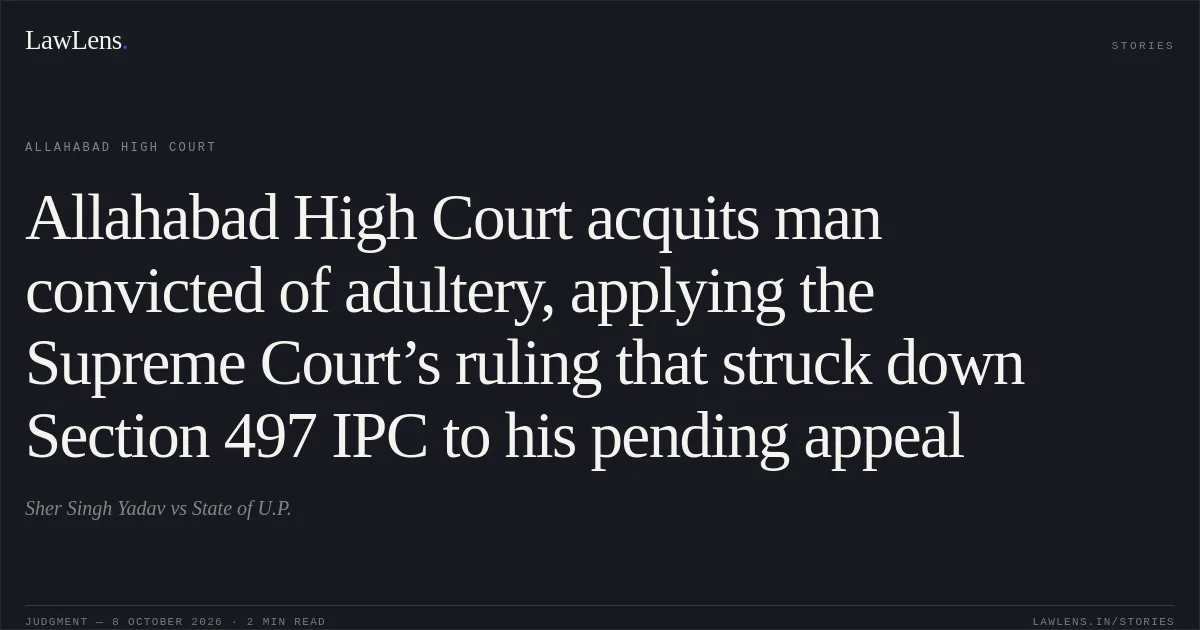
Source reference: para. 2–9The trial court acquitted the appellant of rape under Section 376 IPC but convicted him of adultery under Section 497 IPC and sentenced him to three years’ simple imprisonment and a fine of ₹2,000.
Source reference: para. 2–9The appellant appealed.
Source reference: para. 2–9The trial court’s findings supporting the acquittal under Section 376 IPC were not challenged by the complainant or the State.
Source reference: para. 2–9The complainant’s husband and father, who were said to have been nearby, were not examined as witnesses.
Source reference: para. 15–18Issues
Whether the declaration that Section 497 IPC was unconstitutional applied to the appellant’s pending appeal against conviction and sentence.
Source reference: para. 10–12Whether the conviction under Section 497 IPC could stand where the prosecution was not initiated on a complaint by the husband, as contemplated by Section 198(2) CrPC.
Source reference: para. 13–15Whether the non-examination of the complainant’s husband and father warranted an adverse inference against the prosecution.
Source reference: para. 15–18Law Applied
In Joseph Shine v. Union of India, (2019) 3 SCC 39, the Supreme Court struck down Section 497 IPC as unconstitutional.
Source reference: para. 10Under A.S. Gauraya v. S.N. Thakur, (1986) 2 SCC 709, law declared by the Supreme Court applies to pending proceedings.
Source reference: para. 11Section 198(2) CrPC provided that, for an offence under Section 497 IPC, only the woman’s husband was deemed to be an aggrieved person; Joseph Shine declared that provision unconstitutional only to the extent it applied to adultery.
Source reference: para. 13–14Section 114, Illustration (g), of the Evidence Act permits an adverse inference where material evidence that could have been produced is withheld.
Source reference: para. 16–17Under Davinder Singh v. State of Punjab, (2023) 19 SCC 229, relying on Takhaji Hiraji v. Thakore Kubersing Chamansing, (2001) 6 SCC 145, non-examination of a material witness may support such an inference where the witness could have addressed a gap or infirmity in the prosecution case.
Source reference: para. 16–17Reasoning
The Court held that the appellant’s appeal was a pending proceeding when Joseph Shine was decided; therefore, the declaration invalidating Section 497 IPC applied to it.
Source reference: para. 10–12It also found that the prosecution had not been initiated on a complaint by the complainant’s husband.
Source reference: para. 13–15The husband and father were material witnesses in light of the account that they were nearby and the conflicting evidence about whether they came to the complainant’s aid.
Source reference: para. 15–18Their non-examination supported an adverse inference against the prosecution under Section 114, Illustration (g), of the Evidence Act.
Source reference: para. 15–18The Court consequently found the charge under Section 497 IPC unproved.
Source reference: para. 19Holding
The Court allowed the appeal, set aside the conviction and sentence under Section 497 IPC, and acquitted the appellant of that charge.
Acts & Sections Cited
8 provisions across 2 statutes referred to in this judgment. Each provision opens on LawLens.
Indian Penal Code, 18606
Code of Criminal Procedure, 19732
Original Court PDF
Sher Singh YadavvsState of U.P.
Click to open original judgment
Original judgment, available to read, download and summarize on LawLens.in