Facts
The applicant, Smt. Chandrakanta, alleged to be the mother-in-law of the deceased, sought bail in Case Crime No. 17 of 2026, Police Station Basauni, District Agra, registered under Sections 85, 80(2), 352, 115(2), and 351(3) of the Bharatiya Nyaya Sanhita, 2023 and Sections 3/4 of the Dowry Prohibition Act.
Source reference: para. 2The deceased had died by suicide by hanging within seven years of marriage. The applicant contended that the dispute arose from petty household issues, that the allegations against her were general and vague, and that the first informant’s statement under Section 180 of the Bharatiya Nagarik Suraksha Sanhita, 2023 differed from the FIR.
Source reference: para. 21During the bail proceedings, the Investigating Officer admitted that he had not prepared an audio-video recording while recording the first informant’s statement under Section 180 BNSS, despite the relevant directions and circulars issued by the Director General of Police, Uttar Pradesh.
Source reference: para. 3Issues
1. Whether the applicant, alleged to be the mother-in-law of the deceased in a dowry-related prosecution, was entitled to bail having regard to the nature of the allegations, the evidentiary material, her custodial period, gender, and absence of criminal history?
Source reference: paras. 21–232. Whether the Investigating Officer’s failure to prepare an audio-video recording of the statement under Section 180 BNSS, and the broader investigative practices disclosed before the Court, required directions to ensure a fair, transparent, and impartial investigation?
Source reference: paras. 3–20Law Applied
The Court applied Sections 176, 179, 180, 183(6), 184(1), and 480 of the BNSS, 2023, concerning the duties and procedure of investigation, examination of witnesses, recording of statements before a Magistrate in serious offences, medical examination in sexual-offence cases, and grant of bail to women.
Source reference: paras. 5, 8–10, 19, 21The proviso to Section 180(3) BNSS and Rule 20(1) of the BNSS Rules, 2024 permit the Investigating Officer to record witness statements through audio-video electronic communication.
Source reference: para. 5The Court relied on Regulations 107–109 and 116–117 of the U.P. Police Regulations, which require the Investigating Officer to discover the truth rather than act as a mere clerk, examine the scene and relevant witnesses, record material variations, and conduct fair identification procedures.
Source reference: paras. 11–14It further relied on State of Uttar Pradesh v. Bhagwant Kishore Joshi, 1913 SCC OnLine SC 91, for the principle that investigation principally involves the collection of evidence relating to the offence, and on Vinay Tyagi v. Irshad Ali alias Deepak, (2013) 5 SCC 762, for the requirement that investigation be unbiased, honest, lawful, and directed towards discovering the truth.
Source reference: paras. 17–18Reasoning
The Court found that the optional nature of audio-video recording under the DGP’s circulars had been misused by Investigating Officers and could undermine the reliability and transparency of statements recorded under Section 180 BNSS.
Source reference: paras. 4–7Applying the statutory investigation framework and the U.P. Police Regulations, it emphasised that an Investigating Officer must independently assess the evidence, examine independent witnesses, avoid suggesting incriminating facts to witnesses, and fairly consider material offered by the accused.
Source reference: paras. 11–19The Court therefore directed that audio-video recording of witness statements should preferably be prepared through the E-Sakshya application and made available to the competent court when required.
Source reference: para. 19(i)On the merits of bail, the Court noted the applicant’s status as a woman and mother-in-law, the alleged inconsistencies between the FIR and the subsequent statement, the absence of specific material showing that she had subjected the deceased to cruelty for dowry shortly before the death, her lack of criminal antecedents, and her period of custody.
Source reference: para. 21Holding
Without expressing any final opinion on the merits, these circumstances, together with the nature of the offence, the evidentiary position, overcrowded prisons, and trial delay, justified release on bail.
The Court allowed the bail application and directed that Smt. Chandrakanta be released on furnishing a personal bond and two sureties in the like amount, subject to conditions against influencing witnesses, tampering with evidence, seeking unnecessary adjournments, or committing any further offence.
Source reference: paras. 23–25The Court also directed verification of the identity, residence, mobile number, and Aadhaar details of the applicant and sureties.
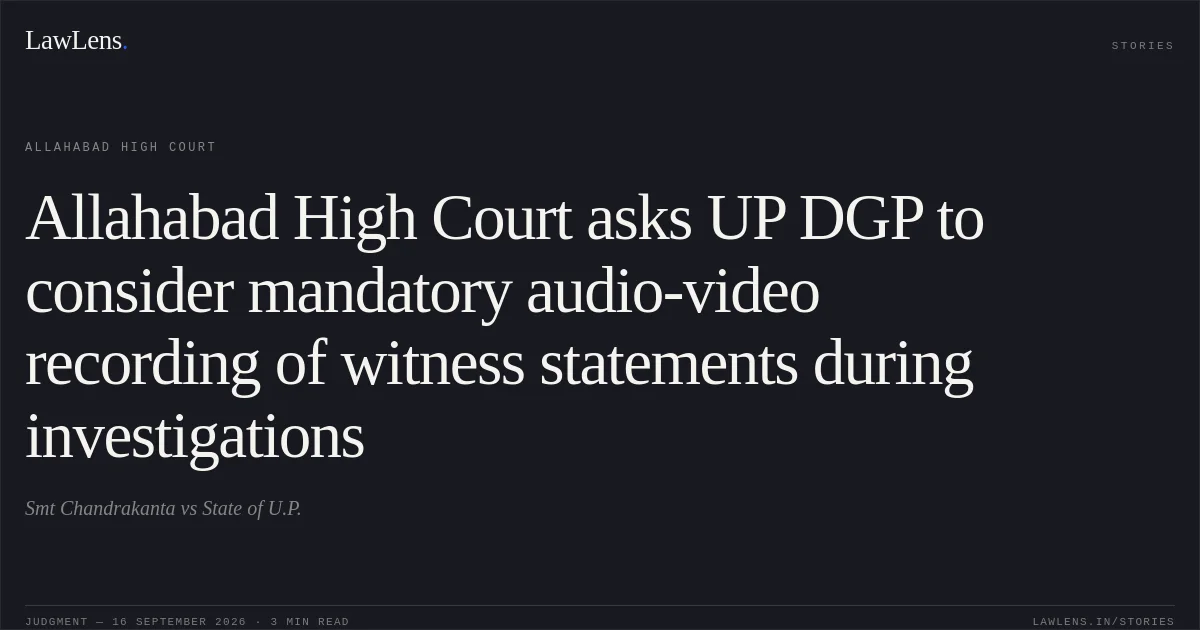
Source reference: paras. 26–27The Director General of Police, Uttar Pradesh, was directed to consider making audio-video recording of statements under Section 180 BNSS mandatory and to circulate the investigative guidelines to all Investigating Officers.
Source reference: paras. 20, 32Acts & Sections Cited
14 provisions across 4 statutes referred to in this judgment. Each provision opens on LawLens.
Bharatiya Nyaya Sanhita, 20235
Bharatiya Nagarik Suraksha Sanhita, 20236
Code of Criminal Procedure, 19731
Original Court PDF
Smt ChandrakantavsState of U.P.
Click to open original judgment
Original judgment, available to read, download and summarize on LawLens.in