Facts
The petitioner-plaintiff sued for a declaration of her claimed rights as the sole legal heir of her deceased father and over the suit properties, and for a declaration that a Surviving Family Members Certificate dated 16 January 2021 was null and void.
Source reference: paras. 3, 7–11Defendant No. 8, who had served as Tahsildar, Khanapur, applied under Order I Rule 10(2) CPC to be removed from the suit, denying that she issued the certificate or certified the disputed mutation entries; the certificate appeared to bear the digital signature of the Deputy Tahsildar.
Source reference: paras. 3, 17–18, 24The Trial Court allowed the application and deleted her name.
Source reference: paras. 5, 15The plaintiff challenged that order under Articles 226 and 227 of the Constitution.
Source reference: p. 2; para. 6Issues
1. Whether defendant No. 8 was a proper party under Order I Rule 10(2) CPC to the plaintiff’s suit.
Source reference: paras. 20–232. Whether the Trial Court’s order deleting defendant No. 8’s name warranted interference under Article 227 of the Constitution.
Source reference: para. 29Law Applied
Order I Rule 10(2) CPC permits a court to strike out an improperly joined party and to add a person whose presence is necessary to enable the court to effectively and completely adjudicate and settle the questions in the suit.
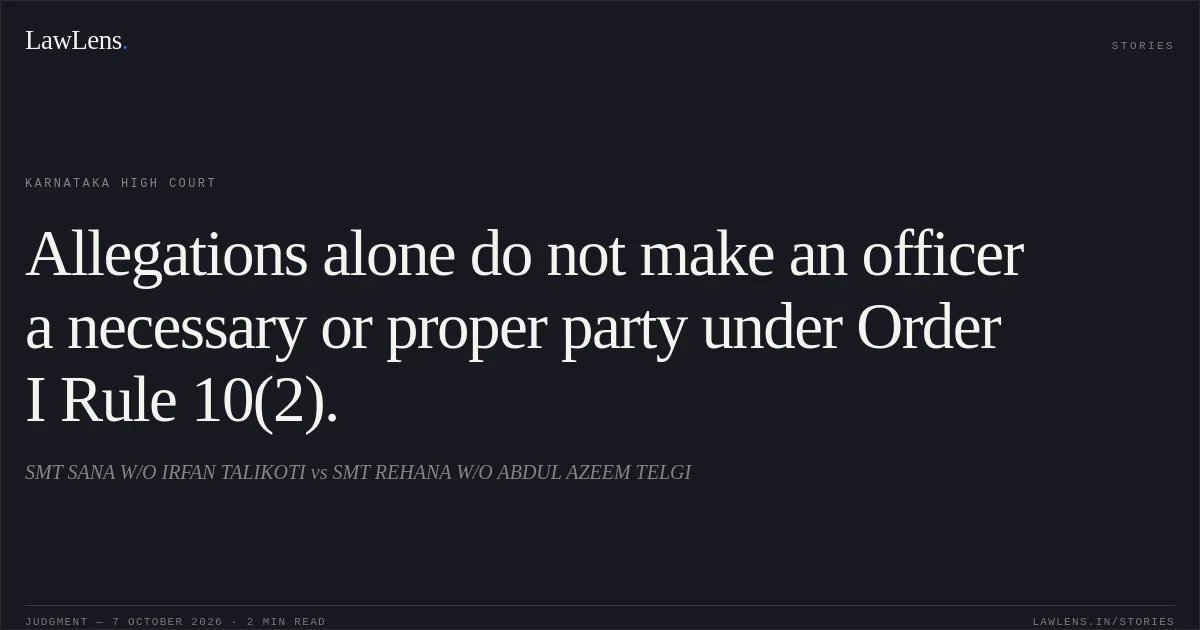
Source reference: para. 21Allegations in a plaint, by themselves, do not make a person a necessary or proper party; the relevant test is whether that person’s presence is required for effective and complete adjudication.
Source reference: para. 25The High Court’s supervisory jurisdiction under Article 227 does not warrant interference absent illegality, infirmity, or jurisdictional error in the order under challenge.
Source reference: para. 29Reasoning
The dispute concerned the plaintiff’s claimed rights in the suit properties and the validity and effect of the certificate and consequential mutation entries.
Source reference: para. 26Defendant No. 8 claimed no interest in the properties, denied issuing the certificate, and was not shown to have certified the entries; the certificate appeared to bear the Deputy Tahsildar’s digital signature.
Source reference: paras. 24, 26–27The plaintiff’s allegation of defendant No. 8’s involvement, without further material showing her presence was necessary, did not satisfy the Order I Rule 10(2) test.
Source reference: paras. 27–28The certificate’s issuance or validity could be considered by reference to the relevant records and competent officer, without defendant No. 8 being indispensable to the adjudication.
Source reference: paras. 27–28The Trial Court’s decision therefore disclosed no ground for supervisory interference.
Source reference: para. 29Holding
The High Court held that defendant No. 8 was not a proper party to the suit and that the Trial Court had rightly allowed I.A. No. VII and deleted her from the array of defendants.
The writ petition was dismissed, with no order as to costs.
Source reference: paras. 30–31Acts & Sections Cited
1 provisions across 1 statute referred to in this judgment. Each provision opens on LawLens.
Code of Civil Procedure, 19081
Original Court PDF
SMT SANA W/O IRFAN TALIKOTIvsSMT REHANA W/O ABDUL AZEEM TELGI
Click to open original judgment
Original judgment, available to read, download and summarize on LawLens.in