Facts
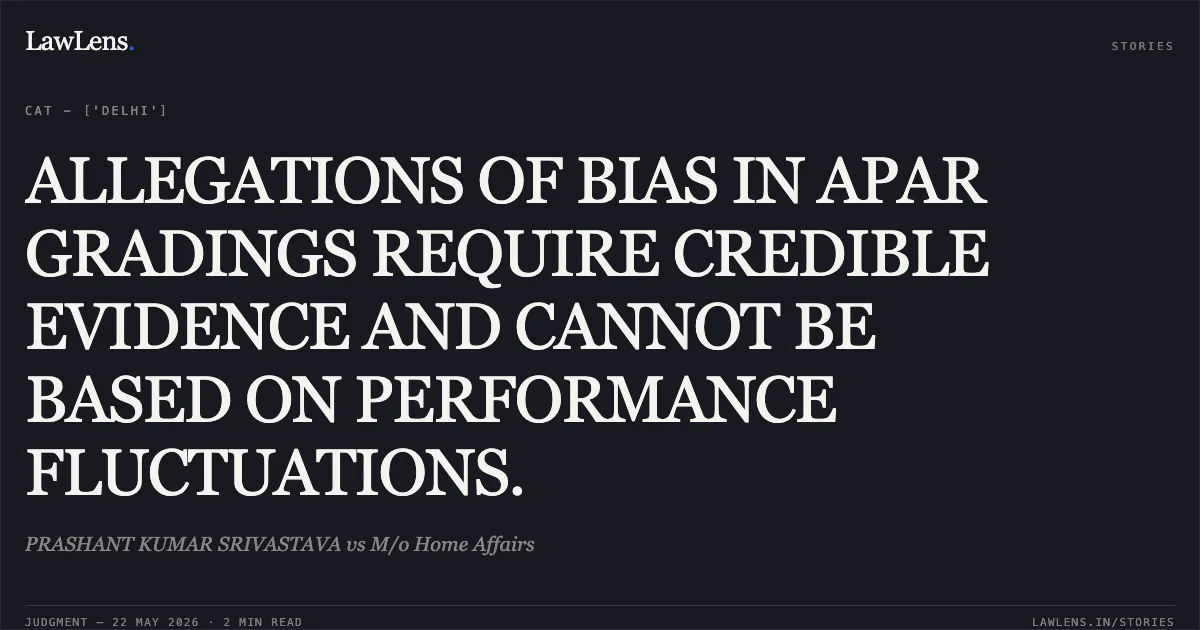
The applicant, a Junior Secretariat Assistant (JSA) in the Intelligence Bureau (IB), challenged the Annual Performance Appraisal Report (APAR) gradings for the periods 01.04.2015 to 31.09.2015 (grading of 4.0) and 01.11.2015 to 31.03.2016 (downgraded to 3.5).
Source reference: p. 2The applicant’s integrity was initially marked as "Doubtful"; however, following a representation dated 10.06.2016, the competent authority expunged the "Doubtful" remark but retained the numerical gradings.
Source reference: p. 2-3The applicant alleged that the Reporting Officer was biased, that he was assigned work above his pay grade, and that his performance could not have deteriorated so sharply compared to the previous year’s grading of '5'.
Source reference: p. 3-4The respondents contended the gradings were justified given two memoranda issued to the applicant (12.02.2016 and 03.05.2016) for refusing work, lack of decorum, and providing incorrect information to external departments.
Source reference: p. 5Issues
1. Whether the downgraded APAR gradings were a result of bias and malafide on the part of the Reporting/Reviewing Officers.
Source reference: p. 5-6 / para 6.12. Whether a prior year's higher grading serves as a sufficient legal basis to set aside lower gradings for a subsequent period.
Source reference: p. 6 / para 6.3Law Applied
The court applied Section 19 of the Administrative Tribunals Act, 1985 regarding the adjudication of service matters.
Source reference: p. 2It adhered to the principle that APARs are assessments of performance and conduct specifically for the "period under report".
Source reference: p. 5The court further applied the evidentiary standard that allegations of bias and malafide must be supported by credible, contemporaneous documentary proof and cannot be raised as an "afterthought" following the communication of adverse entries.
Source reference: p. 6Reasoning
The Tribunal analyzed the applicant's claims of bias and found them unsubstantiated, noting that the applicant failed to represent his concerns to senior officials during the reporting period or request a change of Reporting Officer.
Source reference: p. 6The Tribunal held that previous years’ performance (grading of '5') is not a relevant benchmark for the specific period under report, as performance is evaluated annually.
Source reference: p. 6The court found the respondents' justifications for the low grading credible, specifically citing the two memoranda issued to the applicant for workplace misconduct and factual errors.
Source reference: p. 5, 7The Tribunal emphasized that Reporting and Reviewing officers are the "best judges" of an official’s work, and in the absence of evidence proving bias, the court would not interfere with their professional assessment.
Source reference: p. 7Holding
The Tribunal concluded that the OA lacked merit and dismissed it.
It held that the gradings were justified based on the applicant's recorded conduct during the relevant periods and that the removal of the "Doubtful" integrity remark did not necessitate a mandatory upgrade of the numerical grading.
Source reference: p. 3, 6No order was made as to costs.
Source reference: p. 7Acts & Sections Cited
1 provisions across 1 statute referred to in this judgment. Each provision opens on LawLens.
Administrative Tribunals Act, 19851
Original Court PDF
PRASHANT KUMAR SRIVASTAVAvsM/o Home Affairs
Click to open original judgment
Original judgment, available to read, download and summarize on LawLens.in