Facts
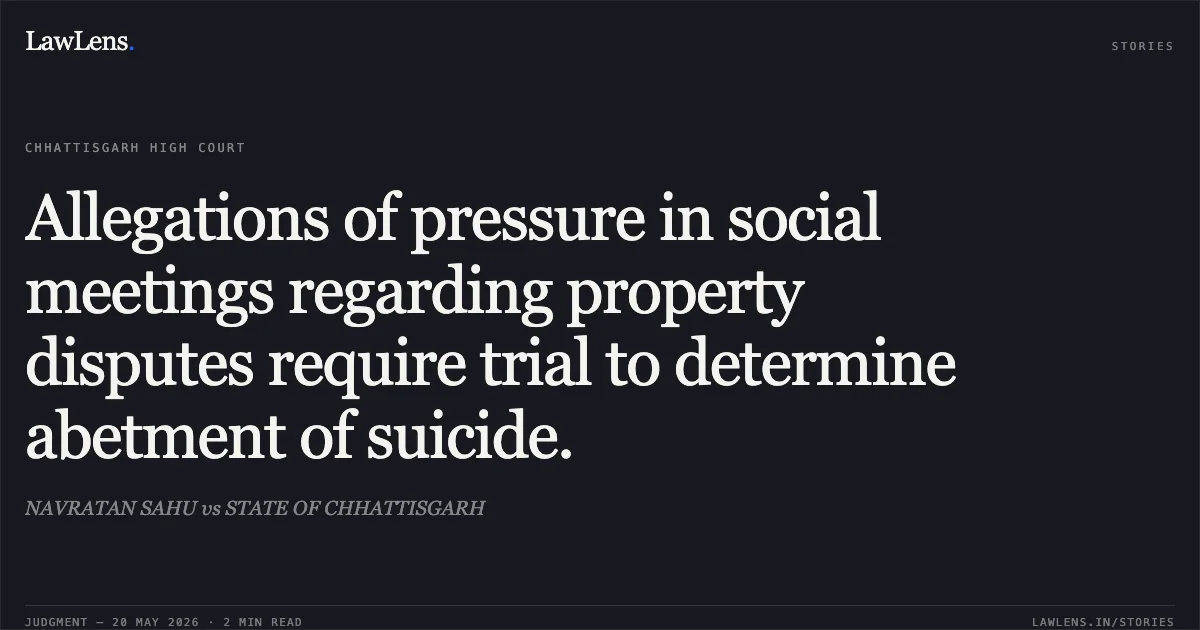
The petitioners sought the quashing of FIR No. 198/2025 and subsequent criminal proceedings, including the charge sheet and the order framing charges under Sections 108 (Abetment of suicide) and 3(5) (Joint liability) of the Bharatiya Nyaya Sanhita (BNS), 2023.
Source reference: para 2The case involves a family property dispute where the deceased, Mehattar Ram Sahu, had gifted land to his younger son's children, leading to a social meeting on 28.03.2025.
Source reference: para 3, 12Allegedly, the petitioners exerted undue pressure on the deceased during this meeting to repartition the property.
Source reference: para 12The deceased committed suicide on 05.04.2025.
Source reference: para 13The petitioners argued that they did not instigate or aid the suicide and that the death occurred three days after the meeting, showing no direct proximity.
Source reference: para 4-5Issues
1. Whether the allegations in the FIR and material in the charge sheet prima facie disclose the commission of an offence under Section 108 of the BNS, 2023, warranting a trial.
Source reference: para 14-172. Whether the High Court should exercise its inherent jurisdiction under Section 528 of the BNSS to quash the criminal proceedings to prevent an abuse of the process of law.
Source reference: para 10, 17Law Applied
The Court applied Section 528 of the Bharatiya Nagarik Suraksha Sanhita (BNSS), 2023 (analogous to Section 482 CrPC), which mandates that inherent powers be exercised sparingly and only when an FIR/charge sheet fails to disclose an offence or constitutes an abuse of process.
Source reference: para 10Regarding the substantive offence, the Court looked to Section 108 of the Bharatiya Nyaya Sanhita (BNS), 2023, concerning the abetment of suicide, and Section 3(5) involving common intention.
Source reference: para 2The court emphasized that at the stage of quashing, it cannot conduct a "mini-trial" or meticulously appreciate evidence that is subject to proof during a full trial.
Source reference: para 10, 14Reasoning
The Court observed that while the petitioners claimed the dispute was civil and lacked the ingredients of abetment, the investigation revealed specific allegations of undue pressure exerted by the petitioners during a social meeting shortly before the suicide.
Source reference: para 12, 15The Court found that whether these acts legally constitute "abetment" is a matter of evidence to be determined during the trial.
Source reference: para 14It noted that sufficient material had been collected during the investigation to file a charge sheet, and the petitioners’ presence at the meeting related to the property dispute provided a prima facie link.
Source reference: para 13, 15The Court also highlighted the petitioners' failure to produce the alleged suicide note for examination.
Source reference: para 16Consequently, it determined that the high threshold for quashing proceedings under Section 528 BNSS—where no cognizable offence is disclosed—was not met.
Source reference: para 17Holding
The High Court dismissed the petition, refusing to interfere with the FIR, charge sheet, or the order framing charges.
The Court held that the allegations prima facie disclose the commission of cognizable offences and that the case does not fall within the exceptional categories warranting the exercise of inherent jurisdiction; the trial court was directed to decide the case on its merits without being influenced by the observations made in this order.
Source reference: para 17-18Acts & Sections Cited
4 provisions across 2 statutes referred to in this judgment. Each provision opens on LawLens.
Bharatiya Nagarik Suraksha Sanhita, 20232
Bharatiya Nyaya Sanhita, 20232
Original Court PDF
NAVRATAN SAHUvsSTATE OF CHHATTISGARH
Click to open original judgment
Original judgment, available to read, download and summarize on LawLens.in