Facts
R. Binduja was appointed as a B.T. Assistant in the Government Education Department in 2008.
Source reference: para. 2, p. 2The appellants alleged that she had manipulated or produced a forged Higher Secondary (+2) marksheet to establish her educational qualification and secure the appointment, although she was allegedly a failed candidate at the relevant time.
Source reference: para. 2, p. 2A criminal case was registered by the District Crime Branch, Tiruvallur, in FIR No. 54 of 2022 under Sections 420, 465, 468 and 471 IPC; the case was pending as C.C. No. 827 of 2025 before the Judicial Magistrate No. I, Tiruvallur.
Source reference: para. 7, p. 4The department issued a show-cause notice based on the report of the Director of Government Examinations and other documents. The respondent proceeded on medical leave and did not submit an explanation. The Chief Educational Officer thereafter passed an order dismissing her from service with effect from 1 November 2023.
Source reference: paras. 3–4, pp. 2–3The writ court set aside the dismissal order, directed her reinstatement, and permitted the authorities to proceed under the Tamil Nadu Civil Services (Discipline and Appeal) Rules, 1955.
Source reference: para. 4, p. 3Issues
Whether the respondent could be dismissed from service on the basis of alleged manipulation or forgery of her +2 marksheet without conducting a disciplinary enquiry in accordance with the Tamil Nadu Civil Services (Discipline and Appeal) Rules, 1955?
Source reference: paras. 8–10, pp. 4–5Whether the pendency of the criminal prosecution barred the department from initiating or concluding disciplinary proceedings against the respondent?
Source reference: paras. 7–10, pp. 4–5Whether reinstatement was the appropriate interim relief, or whether the respondent could be placed under suspension pending disciplinary proceedings?
Source reference: paras. 11–12, pp. 6–7Law Applied
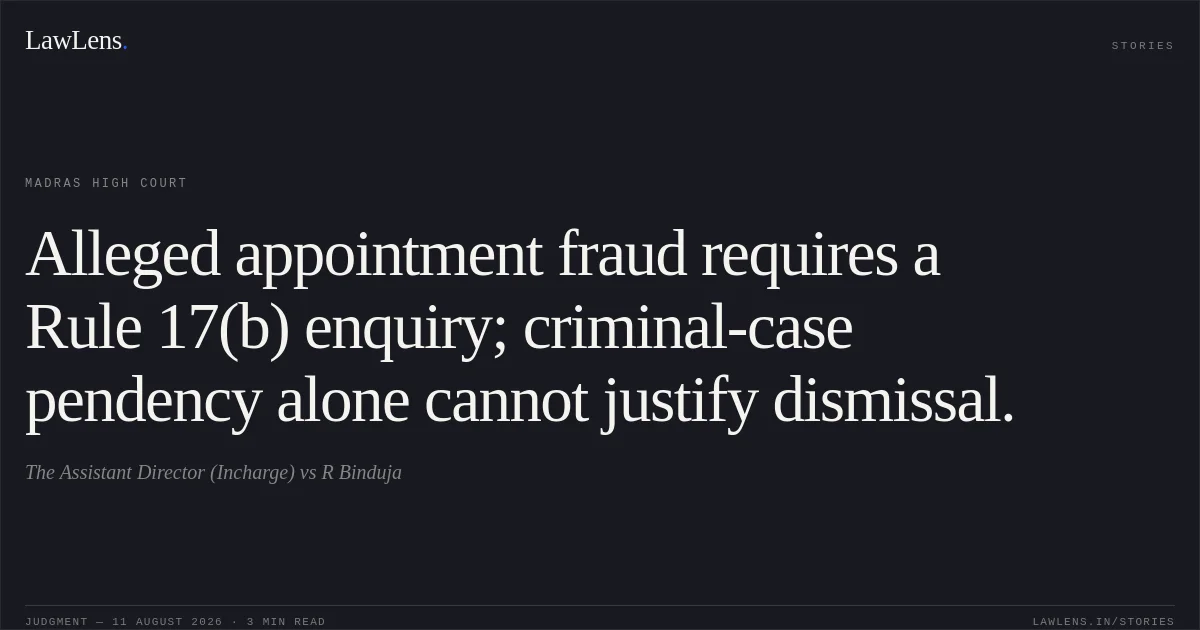
The Court applied the Tamil Nadu Civil Services (Discipline and Appeal) Rules, 1955, particularly Rule 17(b), which requires framing of charges and a regular departmental enquiry before imposing a major penalty; Rule 17(c), under which a show-cause procedure may be sufficient in cases involving conviction by a criminal court; and Rule 17(e), which permits suspension pending disciplinary proceedings.
Source reference: paras. 8–12, pp. 4–7The Court held that the principles of natural justice and the procedural safeguards under the disciplinary rules constitute protection available under Article 311(2) of the Constitution, and cannot ordinarily be dispensed with before imposing a major penalty.
Source reference: para. 9, p. 5It further held that mere pendency of a criminal case does not bar departmental proceedings, particularly where the department possesses the relevant documents, although the disciplinary authority must independently follow Rule 17(b) procedures.
Source reference: para. 10, p. 5Reasoning
The Court distinguished between the seriousness of the allegations and the procedure required to establish them. Although alleged forgery of the marksheet and fraudulent procurement of the initial appointment were grave charges, the existence of departmental documents or a pending criminal prosecution did not by itself justify dismissal.
Source reference: paras. 8, 10–11, pp. 4–6Since the respondent had not been convicted and the criminal trial was pending, Rule 17(c) could not be invoked to dispense with a regular enquiry; the authorities were required to frame a charge memorandum under Rule 17(b), furnish the relied-upon documents, provide an opportunity to submit an explanation, and conduct an enquiry if the explanation was unsatisfactory.
Source reference: paras. 9–12, pp. 5–7At the same time, the seriousness of the allegations justified modifying the reinstatement direction and placing the respondent under suspension pending completion of the disciplinary proceedings.
Source reference: para. 11, p. 6Holding
The writ appeal was partly allowed and the writ court’s order was modified.
The appellants were directed to place the respondent under suspension under Rule 17(e), issue a charge memorandum under Rule 17(b), furnish the relied-upon documents, afford her an opportunity to respond, and conduct a departmental enquiry in accordance with law if necessary.
Source reference: para. 12(a)–(d), pp. 6–7The disciplinary proceedings were directed to be completed within three months, on a day-to-day basis, with the respondent required to cooperate and without unnecessary adjournments.
Source reference: para. 12(e)–(f), p. 7The criminal trial was also requested to be proceeded with expeditiously.
Source reference: para. 12(h), p. 8No costs were awarded, and the connected miscellaneous petition was closed.
Source reference: para. 13, p. 8Acts & Sections Cited
4 provisions across 1 statute referred to in this judgment. Each provision opens on LawLens.
Indian Penal Code, 18604
Original Court PDF
The Assistant Director (Incharge)vsR Binduja
Click to open original judgment
Original judgment, available to read, download and summarize on LawLens.in