Facts
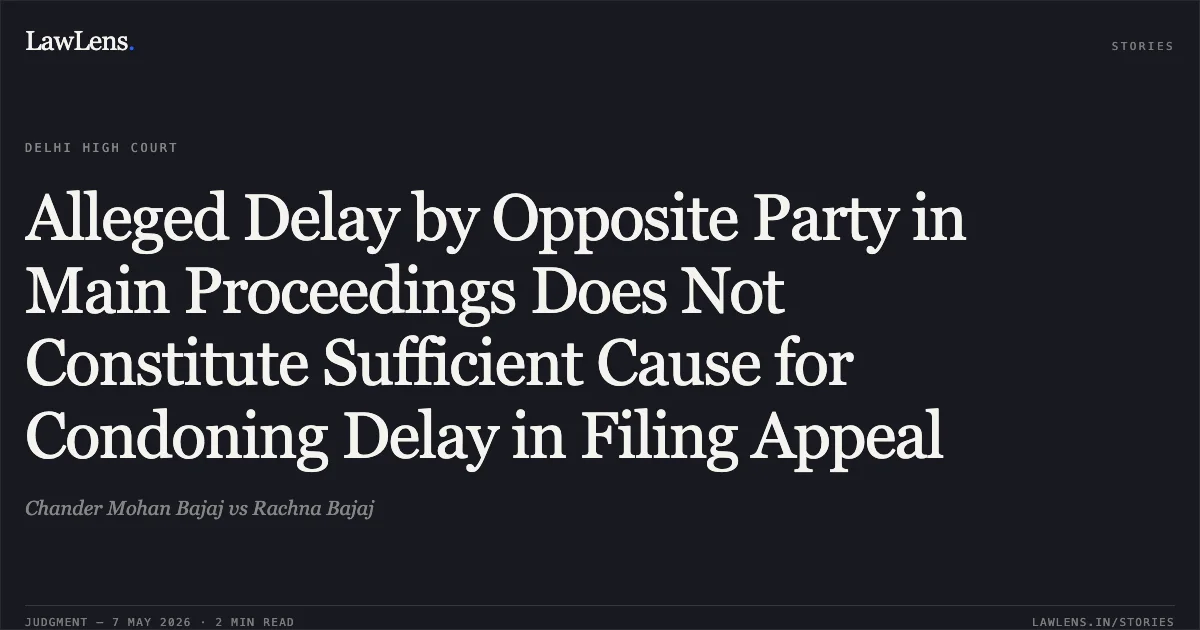
The appellant husband filed an appeal challenging an order dated 17.12.2024 passed by the Principal Judge, Family Court, Central District, Delhi, which granted the respondent wife interim maintenance of ₹10,000 per month under Section 24 of the Hindu Marriage Act, 1955
Source reference: p. 1The appeal was filed with a delay of 420 days.
Source reference: p. 2The appellant contended that the delay was due to the respondent deliberately stalling the divorce proceedings by not filing evidence, and that he eventually obtained a certified copy on 20.02.2026 to file through legal aid counsel
Source reference: p. 2The respondent opposed the application, alleging the appellant was not paying maintenance and had willfully delayed filing the appeal
Source reference: p. 2Issues
1. Whether the appellant shown "sufficient cause" to condone the inordinate delay of 420 days in filing the appeal
Source reference: p. 2, para 52. Whether the alleged delay in trial proceedings by the respondent constitutes a valid legal ground for an extension of limitation for the appellant
Source reference: p. 4, para 8-9Law Applied
The Court applied Section 5 of the Limitation Act regarding the condonation of delay, emphasizing that "sufficient cause" must be construed liberally but should not excuse negligence, inaction, or lack of bona fides
Source reference: p. 2, para 5It relied on Basawaraj v. Land Acquisition Officer (2013), which held that if a party is found to be negligent or not acting diligently, the court is not justified in condoning inordinate delay
Source reference: p. 3, para 6It further cited Esha Bhattacharjee v. Raghunathpur Nafar Academy (2013), establishing that courts must balance a justice-oriented approach with the fact that successful litigants acquire rights through the judgment under challenge
Source reference: p. 3-4, para 7Reasoning
The Court evaluated the appellant's sole justification—that the respondent was delaying divorce proceedings—and found it legally insufficient to explain a 420-day lapse
Source reference: p. 4, para 8The Bench observed that the impugned order specifically concerned interim maintenance under Section 24 of the HMA, a matter distinct from the progress of the trial; if the respondent was indeed delaying the trial, the appellant’s remedy was to move an appropriate application before the Family Court rather than disregarding the limitation period for an appeal
Source reference: p. 5, para 9The Court noted that the explanation was vague, lacked bona fides, and failed to demonstrate any external circumstance that genuinely prevented the appellant from approaching the Court within the prescribed period
Source reference: p. 5, para 10Holding
The Court held that the appellant failed to provide "sufficient cause" for the delay and dismissed the application for condonation of delay (CM APPL. 21196/2026)
Consequently, the appeal (MAT.APP.(F.C.) 117/2026) was dismissed as time-barred. The Court clarified that these observations are limited to the limitation issue and do not prejudice the merits of the ongoing case in the Family Court
Source reference: p. 5, para 13-14Acts & Sections Cited
2 provisions across 2 statutes referred to in this judgment. Each provision opens on LawLens.
Hindu Marriage Act, 19551
Limitation Act, 19631
Original Court PDF
Chander Mohan BajajvsRachna Bajaj
Click to open original judgment
Original judgment, available to read, download and summarize on LawLens.in