Facts
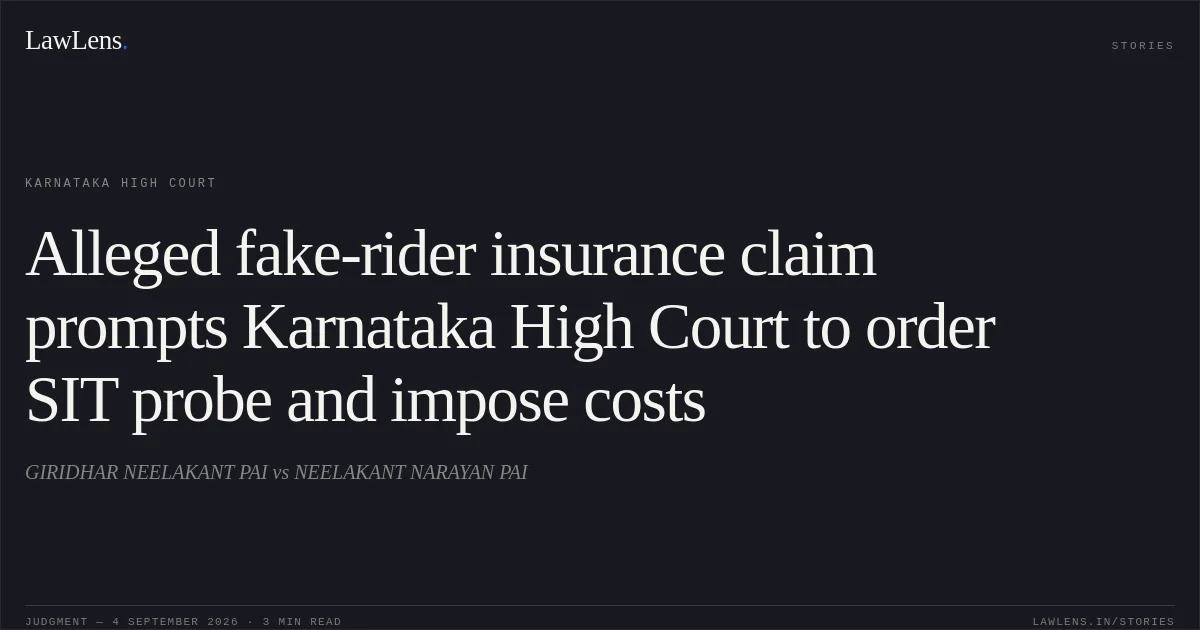
The claimant filed a petition under Section 166 of the Motor Vehicles Act, 1988, claiming ₹15,00,000 for injuries allegedly sustained on 15 September 2010 when he was travelling as a pillion rider on motorcycle No. KA-47/H-3116.
Source reference: paras. 3–5He alleged that respondent No.3 was riding the motorcycle rashly and negligently, causing it to overturn near Shiroor Village; respondent No.1 was the owner and respondent No.2 was the insurer.
Source reference: paras. 3–5The initial complaint stated that the claimant himself was riding the motorcycle and that the accident occurred due to his rash and negligent riding. Approximately one month later, the complainant gave a further statement alleging that respondent No.3 was the rider and that the claimant was only a pillion rider. The police thereafter filed a charge-sheet against respondent No.3.
Source reference: paras. 18–21, 26–29The Tribunal dismissed the claim petition, holding that the claimant failed to establish that he was the pillion rider at the time of the accident. The claimant challenged that decision under Section 173(1) of the Motor Vehicles Act.
Source reference: paras. 1, 8–9Issues
Whether the claimant established that he was the pillion rider of the offending motorcycle at the time of the accident?
Source reference: para. 15Whether the claimant could rely on the subsequent charge-sheet and the evidence of respondent No.3 and the complainant to establish the manner of the accident and the identity of the rider?
Source reference: paras. 20–21, 38–45Law Applied
The Court applied Sections 166 and 173(1) of the Motor Vehicles Act, 1988, governing claims for compensation and appeals against awards.
Source reference: paras. 1, 3Although motor accident claims are decided on the basis of preponderance of probabilities rather than proof beyond reasonable doubt, the claimant retains the initial burden of proving the accident and the material facts pleaded in the claim petition.
Source reference: paras. 39, 42A police charge-sheet is only prima facie evidence and cannot, by itself, conclusively establish the facts stated in it where serious doubts arise regarding its genuineness.
Source reference: paras. 38–40Relying on Umakant Ranappa Bosle v. Rachappa Veerupaxappa Marihal, the Court held that accepting a charge-sheet without proof would render the process of recording evidence and adjudication redundant.
Source reference: para. 39The Court also relied on Oriental Insurance Co. Ltd. v. Premlata Shukla, holding that the contents of a document are not automatically proved merely because the document has been marked as an exhibit.
Source reference: paras. 43–44The decision in Suhagrani v. Manager, Cholamandalam MS General Insurance Co. Ltd. was distinguished on its facts because, unlike that case, the present record contained substantial circumstances creating doubt about the claimant’s version.
Source reference: paras. 45–47Reasoning
The Court found material inconsistencies in the claimant’s case. The initial complaint specifically identified the claimant as the rider, whereas respondent No.3 was introduced as the alleged rider only after approximately one month.
Source reference: paras. 18–21, 47The complainant’s explanation for changing his version was disbelieved because he claimed to have met the claimant at Vivekananda Hospital on 15 October 2010, but the hospital records showed that the claimant had already been discharged on 4 October 2010.
Source reference: paras. 26–29The evidence of the complainant and respondent No.3 was also inconsistent regarding the events immediately after the accident, including whether and when the claimant was taken to hospital.
Source reference: para. 34The Court considered it implausible that respondent No.3 would leave an unconscious injured pillion rider by the roadside and travel by lorry to arrange for the motorcycle, particularly when he allegedly knew the claimant well.
Source reference: paras. 32–33Further, the claimant admittedly had no valid driving licence, while respondent No.3 possessed one, providing a possible motive for substituting respondent No.3 as the rider to secure insurance compensation.
Source reference: para. 30; para. 47(IV)In these circumstances, the Court concluded that the claimant, respondent Nos.1 and 3, and the complainant had colluded to present the claimant as a pillion rider, and that the charge-sheet could not cure the evidentiary deficiencies.
Source reference: paras. 41, 47–48Holding
The Court answered the principal issue against the claimant and held that he failed to establish that he was the pillion rider of the motorcycle.
The appeal was consequently dismissed, and the Tribunal’s dismissal of the compensation claim was upheld.
Source reference: paras. 16, 48–49Costs of ₹10,000 were imposed on the claimant, payable to the Advocates’ Library Fund, High Court of Karnataka, Dharwad Bench, within one month.
Source reference: para. 49(i)–(ii)The Inspector General of Police, Western Range, Mangalore, was directed to constitute a Special Investigation Team, investigate the alleged manipulation afresh, and submit a report within three months.
Source reference: para. 49(iii)–(iv)Acts & Sections Cited
2 provisions across 1 statute referred to in this judgment. Each provision opens on LawLens.
Motor Vehicles Act, 19882
Original Court PDF
GIRIDHAR NEELAKANT PAIvsNEELAKANT NARAYAN PAI
Click to open original judgment
Original judgment, available to read, download and summarize on LawLens.in