01Facts
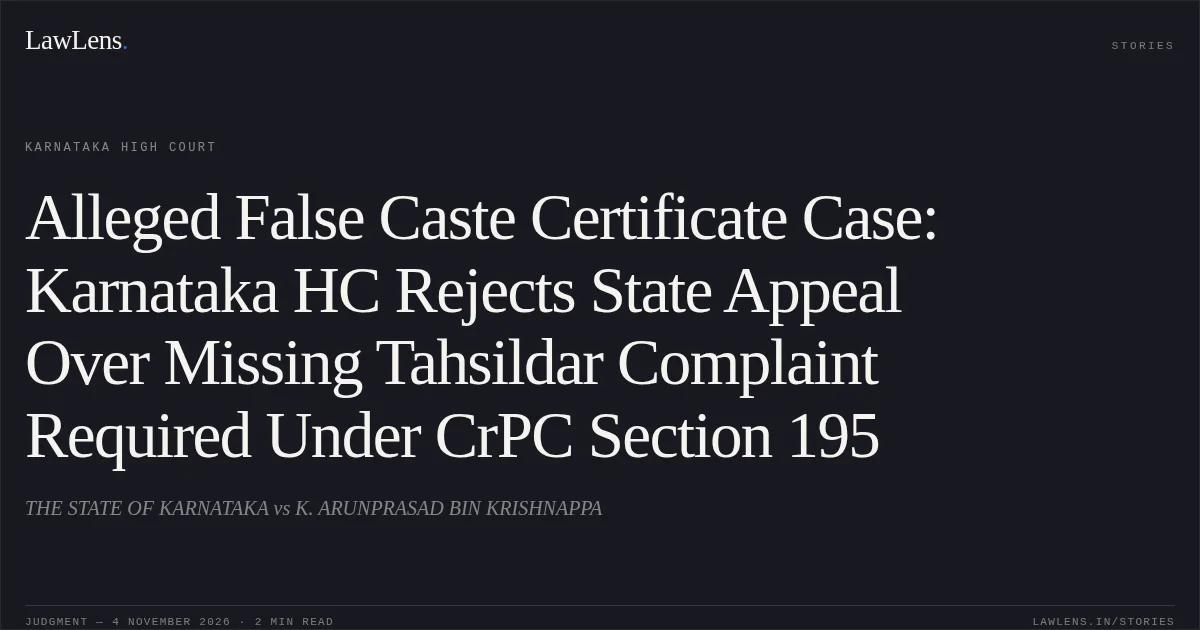
The prosecution alleged that the respondent, who did not belong to the Mogera Scheduled Caste community, gave false information to the Tahsildar, Sagar Taluk, on 7 May 1990 and obtained a caste certificate.
¶ 3–6He was charged under Sections 177 and 181 of the Indian Penal Code, 1860.
¶ 3–6The case proceeded on a police charge-sheet; the trial court acquitted him after trial.
¶ 3–6The State appealed and sought leave to appeal against the acquittal
¶ 3–602Issues
i.Whether the trial court was justified in taking cognizance of offences under Sections 177 and 181 IPC on a police report, given the bar under Section 195(1)(a)(i) CrPC
¶ 7ii.Whether the State had established grounds to obtain leave to appeal and interfere with the acquittal
¶ 703Law Applied
Section 195(1)(a)(i) CrPC bars a court from taking cognizance of offences under Sections 172–188 IPC, including Sections 177 and 181, except on a written complaint by the public servant concerned or a public servant to whom that officer is administratively subordinate.
¶ 9–10Although Section 2(d) CrPC, including its Explanation, deems a police report disclosing a non-cognizable offence to be a complaint, that deeming provision does not satisfy Section 195 where the required complainant is the concerned public servant or an administratively superior public servant.
¶ 11–12In an appeal against acquittal, the presumption of innocence is reinforced, and interference is warranted where the trial court’s view is perverse or not a possible view.
¶ 13The Court noted that, as the appeal was pending on 1 July 2024, the CrPC continued to govern under Section 531(2)(a) of the Bharatiya Nagarik Suraksha Sanhita, 2023.
¶ 1Provisions in the judgment · 39 · Linked ones open on LawLens
Code of Criminal Procedure, 1973 Section 2Section 195Section 313Section 378
Indian Penal Code, 1860 35 provisions
Section 172Section 173Section 174Section 175Section 176Section 177Section 178Section 179Section 180Section 181Section 182Section 183Section 184Section 185Section 186Section 187Section 188Section 193Section 194Section 195Section 196Section 199Section 200Section 205Section 206Section 207Section 208Section 209Section 210Section 211Section 228Section 463Section 471Section 475Section 47604Reasoning
Sections 177 and 181 IPC fall within the offences covered by Section 195(1)(a)(i) CrPC.
¶ 10–12The alleged false information was given to the Tahsildar, who was the public servant concerned, but neither the Tahsildar nor an administratively superior public servant lodged a written complaint before the Magistrate.
¶ 10–12The prosecution instead proceeded on a police charge-sheet, which could not meet Section 195’s requirement, even if treated as a complaint under Section 2(d)’s Explanation.
¶ 10–12The cognizance and resulting proceedings were therefore vitiated.
¶ 10–12Independently, the Court found no perversity or other basis to disturb the acquittal.
¶ 1305Holding
The Court answered both issues in the negative.
¶ 8, 13It held that cognizance on the police charge-sheet was barred by Section 195(1)(a)(i) CrPC and that the State had shown no ground to interfere with the acquittal.
¶ 8, 13Leave to appeal under Section 378(3) CrPC was rejected, and the appeal was dismissed.
¶ 8, 13Original Court PDF
THE STATE OF KARNATAKAvsK. ARUNPRASAD BIN KRISHNAPPA
Click to open original judgment
Original judgment, available to read, download and summarize on LawLens.in