01Facts
Respondent No. 2 alleged that, after her marriage to petitioner No. 1, he left India for Malaysia and did not return; she later learned that he had married again.
p. 6 · ¶ 3She alleged that, while she lived with petitioners Nos. 2 and 3, they and the other petitioners harassed her, demanded ₹5 lakh and 150 grams of gold, and failed to provide proper food.
p. 9 · ¶ 8A complaint led to registration of Crime No. 20/2024, a charge-sheet, and cognizance in C.C. No. 126/2024 for offences under Sections 498-A, 342, 417, 109, 506 read with Section 34 IPC and Sections 3 and 4 of the Dowry Prohibition Act.
pp. 5–7 · ¶ 1, 3The nine accused sought quashing under Section 482 Cr.P.C.
p. 5 · ¶ 102Issues
i.1. Whether the charge-sheet materials disclosed a prima facie case against petitioners Nos. 1 to 3 warranting continuation of the proceedings.
pp. 9–10 · ¶ 8ii.2. Whether the proceedings against petitioners Nos. 4 to 9 should be quashed where the allegations were general and omnibus and they resided separately.
pp. 9–13 · ¶ 8, 12–1403Law Applied
Section 482 Cr.P.C. empowers the High Court to quash proceedings where their continuation would amount to abuse of the process of court.
In matrimonial prosecutions, courts should scrutinize allegations carefully and avoid proceeding against relatives on the basis of omnibus allegations unsupported by specific instances of involvement.
The Court relied on K. Subba Rao v. State of Telangana, 2024 INSC 960, for the principle that distant relatives should not be implicated without specific instances of involvement.
p. 9 · ¶ 9Dara Lakshmi Narayan v. State of Telangana, (2025) 3 SCC 735, cautions against prosecuting family members on generalized accusations absent particularized allegations.
pp. 10–12 · ¶ 11–13Provisions in the judgment · 8 · Linked ones open on LawLens
Code of Criminal Procedure, 1973 Section 482
Indian Penal Code, 1860 Section 342Section 417Section 109Section 506Section 34
04Reasoning
The Court found that the complaint allegations and witness statements made out a prima facie case against petitioners Nos. 1 to 3 concerning dowry demands and harassment.
p. 9 · ¶ 8By contrast, the charge-sheet contained no specific details—such as dates, times, places, or particular acts—showing how petitioners Nos. 4 to 9 had participated in the alleged harassment; they also resided separately.
p. 9, 12 · ¶ 8, 12Applying the principles against prosecution based on vague, collective allegations, the Court held that continuing the case against those six petitioners would be an abuse of process.
pp. 12–13 · ¶ 12–1405Holding
The petition was dismissed as to petitioners Nos. 1 to 3, and proceedings against them were allowed to continue, with the Court’s observations not to affect the trial court’s consideration.
p. 13, order cl. (i)The petition was allowed as to petitioners Nos. 4 to 9, and proceedings against them in C.C. No. 126/2024 were quashed; the operative order lists Sections 498-A, 34, 417, 109 and 506 IPC, and Sections 3 and 4 of the Dowry Prohibition Act.
pp. 13–14, order cl. (ii)Original Court PDF
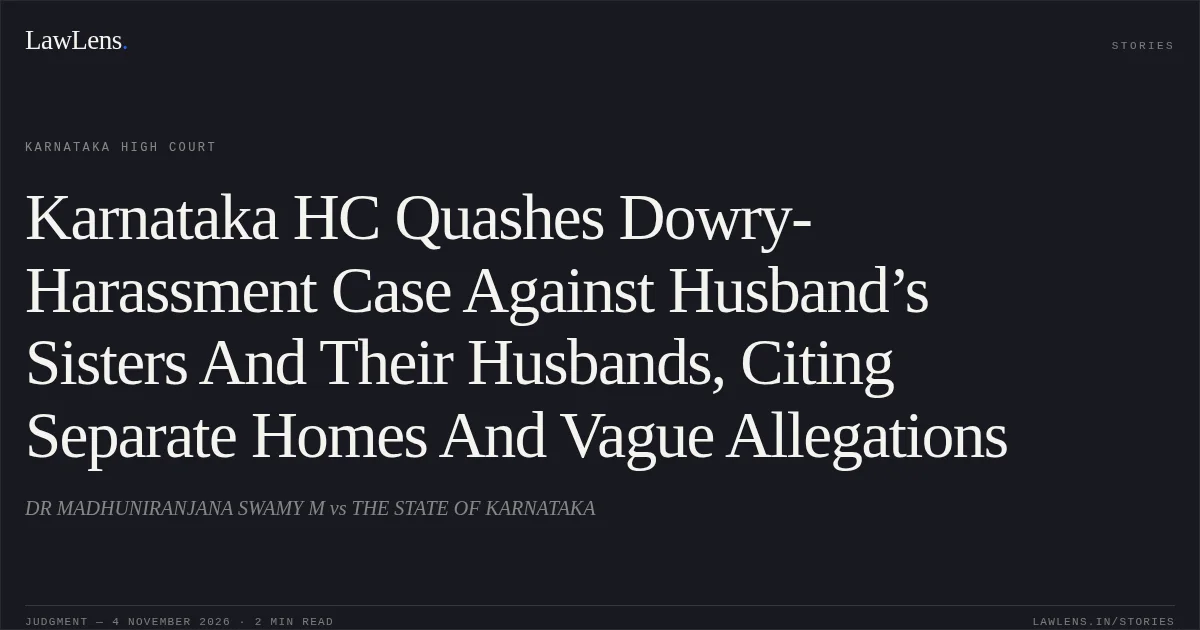
DR MADHUNIRANJANA SWAMY MvsTHE STATE OF KARNATAKA
Click to open original judgment
Original judgment, available to read, download and summarize on LawLens.in