Facts
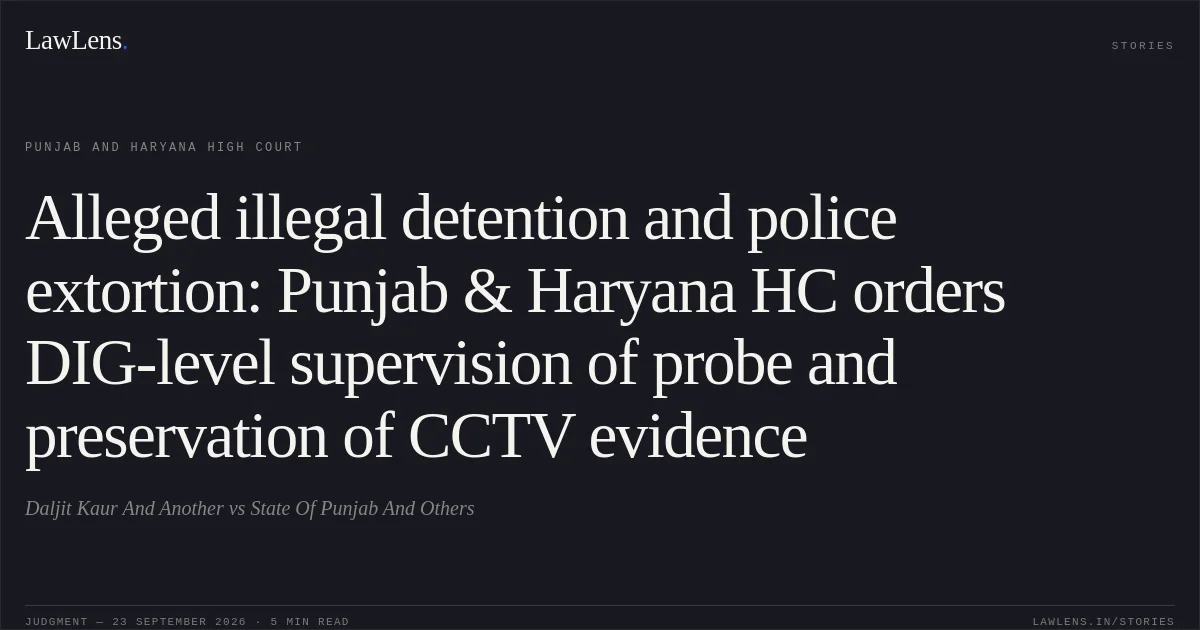
The petitioners, residents of Village Chari, District Fatehgarh Sahib, alleged that local police officials had subjected them to illegal detention, threats, demands for illegal gratification, custodial intimidation, trespass, and removal of CCTV/DVR equipment, cash and jewellery from their residence. Their grievance arose principally from police action allegedly connected with their estranged son, whom they claimed to have publicly disowned and disinherited in 2021.
Source reference: para. 2FIR No. 67 dated 25.03.2026 was registered at Police Station Payal under Sections 308 and 351(2) of the Bharatiya Nyaya Sanhita, 2023. The petitioners alleged that petitioner No. 2 was taken from his residence during the night of 29/30.03.2026 without disclosure of the grounds of arrest, but was subsequently shown as arrested from Bus Stand Majri. Petitioner No. 2 was later granted regular bail.
Source reference: para. 3FIR No. 90 dated 24.04.2026 was thereafter registered at Police Station Doraha, in which petitioner No. 2 was arrested through production warrants and subsequently granted bail.
Source reference: para. 4Following further representations to senior police authorities, both petitioners alleged that police officials entered their residence during the night of 19/20.05.2026, forcibly took them away, and removed the CCTV/DVR system, cash and jewellery. The State denied the allegations, asserting that the petitioners had been arrested lawfully in FIR No. 101 dated 01.05.2026 and that the DVR had been seized as case property and sent to the Forensic Science Laboratory.
Source reference: paras. 4, 7The petitioners sought protection of their life and liberty under Article 21, constitution of an independent SIT or transfer of investigation to the CBI, preservation of electronic and documentary evidence, and action against responsible police officials.
Source reference: para. 1Issues
Whether the material on record justified the extraordinary direction to transfer the investigation to the CBI or constitute an independent SIT?
Source reference: para. 9If not, whether a lesser constitutional or administrative safeguard was necessary to ensure a fair investigation and preservation of relevant evidence?
Source reference: para. 9Law Applied
The Court exercised jurisdiction under Article 226 of the Constitution to protect life, personal liberty and the right to a fair investigation under Articles 14, 21 and 22. It relied on D.K. Basu v. State of West Bengal, which requires safeguards against custodial abuse and unlawful arrest; Joginder Kumar v. State of Uttar Pradesh and Arnesh Kumar v. State of Bihar, which caution against routine or casual arrests; and Sections 36, 47, 48 and 58 of the BNSS, 2023, concerning identification of arresting officers, arrest memos, communication of the grounds of arrest, intimation to relatives and production before a Magistrate within twenty-four hours.
Source reference: para. 11The Court further applied State of West Bengal v. Committee for Protection of Democratic Rights, K.V. Rajendran v. Superintendent of Police, CBCID, Dharam Pal v. State of Haryana and Pooja Pal v. Union of India, holding that transfer of investigation to the CBI or another independent agency is an extraordinary remedy to be exercised sparingly, cautiously and only in rare or exceptional cases where the investigation is prima facie tainted, biased, incapable of inspiring public confidence, or requires such intervention for enforcing fundamental rights.
Source reference: paras. 12–13The Court also relied on Manohar Lal Sharma v. Principal Secretary to distinguish permissible monitoring of an investigation from impermissible judicial supervision of its manner or outcome.
Source reference: para. 16The Court also relied on Vihaan Kumar v. State of Haryana and Mihir Rajesh Shah v. State of Maharashtra regarding the State’s obligation to establish compliance with the constitutional requirement of communicating the grounds of arrest through contemporaneous records.
Source reference: para. 14Reasoning
The Court held that the allegations were not liable to be dismissed merely because criminal cases had been registered against the petitioners; Articles 21 and 22 protect even accused persons and detainees.
Source reference: para. 11However, the material did not establish that the State police as a whole, or its senior hierarchy, was incapable of conducting a fair investigation, nor did it demonstrate a prima facie tainted investigation warranting transfer to the CBI or constitution of an SIT.
Source reference: para. 14The Court declined to determine the evidentiary value of disclosure statements, financial transactions or the observations in the bail orders, since those matters were pending before the competent criminal courts.
Source reference: para. 10Nevertheless, the Court found that the petitioners’ grievance had an objective factual foundation. The State admitted possession of the DVR, while the parties gave conflicting accounts regarding the circumstances and location of petitioner No. 2’s arrest on 29/30.03.2026.
Source reference: paras. 14–15These disputes could be tested through arrest memos, grounds of arrest, general diary entries, medical records, production records, CCTV footage, call-detail records and location data.
Source reference: para. 15Since the DVR could both constitute case property and contain evidence relevant to the alleged police conduct, its preservation and forensic examination were material to a fair investigation.
Source reference: para. 15Accordingly, rather than transferring the investigation, the Court imposed an additional internal safeguard by requiring supervision by a senior, unconnected IPS officer, without interfering with the investigating officer’s independent assessment or directing any particular outcome.
Source reference: para. 16Holding
The Court answered the first issue in the negative and declined to transfer the investigations to the CBI or constitute an independent SIT. It held that a lesser safeguard was appropriate to secure fairness, objectivity and preservation of evidence.
The petition was disposed of with directions that the Commissioner of Police, Ludhiana, ensure supervision of investigations in FIR Nos. 67, 90 and 101 by a senior IPS officer not below the rank of Deputy Inspector General of Police, who was not directly connected with the investigations.
Source reference: para. 17(i)The supervising officer was directed to monitor the investigation, ensure compliance with law, and secure and examine the DVR, FSL report, CCTV footage and other electronic evidence.
Source reference: para. 17(ii)–(iii)The allegations of illegal detention, demand of money and removal or destruction of electronic evidence were to be considered in accordance with law, without being influenced by the judgment, which expressed no opinion on the merits of the pending criminal cases.
Source reference: para. 17(iv)–(v)Acts & Sections Cited
8 provisions across 2 statutes referred to in this judgment. Each provision opens on LawLens.
Bharatiya Nyaya Sanhita, 20234
Bharatiya Nagarik Suraksha Sanhita, 20234
Original Court PDF
Daljit Kaur And AnothervsState Of Punjab And Others
Click to open original judgment
Original judgment, available to read, download and summarize on LawLens.in