Facts
The petitioner, a Sub Auditor in the Cooperative Department and a person appointed under the disability category, was alleged to have failed to complete the audit of 122 cooperative societies within the prescribed period.
Source reference: pp. 1–3, paras. 2–4He was issued a show-cause notice and submitted his reply denying the allegations. He was thereafter suspended on 11 August 2025.
Source reference: pp. 1–3, paras. 2–4Although the respondents’ order recorded that a charge-sheet had been issued and a departmental inquiry instituted, the petitioner contended that no effective or regular inquiry was conducted despite his factual denial of the charges.
Source reference: pp. 1–3, para. 9On 4 December 2025, the disciplinary authority revoked the suspension, treated the suspension period as leave, and imposed the minor penalty of withholding one annual increment without cumulative effect.
Source reference: pp. 3–4, paras. 4–5Although he filed a departmental appeal on 31 December 2025, it remained undecided.
Source reference: p. 4, para. 5Issues
Whether the disciplinary authority’s order imposing the penalty was liable to be quashed for being non-speaking and unreasoned, particularly because it failed to consider the petitioner’s reply and grounds of defence?
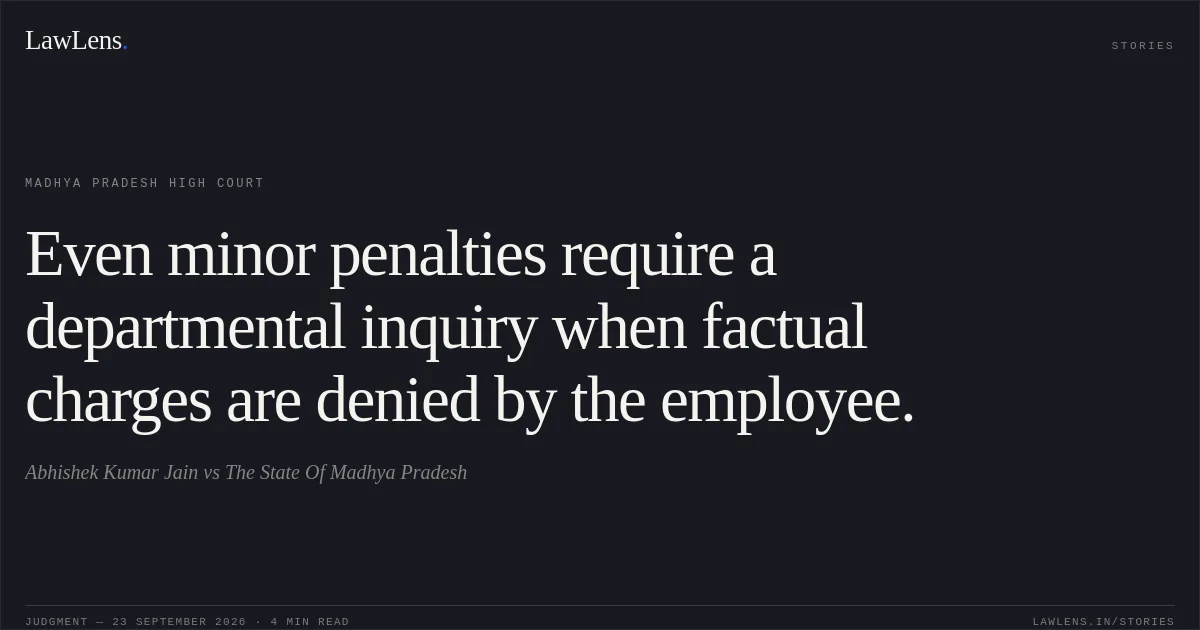
Source reference: pp. 4–6, paras. 10–16Whether an inquiry was mandatory before imposing even a minor penalty where the petitioner had denied the factual allegations?
Source reference: pp. 8–10, paras. 17–18Whether the alleged failure to complete audits constituted misconduct warranting disciplinary punishment in the absence of a finding of wilful negligence or mens rea?
Source reference: pp. 10–11, paras. 19–21Whether the petitioner could be relegated to the departmental appellate remedy despite the defects in the original disciplinary order?
Source reference: pp. 6–8, para. 16Law Applied
The Court applied Rule 10 of the Madhya Pradesh Civil Services (Classification, Control and Appeal) Rules, 1966, under which withholding an increment may constitute a minor penalty, but relied on O.K. Bharadwaj v. Union of India, (2001) 9 SCC 180, for the rule that even before imposing a minor penalty the employee must receive an opportunity to explain the charges, and where factual charges are denied, an inquiry must ordinarily be held.
Source reference: p. 9, paras. 17–18It further applied the settled requirement that quasi-judicial and administrative orders affecting rights must be reasoned and self-contained, relying on State of Punjab v. Bandip Singh, (2016) 1 SCC 724, Kranti Associates Pvt. Ltd. v. Masood Ahmed Khan, (2010) 9 SCC 496, and Oryx Fisheries Pvt. Ltd. v. Union of India, (2010) 13 SCC 427; reasons cannot be supplied for the first time in an appellate order.
Source reference: pp. 4–8, paras. 11–16Finally, relying on S.D. Bind v. Union of India, 2015 (1) MPLJ 574, Union of India v. J. Ahmed, (1979) 2 SCC 286, and Inspector Prem Chand v. Government of NCT of Delhi, (2007) 4 SCC 566, the Court held that mere inefficiency, an isolated error, or negligence simpliciter does not constitute punishable misconduct without a finding of blameworthy or wilful conduct.
Source reference: pp. 10–11, paras. 19–20Reasoning
The Court found that the punishment order merely stated that the petitioner’s reply and submissions had been considered, without addressing the specific facts and grounds raised in his defence.
Source reference: pp. 4–6, paras. 10–15It therefore failed to disclose the reasoning by which the disciplinary authority concluded that the charge was established and that withholding an increment was justified; the order was consequently non-speaking and unreasoned.
Source reference: pp. 4–6, paras. 10–15The Court further held that the defect could not be cured by directing the petitioner to pursue his appeal, since reasons absent from the original order could not be supplied for the first time by the appellate authority, and an appeal could not substitute for a fair original disciplinary process.
Source reference: pp. 6–8, para. 16Because the allegations were factual and had been denied, the minimum requirement of natural justice under O.K. Bharadwaj required a proper departmental inquiry, which had not been effectively conducted.
Source reference: pp. 8–10, paras. 17–18Additionally, the alleged lapse concerned failure to complete audits and was treated by the Court as a procedural lapse unsupported by any finding of wilful conduct or mens rea.
Source reference: pp. 10–11, paras. 19–21On the authorities concerning negligence and misconduct, the Court held that the allegation did not, on the facts, justify disciplinary punishment.
Source reference: pp. 10–11, paras. 19–21Holding
The Court held that the disciplinary order dated 4 December 2025 was non-speaking, unreasoned, and passed without the inquiry required where factual charges had been denied.
It also held that the alleged procedural lapse, absent proof of wilful negligence or mens rea, did not constitute misconduct warranting punishment.
Source reference: p. 12, paras. 21–24The impugned order was accordingly quashed, and the respondents were directed to grant the petitioner all consequential benefits within three months from receipt of the certified copy of the judgment.
Source reference: p. 12, paras. 21–24The writ petition was disposed of, and pending interlocutory applications were also disposed of.
Source reference: p. 12, paras. 21–24Original Court PDF
Abhishek Kumar JainvsThe State Of Madhya Pradesh
Click to open original judgment
Original judgment, available to read, download and summarize on LawLens.in