Facts
The appellant was convicted by the Additional Sessions Judge, Raipur (F.T.C.), in Special Sessions Trial No. 598/2015 for offences under Sections 363, 366 and 376(2)(n) of the IPC and Section 6 of the POCSO Act.
Source reference: para. 1He was sentenced to three years’ rigorous imprisonment under Section 363, seven years under Section 366, and ten years under Section 376(2)(n), with the sentences directed to run concurrently.
Source reference: para. 1The prosecution alleged that the victim went missing on 18 September 2014 and was recovered from the appellant’s house on 15 January 2015.
Source reference: para. 2Medical examination indicated sexual intercourse, while the FSL report detected semen and sperm on the victim’s underwear and vaginal slides.
Source reference: para. 2The prosecution relied principally on the school register recording the victim’s date of birth as 12 February 1998.
Source reference: paras. 10–11, 16–17The victim’s father, however, did not know her date of birth and admitted that the date had been recorded on an assumption by the victim’s uncle.
Source reference: paras. 10–11, 16–17The victim gave evidence alleging forcible abduction and repeated rape, but her statement under Section 164 Cr.P.C. indicated that she had voluntarily accompanied the appellant and had consensual physical relations with him on the promise of marriage.
Source reference: paras. 19–20The trial court nevertheless convicted the appellant, leading to the present appeal under Section 374(2) Cr.P.C.
Source reference: para. 1Issues
Whether the prosecution proved beyond reasonable doubt that the victim was below eighteen years of age on the date of the alleged incident, so as to attract the POCSO Act and statutory consequences under the IPC?
Source reference: paras. 9–17Whether the appellant had taken or enticed the victim away from the keeping of her lawful guardian, thereby committing offences under Sections 363 and 366 IPC?
Source reference: paras. 18–22Whether the prosecution established forcible rape or repeated rape under Section 376(2)(n) IPC, notwithstanding the victim’s inconsistent statements and the alleged consensual relationship?
Source reference: paras. 18–27Law Applied
The Court applied Sections 363, 366 and 376(2)(n) of the IPC and Section 6 of the POCSO Act, under which sexual intercourse with a child below eighteen years attracts criminal liability irrespective of consent.
Source reference: paras. 1, 7On proof of age, the Court relied on Section 35 of the Evidence Act and Alamelu v. State, holding that a school record may be admissible but has limited evidentiary value where the foundational material on which the date of birth was recorded is not proved.
Source reference: paras. 12–13It also relied on Rishipal Singh Solanki v. State of Uttar Pradesh and P. Yuvaprakash v. State, concerning the hierarchy and reliability of documents for age determination and the limited role of medical opinion in the absence of reliable documentary evidence.
Source reference: paras. 14–15For kidnapping, the Court applied S. Varadarajan v. State of Madras, which distinguishes “taking” from voluntarily allowing a minor to accompany the accused and requires proof of inducement, solicitation or active participation in the minor’s departure.
Source reference: paras. 21–22The Court further applied the principle that the testimony of a prosecutrix can independently sustain conviction only when it is trustworthy and inspires confidence, relying on Rai Sandeep v. State (NCT of Delhi) as quoted in Santosh Prasad v. State of Bihar.
Source reference: para. 23Reasoning
The Court held that the school register did not reliably establish the victim’s age because the record related to her admission in Class VI, the records of her initial schooling were not produced, and no birth certificate, matriculation certificate or reliable foundational document was proved.
Source reference: paras. 10–17The father’s admission that he did not know the victim’s date of birth and that it had been entered on assumption materially weakened the prosecution’s age evidence.
Source reference: para. 17Consequently, the prosecution failed to prove that the victim was below eighteen years of age.
Source reference: no citationThe Court further found the victim’s testimony unreliable because her courtroom version of forcible abduction and rape materially conflicted with her Section 164 Cr.P.C. statement, in which she stated that she voluntarily accompanied the appellant and had physical relations with him on her own will.
Source reference: paras. 19–20Her prolonged stay with the appellant for approximately four months, absence of any contemporaneous complaint or alarm, and the father’s admissions that she had communicated that she was living happily and had married the appellant further undermined the prosecution case.
Source reference: paras. 20, 24Applying S. Varadarajan, the Court concluded that the evidence did not establish the requisite taking or inducement.
Source reference: no citationThe medical and FSL evidence established sexual intercourse but did not prove force, absence of consent, kidnapping, or the victim’s minority.
Source reference: paras. 26–27Holding
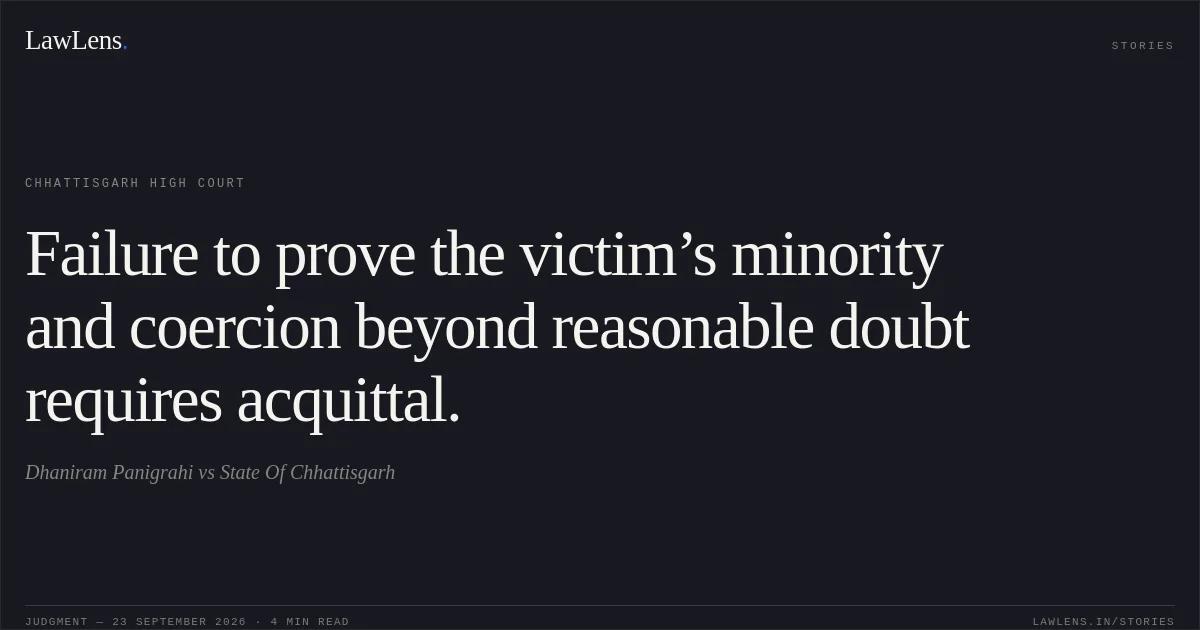
The Court held that the prosecution failed to prove beyond reasonable doubt either that the victim was below eighteen years of age or that the appellant kidnapped, abducted or raped her.
Giving the appellant the benefit of doubt, it allowed the appeal and set aside the conviction and sentences under Sections 363, 366 and 376(2)(n) IPC and Section 6 of the POCSO Act.
Source reference: para. 28The appellant was acquitted of all charges.
Source reference: no citationAs he was on bail, his bail bonds were directed to continue for six months under Section 481 of the Bharatiya Nagarik Suraksha Sanhita, 2023, and the trial court record was ordered to be returned for compliance.
Source reference: paras. 29–30Acts & Sections Cited
12 provisions across 5 statutes referred to in this judgment. Each provision opens on LawLens.
Code of Criminal Procedure, 19734
Indian Penal Code, 18603
Juvenile Justice (Care and Protection of Children) Act, 2015.2
Bharatiya Nagarik Suraksha Sanhita, 20231
Original Court PDF
Dhaniram PanigrahivsState Of Chhattisgarh
Click to open original judgment
Original judgment, available to read, download and summarize on LawLens.in
![Notional service must be reckoned for consequential retirement benefits when severance is limited to pre-notional service.. RAJASEKHARAN B vs D/o Post. CAT - ['Ernakulam']. LawLens](/stories/thumbnails/notional-service-must-be-reckoned-for-consequential-retirement-benefits-when-severance-is-aa1961b944944dbea20e6e3d73025883.webp)
![Authorities must verify parity and grant retrospective pay benefits where the case is identical to settled precedent.. DEVENDRA SINGH SHEKHAWAT vs M/O FINANCE, D/O REVENUE. CAT - ['Jaipur']. LawLens](/stories/thumbnails/authorities-must-verify-parity-and-grant-retrospective-pay-benefits-where-the-case-is-iden-2e3cc02e0628453198c66a82b7a85f67.webp)