Facts
The petitioner filed a criminal complaint under Section 200 of the Cr.P.C. alleging that the respondents—driven by personal vendetta following a prior conviction—maliciously passed a Gram Panchayat resolution on 26.01.2014 to remove encroachments.
Source reference: para. 2The petitioner claimed that on 17.12.2014 and 15.10.2017, the respondents illegally demolished his shop and house using a JCB machine, despite the Tahsildar stating no formal proceedings under Section 248 of the M.P. Land Revenue Code were pending.
Source reference: para. 2The Judicial Magistrate First Class and the IInd Additional Sessions Judge (Revision Court) both dismissed the complainant’s plea, finding the matter to be civil in nature.
Source reference: para. 1, 6The petitioner challenged these concurrent findings under Section 482 of the Cr.P.C.
Source reference: para. 1Issues
1. Whether the allegations regarding the demolition of property and dispossession by the Gram Panchayat constitute a criminal offence or a civil dispute.
Source reference: para. 62. Whether the complaint disclosed sufficient ingredients to attract penal provisions under Sections 294, 506, 427, 471, 468, and 465 of the IPC.
Source reference: para. 2, 6Law Applied
Principles governing the inherent powers of the High Court under Section 482 of the Code of Criminal Procedure (Cr.P.C.), which mandates that such powers be exercised sparingly and only to prevent abuse of process or to secure the ends of justice.
Source reference: para. 6Distinction between criminal trespass/mischief and civil disputes regarding land possession, noting that where an efficacious remedy exists in civil jurisdiction, criminal proceedings may not be maintainable.
Source reference: para. 6Reasoning
The Court observed that the core of the dispute was the petitioner's dispossession from land following a resolution by the Gram Panchayat, which signifies a conflict over possession and land rights rather than criminal intent.
Source reference: para. 6The Court noted that the petitioner failed to provide specific or categorical instances of abusive language to satisfy the requirements of Section 294 or 506 of the IPC.
Source reference: para. 6By evaluating the material on record, the Court determined that the concurrent findings of the lower courts were correct: the act of removing alleged encroachments under a local body's resolution creates a civil cause of action.
Source reference: para. 6The court reasoned that since the essential ingredients of the cited penal provisions were absent, invoking criminal jurisdiction would be an inappropriate use of the legal process.
Source reference: para. 6Holding
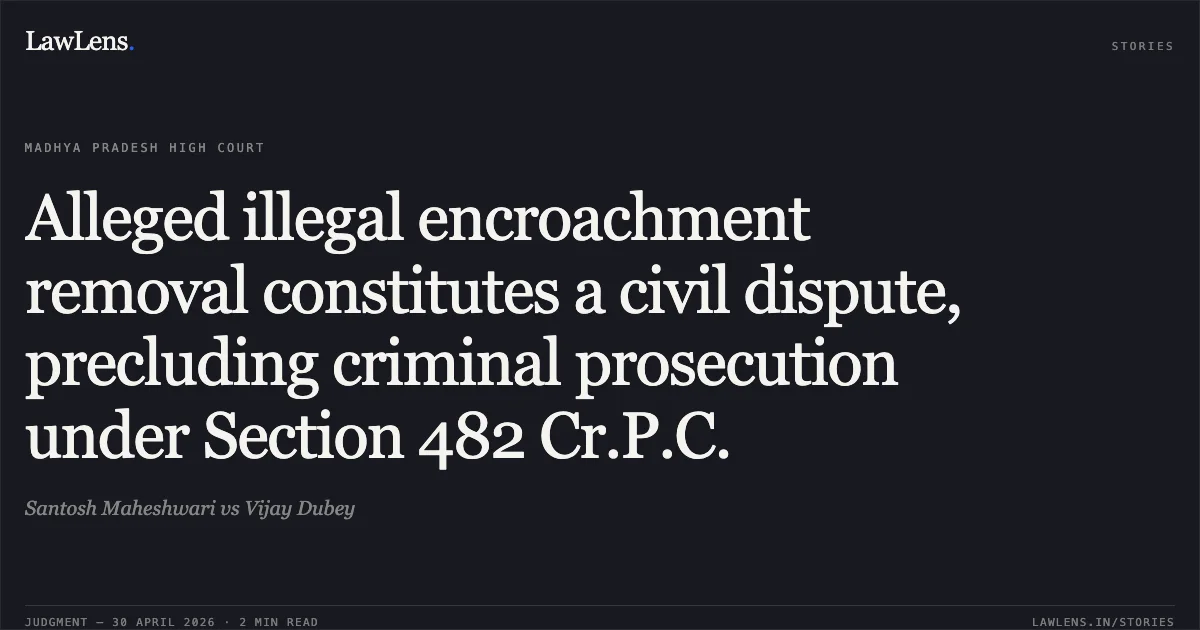
The Court answered the issues by holding that the dispute is essentially civil in nature and the complaint lacked specific allegations to sustain criminal charges.
The High Court found no material illegality or jurisdictional error in the lower courts' orders. Consequently, the petition was dismissed, affirming that the petitioner’s remedy lies within civil jurisdiction rather than criminal prosecution.
Source reference: para. 6Acts & Sections Cited
9 provisions across 3 statutes referred to in this judgment. Each provision opens on LawLens.
Code of Criminal Procedure, 19732
Indian Penal Code, 18606
MP Land Revenue Code 19591
Original Court PDF
Santosh MaheshwarivsVijay Dubey
Click to open original judgment
Original judgment, available to read, download and summarize on LawLens.in