Facts
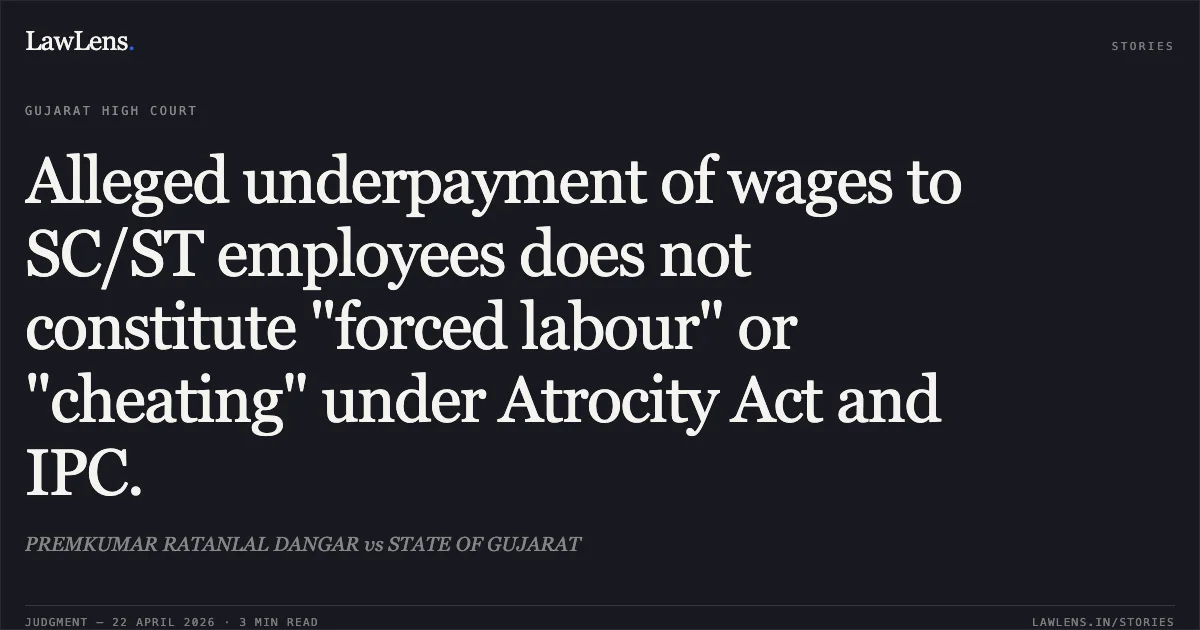
The applicant, President of the Akhil Bhartiya Mazdoor Sangh (Union), representing daily-wage sweepers belonging to the Scheduled Caste (SC) community, filed a private complaint against the office bearers of the Talala Municipality (Respondents No. 2 to 5).
Source reference: p. 2He alleged that the sweepers had worked for 20-25 years without regularization or minimum wages, which he equated to "forced labour" under Article 23 of the Constitution.
Source reference: p. 2He further alleged that upon demanding minimum wages, the respondents threatened and illegally removed the workers, violating sections of the IPC and the Atrocity Act.
Source reference: p. 3, 6A police inquiry report by the SC/ST Cell concluded no offence was made out.
Source reference: p. 4Consequently, the Special Judge dismissed the Criminal Inquiry Case No. 1/2019 on 03.10.2019, leading to this revision application.
Source reference: p. 1, 4Issues
1. Whether the non-payment of minimum wages and subsequent termination of SC/ST daily wagers constitutes "forced labour" or "begar" under Section 3(1)(h) of the Atrocity Act.
Source reference: p. 72. Whether the actions of the public servants involved amounted to criminal cheating (S. 420 IPC), unlawful compulsion of labour (S. 374 IPC), or public servant disobeying law (S. 166 IPC).
Source reference: p. 8-93. Whether the High Court should interfere with the discretionary order of the subordinate court in its revisional jurisdiction.
Source reference: p. 10Law Applied
The court primarily applied Section 3(1)(h) of the Scheduled Caste and Scheduled Tribes (Prevention of Atrocities) Act, which criminalizes compelling a member of an SC/ST community to perform "begar" or forced labour.
Source reference: p. 7It also considered Sections 374 (unlawful compulsory labour), 420 (cheating), and 166 (public servant disobeying law) of the Indian Penal Code.
Source reference: p. 8Regarding the procedural remedy for wage disputes, the court referenced Section 22 of the Minimum Wages Act, 1948, which provides a specific mechanism and requires a written complaint by a competent authority for cognizance.
Source reference: p. 9For the standard of revision, it relied on Amit Kapoor v. Ramesh Chander (2012) and Malkeet Singh Gill v. State of Chhatisgarh (2022), establishing that revisional courts should only interfere in cases of patent illegality or perversity.
Source reference: p. 10Reasoning
The Court reasoned that the mere fact that daily wagers belong to the SC community does not automatically invoke the Atrocity Act without evidence of compulsion or bonded labour.
Source reference: p. 7Since the sweepers joined the Municipality voluntarily for public service, their engagement does not qualify as "forced labour" under Section 3(1)(h).
Source reference: p. 7-8Regarding the IPC charges, the Court found no evidence of mens rea (guilty mind), dishonesty, or intentional injury required to satisfy Sections 420 or 166.
Source reference: p. 8-9The Court observed that the dispute was essentially a civil/labour matter regarding wages and service benefits.
Source reference: p. 5, 9It held that the applicant attempted to give a "cloak of criminality" to a labour dispute and should have approached the Labour Commissioner under the Minimum Wages Act instead of filing a criminal complaint.
Source reference: p. 9-10Applying the limits of revisional jurisdiction, the Court found no perversity or jurisdictional error in the Special Judge's dismissal.
Source reference: p. 11Holding
The High Court dismissed the revision application, upholding the lower court's decision to dismiss the private complaint.
The Court held that no prima facie case was made out under the Atrocity Act or the IPC.
Source reference: p. 8-9It concluded that the proper remedy for wage grievances lies under specialized labour legislation (Minimum Wages Act) or writ jurisdiction, not through criminal prosecution under the Atrocity Act.
Source reference: p. 9-10Rule was discharged.
Source reference: p. 11Acts & Sections Cited
9 provisions across 4 statutes referred to in this judgment. Each provision opens on LawLens.
Code of Criminal Procedure, 19732
Indian Penal Code, 18604
Gujarat Police Act, 1951.1
Original Court PDF
PREMKUMAR RATANLAL DANGARvsSTATE OF GUJARAT
Click to open original judgment
Original judgment, available to read, download and summarize on LawLens.in


