Facts
The original plaintiffs (respondents) filed a suit for partition, declaration, and injunction regarding two sets of properties: 'Suit Property A' (forest land allotted to the plaintiffs' father by the Collector in 1997) and 'Suit Property B' (ancestral land).
Source reference: para. 3The defendants (appellants) contested the suit, claiming that Property A, though allotted in the name of the plaintiffs' father, was jointly cultivated and partitioned during the lifetime of their respective fathers, who were brothers.
Source reference: para. 4The Trial Court granted a preliminary decree in favor of the plaintiffs and dismissed the defendants' counterclaim.
Source reference: para. 3.1The First Appellate Court confirmed this judgment.
Source reference: para. 3.2The defendants approached the High Court in a Second Appeal, asserting rights over Property A based on joint cultivation and oral evidence.
Source reference: para. 4.1-4.4Issues
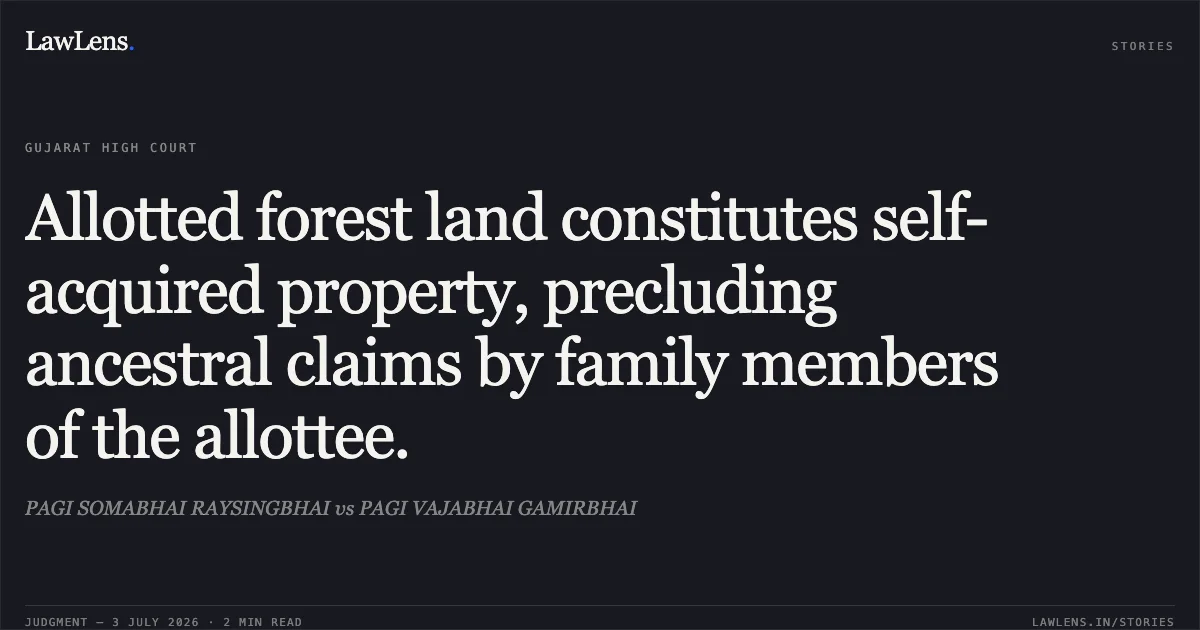
1. Whether 'Suit Property A', being forest land allotted by the Government to an individual, constitutes self-acquired property or joint ancestral property.
Source reference: para. 92. Whether the High Court can interfere with concurrent findings of fact regarding ownership and possession in a Second Appeal under Section 100 of the CPC.
Source reference: para. 12-12.2Law Applied
Section 100 of the Civil Procedure Code (CPC), which restricts Second Appeals to "substantial questions of law" rather than mere questions of fact.
Source reference: para. 1, 12.1The principle from Arunachala Gounder (Dead) v. Ponnusamy (2022) that land allotted by the Government to an individual qualifies as self-acquired property.
Source reference: para. 9The standards for appellate interference established in Jaichand v. Sahnulal (2024) and Russi Fisheries (P) Ltd. v. Bhavna Seth (2026), which stipulate that concurrent findings of fact cannot be disturbed unless they are perverse, contrary to mandatory provisions of law, or based on inadmissible evidence.
Source reference: para. 12.1, 12.2Reasoning
The Court observed that 'Suit Property A' was specifically allotted to the plaintiffs' father by the Collector under a Government Resolution dated 05.07.1972, and revenue entries (Entry No. 730) exclusively reflected his name since 1997.
Source reference: para. 8.1The defendants failed to provide cogent evidence of joint cultivation or a prior legal partition that would override the official allotment and revenue record.
Source reference: para. 9The Appellate Court noted that the defendants did not challenge the revenue entries for over two decades until 2019.
Source reference: para. 11, citing para. 15.5 of the lower court judgmentThe High Court reasoned that since the allotment was a statutory act by the Collector, it vested exclusive title in the form of self-acquired property.
Source reference: para. 9Applying the restrictive scope of Section 100 CPC, the Court found no perversity in the lower courts' appreciation of evidence and determined that no substantial question of law arose for consideration.
Source reference: para. 12-14Holding
The court held that the plaintiffs held exclusive title to 'Suit Property A' as it was self-acquired property through government allotment, and both parties held equal shares in the ancestral 'Suit Property B'.
The High Court dismissed the Second Appeal in limine, affirming the concurrent findings of the Trial and lower Appellate Courts. The preliminary decree for partition and injunction stands.
Source reference: para. 14Acts & Sections Cited
2 provisions across 1 statute referred to in this judgment. Each provision opens on LawLens.
Code of Civil Procedure, 19082
Original Court PDF
PAGI SOMABHAI RAYSINGBHAIvsPAGI VAJABHAI GAMIRBHAI
Click to open original judgment
Original judgment, available to read, download and summarize on LawLens.in


