Facts
The petitioner, an In-charge of the Student Branch at Gajra Raja Medical College, was a witness in the "Vyapam Scam" investigation
Source reference: para. 2Following his testimony, he alleged that motivated complaints were filed against him, leading to his transfer and a subsequent show-cause notice dated 13.06.2026
Source reference: para. 2Despite his reply, an order of suspension was issued on 16.06.2026 under Rule 9(1)(a) of the Madhya Pradesh Civil Services (CCA) Rules, 1966
Source reference: para. 2The petitioner challenged this suspension directly before the High Court via a writ petition, while the State raised a preliminary objection regarding the availability of an alternative statutory remedy of appeal
Source reference: paras. 1-3Issues
1. Whether a writ petition under Article 226 of the Constitution is maintainable when a statutory alternative remedy of appeal is available to the petitioner
Source reference: para. 32. Whether the court should exercise its discretionary jurisdiction to quash a suspension order before the exhaustion of statutory remedies
Source reference: paras. 9-11Law Applied
The court applied the principle of "alternative remedy" as a self-imposed limitation on writ jurisdiction under Article 226 of the Constitution of India
Source reference: para. 7Writ jurisdiction should not be used to bypass machinery set up by statute (Thansingh Nathmal v. A. Mazid [AIR 1964 SC 1419])
Source reference: para. 7A party's failure to exhaust statutory remedies within time does not entitle them to discretionary relief (A.V. Venkateswaran v. Ramchand Sobhraj Wadhwani [AIR 1961 SC 1506])
Source reference: para. 8Distinction between the "maintainability" and "entertainability" of a writ petition (Godrej Sarah Lee v. Excise and Taxation Officer [2023 SCC OnLine SC 95])
Source reference: para. 6Reasoning
The court reasoned that while Article 226 provides wide jurisdiction, it is discretionary and should not be exercised merely because it is lawful to do so
Source reference: para. 7The Judge observed that when a statute provides an equally efficacious and speedy remedy, the High Court should normally refuse to entertain the petition to avoid trenching upon the statutory machinery
Source reference: para. 7In this specific context, where the petitioner sought to challenge a suspension order, the court noted that the Madhya Pradesh Civil Services (CCA) Rules provide a clear appellate route
Source reference: para. 11The court distinguished the precedent cited by the petitioner (Lokendra Singh Hihore v. State of M.P.) on the grounds that the previous coordinate Bench had not considered the binding Supreme Court decisions regarding the exhaustion of alternative remedies
Source reference: para. 10Holding
The court declined to interfere with the suspension order on merits at this stage, holding that the petitioner must first exhaust the statutory remedy of appeal
The petition was disposed of with a direction to the petitioner to file an appeal before the competent authority within two weeks. The appellate authority was further directed to decide the appeal on its merits via a reasoned and speaking order within one month, providing the petitioner an opportunity for a personal hearing. No opinion was expressed on the merits of the case.
Source reference: paras. 12-13Original Court PDF
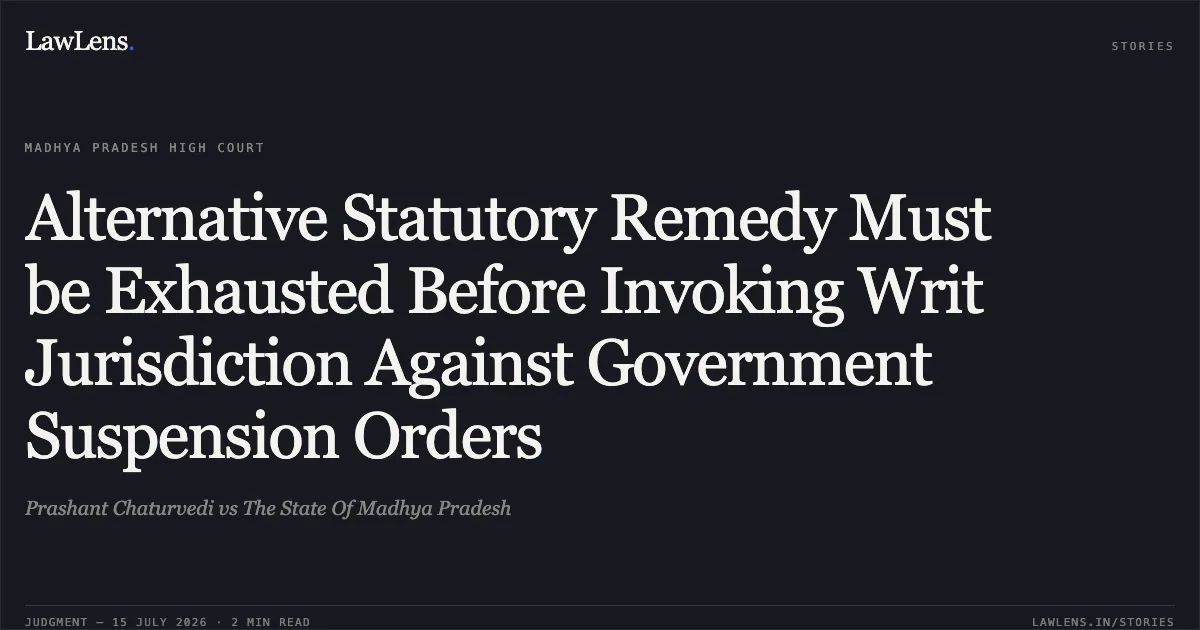
Prashant ChaturvedivsThe State Of Madhya Pradesh
Click to open original judgment
Original judgment, available to read, download and summarize on LawLens.in