01Facts
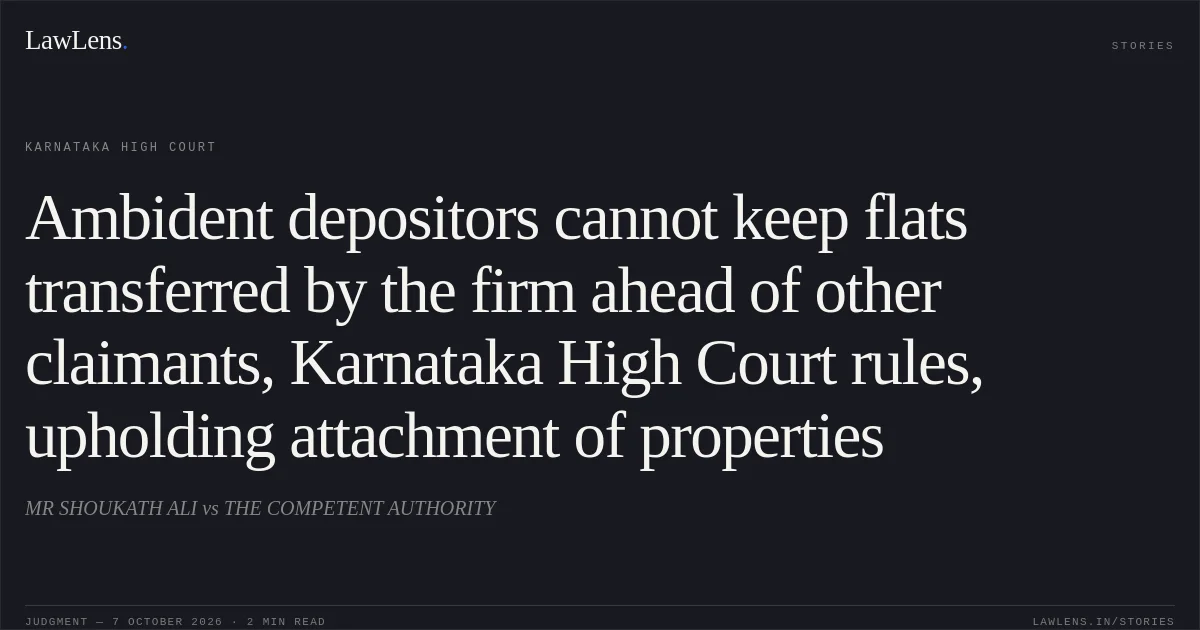
Respondent No. 2, Ambident Marketing Private Limited, collected deposits from the public under investment schemes but failed to repay them.
pp. 18–21, 26–31 · ¶ 3, 10–13After complaints from depositors, the Government provisionally attached properties under Section 3(2) of the Karnataka Protection of Interest of Depositors in Financial Establishments Act, 2004 (“KPIDFE Act”). The Competent Authority applied to make the attachment absolute. The Special Court allowed the applications, and the appellants challenged those orders in these appeals.
pp. 20–22 · ¶ 302Issues
i.1. Whether the properties conveyed or agreed to be conveyed to the appellants, but acquired using funds paid by the financial establishment or its sister concern, were liable to attachment under Section 3(2) of the KPIDFE Act.
pp. 27–33 · ¶ 10–15ii.2. Whether the appellants’ alleged status as depositors and the transfer of the apartments in settlement of their claims entitled them to retain the properties ahead of other depositors.
pp. 22–26, 31–34 · ¶ 4–9, 14–1603Law Applied
Section 3(2) of the KPIDFE Act authorises attachment of money or property believed to have been acquired by a financial establishment from deposits collected by it, whether held in its own name or in the name of another person; it also permits attachment of other specified property where the establishment’s own attachable property is unavailable or insufficient.
pp. 28–30 · ¶ 12“Deposit” under Section 2(2) includes money received by a financial establishment to be returned, with or without an assured benefit, while Section 2(3) defines a “depositor” as a person who has made deposits with the establishment.
pp. 32–33 · ¶ 1404Reasoning
The sale deeds and agreements showed that the substantial portion of the purchase consideration had been paid by Ambidant Construction, while the appellants had paid only relatively small sums.
pp. 26–31 · ¶ 10–13Even accepting the appellants’ account that the transfers settled their deposit claims, the Court considered that arrangement impermissible insofar as it gave them the benefit of specific properties ahead of other depositors who remained unpaid.
pp. 31–34 · ¶ 14–1605Holding
The Court answered the issues against the appellants. It held that the properties were liable to remain attached and that the appellants could not obtain priority over other depositors through the transfers.
pp. 34–35 · ¶ 17All appeals were dismissed, and pending interlocutory applications were disposed of.
pp. 34–35 · ¶ 17Original Court PDF
MR SHOUKATH ALIvsTHE COMPETENT AUTHORITY
Click to open original judgment
Original judgment, available to read, download and summarize on LawLens.in