01Facts
The appellant challenged his conviction under Section 6 of the Protection of Children from Sexual Offences (POCSO) Act and Section 376(3) of the Indian Penal Code (IPC), following a judgment by the Special Judge, Udalguri
p. 2The prosecution alleged that the appellant kidnapped the 15-year-old victim (PW-2) on January 21, 2023, took her to Guwahati and Golaghat, and forcibly established a "physical relationship"
pp. 3-4The appellant maintained they were in a consensual love affair and that no sexual intercourse occurred
p. 2The trial court convicted the appellant and sentenced him to 20 years of rigorous imprisonment
p. 3The medical evidence (PW-7) estimated the victim's age at 15–17 years via radiological examination but found no spermatozoa or signs of recent sexual intercourse
p. 2, 602Issues
i.1. Whether the prosecution proved beyond reasonable doubt that the victim was below 18 years of age at the time of the incident?
pp. 6-7ii.2. Whether the term "physical relationship" used in the victim’s testimony is sufficient to establish "penetrative sexual assault" as defined under Section 3 of the POCSO Act?
p. 7iii.3. Whether the conviction and sentence under Section 376(3) IPC and Section 6 of the POCSO Act are sustainable based on the evidence on record?
pp. 7-803Law Applied
The court applied Section 3 and Section 6 of the POCSO Act, 2012, which define and penalize penetrative sexual assault, and Section 376(3) of the IPC
p. 2, 7It relied on the settled legal principle regarding age determination via ossification tests, which allows for a margin of error of ± 1 to 2 years in favor of the accused
p. 7Furthermore, the court applied the fundamental criminal jurisprudence principle that if two views are possible, the view favoring the accused must be adopted
p. 7The court also emphasized the requirement of specific evidence of "penetration" to satisfy the statutory requirements of Section 3 of the POCSO Act
p. 7Provisions in the judgment · 8 · Linked ones open on LawLens
Protection of Children from Sexual Offences Act, 2012 Section 3Section 5Section 6Section 42
Indian Penal Code, 1860 Section 366Section 376
Code of Criminal Procedure, 1973 Section 164Section 313
04Reasoning
The court found that the prosecution failed to exhibit the victim’s birth certificate, rendering her age proof dependent solely on a radiological exam (15–17 years); applying the standard margin of error of ± 2 years, the victim could be considered an adult
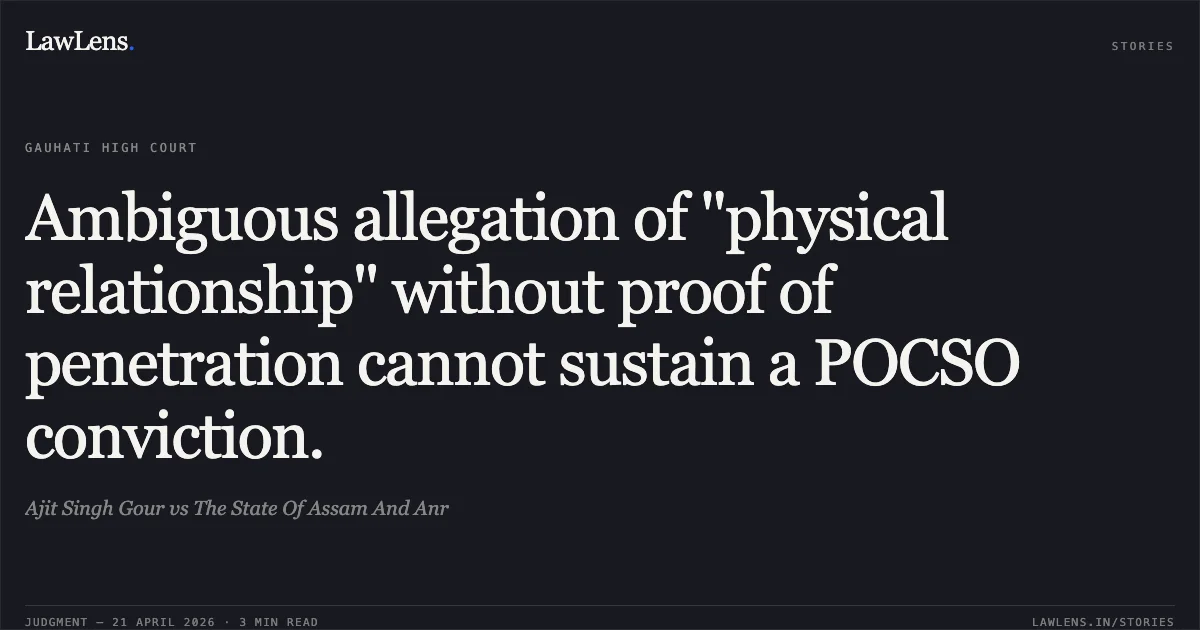
pp. 6-7Regarding the act itself, the court observed that the victim’s testimony used the ambiguous phrase "physical relationship," which does not necessarily imply penetration as required by the POCSO Act
p. 7The medical report (PW-7) corroborated this lack of evidence, noting no signs of sexual intercourse or injury
p. 6The court further noted that the victim’s conduct—carrying a bag of clothes, waiting for the appellant, and failing to raise an alarm despite traveling through crowded public spaces and staying in a room with 20–25 neighbors—contradicted her claim of being taken forcibly
pp. 4-5Additionally, the testimony of PW-6, who stayed with the couple, indicated no sexual activity occurred, thereby discrediting the victim’s version of events
p. 605Holding
The Court answered the issues in the negative, holding that the prosecution failed to prove either the minority of the victim or the commission of penetrative sexual assault beyond all reasonable doubt
p. 8The High Court set aside the conviction and sentence order dated September 7, 2024, and September 17, 2024
p. 8The appellant was acquitted of all charges under Section 376(3) IPC and Section 6 of the POCSO Act by being granted the benefit of doubt and was ordered to be discharged from his bail bond
p. 8Original Court PDF
Ajit Singh GourvsThe State Of Assam And Anr
Click to open original judgment
Original judgment, available to read, download and summarize on LawLens.in