Facts
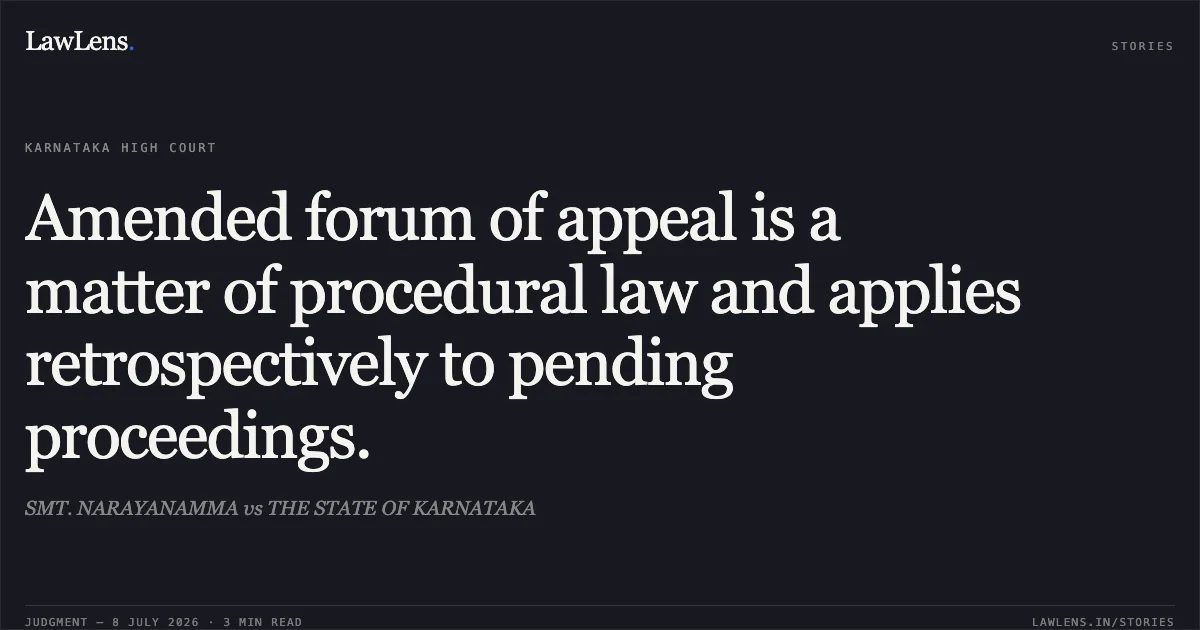
The Appellants and Petitioner challenged the constitutional validity of the Karnataka Civil Courts (Amendment) Act, 2023 and the Karnataka High Court (Amendment) Act, 2023 (impugned legislations). These amendments enhanced the pecuniary jurisdiction of Civil Judges and transferred the appellate jurisdiction for decrees passed by Senior Civil Judges from the High Court to District Courts.
Source reference: p. 7-10Section 4 of the Civil Courts Amendment Act gave the amendments retrospective effect from 28.08.2007.
Source reference: p. 8Litigants feared this would nullify nearly 20 years of High Court judgments and take away vested rights to a specific forum.
Source reference: para 15-16A Single Judge previously upheld the Acts but struck down the retrospectivity; the State and litigants appealed this finding.
Source reference: para 1, 5Issues
1. Whether the State Legislature has the competence to enact laws altering the jurisdiction and forum of appeal
Source reference: para 322. Whether the impugned legislations are manifestly arbitrary under Article 14 for lack of consultation with the High Court
Source reference: para 34-363. Whether the forum of appeal is a vested substantive right or a matter of procedural law
Source reference: para 564. Whether the retrospective operation under Section 4 must be read down to save the legislation from unconstitutionality
Source reference: para 89-91Law Applied
Entry 11-A of List III and Entry 13 read with Entry 46 of List III of the Seventh Schedule, affirming State competence over "administration of justice" [Jamshed N. Guzdar v. State of Maharashtra].
Source reference: para 32-33The principle that the right to appeal is substantive, but the forum of appeal is procedural [Neena Aneja v. Jai Prakash Associates Ltd.].
Source reference: para 59Doctrine of Reading Down and Purposive Interpretation to prevent manifest absurdity and preserve constitutional validity [Shailesh Dhairyawan v. Mohan Balkrishna Lulla and Ahmedabad Municipal Corp. v. Nilaybhai R. Thakore].
Source reference: para 67, 72, 109Reasoning
The Court held that while the legislature has the power to enact retrospective laws, such laws must not be "manifestly arbitrary".
Source reference: para 31, 62It determined that the forum of appeal is procedural; therefore, a change in forum applies to pending cases unless stated otherwise.
Source reference: para 59-60A literal reading of Section 4 (making the law retrospective to 2007) without a savings clause would absurdly nullify thousands of concluded judgments, rendering the law "harsh and unreasonable".
Source reference: para 71-90To "iron out the creases," the Court applied purposive interpretation to align the law with the legislative intent of reducing pendency (as suggested in Smt. Thirakavva v. Smt. Ratnavva) without disturbing finality.
Source reference: para 38, 72The Court found that "substitution" of provisions implies the new rules govern pending actions immediately.
Source reference: para 97-103Finally, it rejected the discrimination claim, holding that the distinction between the Bengaluru City Civil Court (presided by District Judges) and other District Courts was a "reasonable classification".
Source reference: para 116-117Holding
The Court upheld the constitutional validity of the impugned legislations and modified the Single Judge’s order by reading down Section 4 of the Civil Courts Amendment Act: the retrospective operation is valid but limited to pending proceedings only.
It expressly excludes (a) appeals concluded by final judgments prior to the notification and (b) interlocutory orders already passed in pending proceedings. Pending appeals are to be transferred to jurisdictional District Courts and continued from the current stage. WP No. 17588/2024 was dismissed; WA No. 200260/2025 was disposed of with the aforementioned modifications.
Source reference: para 115, 122, 123Acts & Sections Cited
11 provisions across 5 statutes referred to in this judgment. Each provision opens on LawLens.
KARNATAKA CIVIL COURTS ACT, 19643
Code of Civil Procedure, 19083
KARNATAKA GENERAL CLAUSES ACT, 18991
Original Court PDF
SMT. NARAYANAMMAvsTHE STATE OF KARNATAKA
Click to open original judgment
Original judgment, available to read, download and summarize on LawLens.in