Facts
The plaintiff/respondent No. 1 instituted a suit for declaration and permanent injunction concerning the suit land.
Source reference: no citationThe defendants filed a written statement disputing the plaintiff’s claim.
Source reference: no citationDuring the pendency of the suit, the petitioners/defendants sought amendment of their written statement under Order VI Rule 17 read with Section 151 CPC to incorporate additional defences, including adverse possession and limitation.
Source reference: no citationThe trial court rejected the application on the grounds that the proposed facts were already within the petitioners’ knowledge before filing the written statement and that the trial had commenced because issues had been framed and the matter was fixed for the plaintiff’s evidence.
Source reference: paras. 2, 6The petitioners challenged that order under Article 227 of the Constitution.
Source reference: para. 2Issues
1. Whether the amendment application could be rejected merely because the facts sought to be pleaded were within the petitioners’ knowledge before filing the written statement.
Source reference: paras. 6–72. Whether the trial had commenced for purposes of the proviso to Order VI Rule 17 CPC merely because issues had been framed, in the absence of affidavits under Order XVIII Rule 4 CPC.
Source reference: paras. 4, 8–93. Whether the proposed amendment to the written statement was necessary for determining the real controversy and caused prejudice or injustice to the opposite party.
Source reference: paras. 7, 9–10Law Applied
The Court applied Order VI Rule 17 CPC, under which amendments necessary for determining the real questions in controversy are ordinarily to be allowed, subject to the proviso requiring due diligence once trial has commenced.
Source reference: no citationRelying on Life Insurance Corporation of India v. Sanjeev Builders Pvt. Ltd., 2022 SCC OnLine SC 1128, the Court held that mere delay is not by itself a ground to reject an amendment; amendments should be liberally allowed where they facilitate effective adjudication, do not introduce a time-barred claim or entirely new cause of action, withdraw an admission, or cause irreparable prejudice.
Source reference: para. 7Relying on Vidyabai v. Padmalatha, (2009) 2 SCC 409, and the coordinate Bench decision in Shakuntala Bai v. Rajendra Kumar, (2015) 1 MPLJ 191, the Court held that commencement of trial is not established merely by framing issues; filing of affidavits in lieu of examination-in-chief under Order XVIII Rule 4 CPC constitutes commencement of trial.
Source reference: paras. 4, 8–9The Court exercised supervisory jurisdiction under Article 227 of the Constitution to correct the erroneous refusal of amendment.
Source reference: para. 10Reasoning
The trial court relied on two grounds—prior knowledge of the proposed pleas and commencement of trial.
Source reference: no citationThe High Court held that prior knowledge and delay, without more, do not justify refusal of an amendment to a written statement, particularly when the amendment assists in determining the real controversy and does not cause irreparable prejudice.
Source reference: paras. 7, 9Further, although issues had been framed, the record did not establish that affidavits under Order XVIII Rule 4 CPC had been filed when the amendment application was made.
Source reference: paras. 8–10Applying Shakuntala Bai, the Court therefore concluded that the trial had not commenced for purposes of the proviso to Order VI Rule 17 CPC.
Source reference: paras. 8–10Since both reasons given by the trial court were legally erroneous, interference under Article 227 was warranted.
Source reference: para. 10Holding
The High Court allowed the miscellaneous petition and set aside the trial court’s order dated 6 July 2023.
The petitioners’ application under Order VI Rule 17 CPC was allowed, permitting amendment of the written statement.
Source reference: para. 10Respondent No. 1 was granted liberty to seek consequential amendment of the plaint.
Source reference: para. 10The Court clarified that the entire trial would not be reopened; the trial court could permit further evidence only to the extent necessary to address the amended written statement and any consequential amendment to the plaint.
Source reference: para. 11The petition and pending applications were accordingly disposed of.
Source reference: paras. 12–13Acts & Sections Cited
1 provisions across 1 statute referred to in this judgment. Each provision opens on LawLens.
Code of Civil Procedure, 19081
Original Court PDF
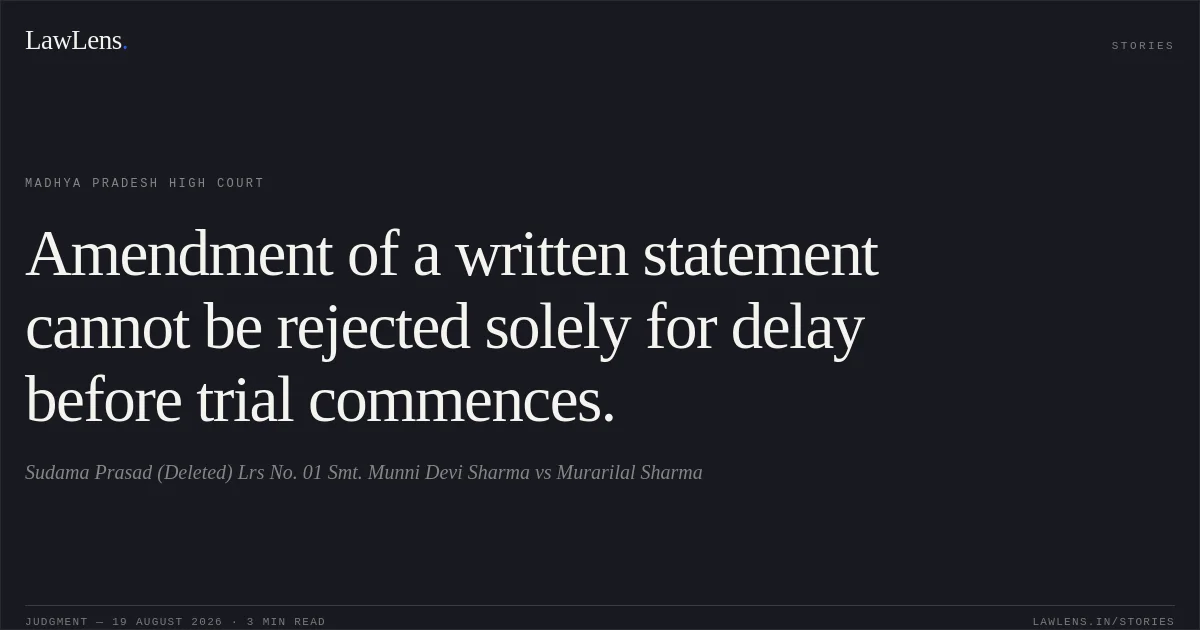
Sudama Prasad (Deleted) Lrs No. 01 Smt. Munni Devi SharmavsMurarilal Sharma
Click to open original judgment
Original judgment, available to read, download and summarize on LawLens.in