Facts
The Appellant’s land (parcels of 193 sq. m. and 5294 sq. m.) was acquired for the Delhi Metro Rail Corporation via notifications issued in 2004 under Sections 4, 6, and 17 of the Land Acquisition Act, 1894.
Source reference: p. 4The Land Acquisition Collector fixed the market value at Rs. 19,660 per sq. m. in 2005, which was subsequently enhanced by the Reference Court to approximately Rs. 29,956 and Rs. 26,896 for the respective parcels.
Source reference: p. 5The Appellant filed appeals in 2009, initially restricting the claims to Rs. 40,000 and Rs. 50,000 per sq. m. due to alleged financial constraints.
Source reference: p. 6In 2025, the Appellant filed applications under Order VI Rule 17 of the Code of Civil Procedure (CPC) seeking to amend the appeals to claim a market value of Rs. 1,30,000 per sq. m., citing parity with a recent Coordinate Bench judgment in M/s Anant Raj Projects Ltd. v. Union of India, which involved adjacent land acquired under the same notification.
Source reference: p. 6-7The Respondent/DMRC opposed the amendment on grounds of a 16-year delay and financial prejudice.
Source reference: p. 9Issues
1. Whether the applications for amendment of the claim amount in land acquisition appeals, filed after a significant delay, are maintainable under Order VI Rule 17 of the CPC.
Source reference: p. 10, para 112. Whether the Appellant is entitled to interest on the enhanced amount for the period of delay in seeking the amendment.
Source reference: p. 20, para 37; p. 21, para 40Law Applied
Order VI Rule 17 of the CPC, which permits amendment of pleadings at any stage if necessary for determining the real question in controversy.
Source reference: p. 11, para 14Revajeetu Builders & Developers v. Narayanaswamy & Sons, establishing that amendments should be allowed if they do not change the nature of the suit or cause irreparable prejudice that cannot be compensated by costs.
Source reference: p. 14, para 20Section 54 of the Land Acquisition Act, 1894, regarding appellate jurisdiction to determine "just" market value.
Source reference: p. 10, para 12Sections 148 and 149 of the CPC, noting they relate to procedural time extensions and deficiency of court fees rather than the substantive right to amend a claim.
Source reference: p. 18-19, para 29-30Reasoning
The court observed that the amendment sought was limited to the quantum of compensation and did not alter the foundational facts or the nature of the proceedings, which remained a determination of market value under Section 54 of the Act.
Source reference: p. 17-18, para 26-27It held that the "nature and character" of the appeals remained unchanged as the Respondents were not required to meet a new case or lead additional evidence.
Source reference: p. 18, para 28Regarding the 16-year delay, the court noted that Order VI Rule 17 does not impose a strict time limit if the amendment is necessary for justice.
Source reference: p. 20, para 34It found the Appellant’s request for parity with the Anant Raj Projects Ltd. judgment to be a valid ground for seeking higher compensation.
Source reference: p. 20, para 36However, the court acknowledged the prejudice caused to the public exchequer by the delay and applied the principle of balancing equities by denying interest for the period of delay.
Source reference: p. 20-21, para 38-41Holding
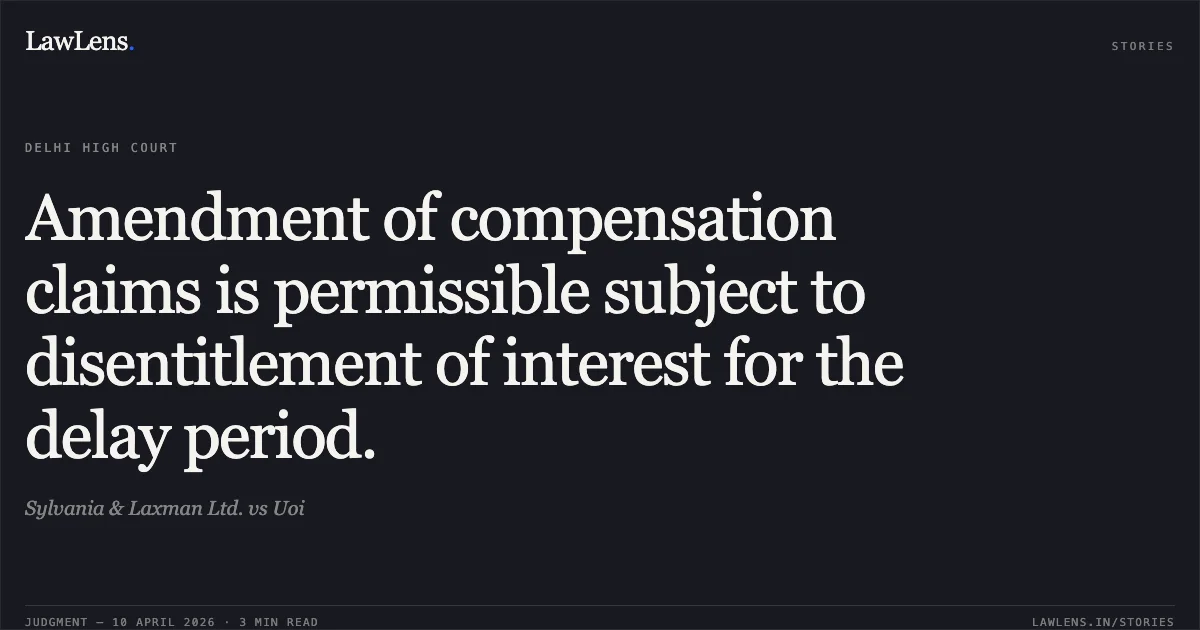
The court allowed the amendment applications, permitting the Appellant to enhance its claim to Rs. 1,30,000 per sq. m.
The holding was subject to the condition that the Appellant shall not be entitled to interest on the enhanced amount (if eventually awarded) for the period between the filing of the appeals (2009) and the filing of the amendment applications (2025).
Source reference: p. 21, para 41The Appellant was directed to deposit the requisite additional court fees and file the amended memo of appeals within six weeks.
Source reference: p. 21, para 43No order as to costs was made.
Source reference: p. 21, para 45Acts & Sections Cited
4 provisions across 1 statute referred to in this judgment. Each provision opens on LawLens.
Code of Civil Procedure, 19084
Original Court PDF
Sylvania & Laxman Ltd.vsUoi
Click to open original judgment
Original judgment, available to read, download and summarize on LawLens.in