Facts
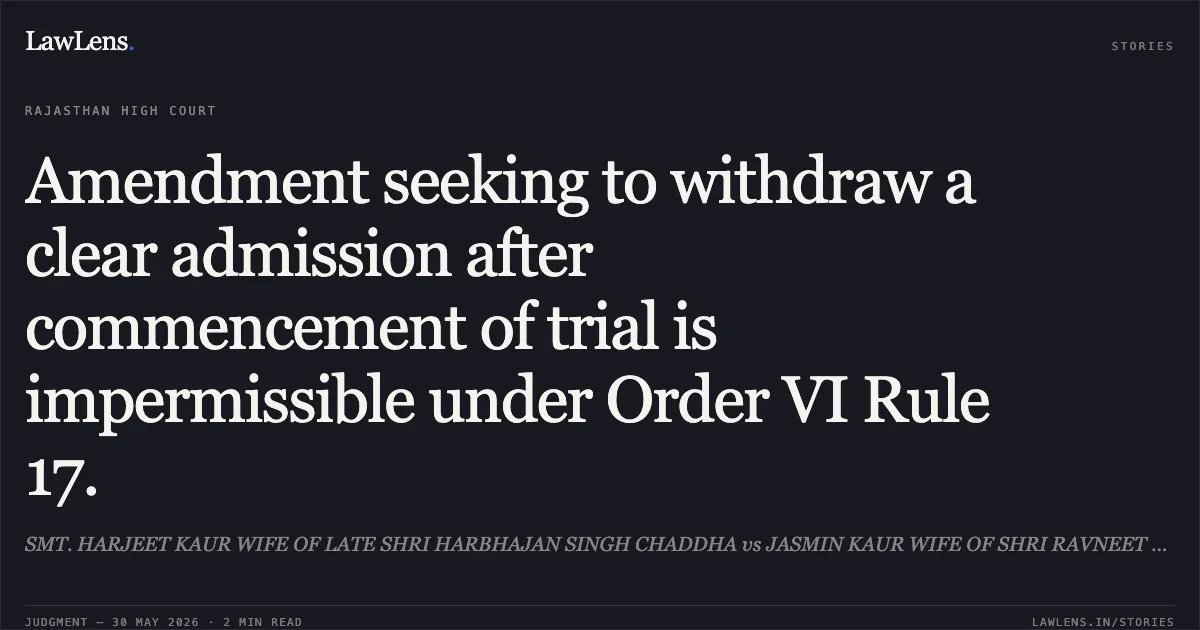
The respondent/plaintiff filed a civil suit in 2022 for partition and permanent injunction regarding property House No. J-113, Jaipur, belonging to her late father, Harbhajan Singh Chaddha.
Source reference: para 2The petitioners/defendants filed a written statement admitting the property belonged to the deceased and devolved upon all legal heirs.
Source reference: para 3.2After issues were framed on 10.05.2023, the defendants moved an application under Order VI Rule 17 CPC on 02.02.2024 to amend the written statement.
Source reference: para 2.1They sought to plead that the plaintiff had already received her share through a Pune flat and family business settlements, thereby contesting her 1/4th share entitlement.
Source reference: para 2.3The Trial Court dismissed the application on 22.03.2024, leading to this writ petition.
Source reference: para 2.6Issues
1. Whether the proposed amendment to the written statement was permissible under Order VI Rule 17 CPC after the commencement of trial.
Source reference: para 7.62. Whether the proposed amendment amounted to a withdrawal of a judicial admission regarding the plaintiff's rights in the suit property.
Source reference: para 7.8Law Applied
The Court applied Order VI Rule 17 of the CPC, which permits amendments necessary for determining the real controversy but contains a proviso barring amendments after the trial has commenced unless "due diligence" is proved.
Source reference: para 7It relied on Life Insurance Corporation of India v. Sanjeev Builders Private Limited (2022), which established that amendments should not be allowed if they withdraw a clear admission or cause irreparable prejudice.
Source reference: para 7.4The court also noted the limited supervisory jurisdiction under Article 227 of the Constitution as per Sadhana Lodh v. National Insurance Co. and Ranjeet Singh v. Ravi Prakash, restricting interference to cases of patent error or jurisdictional overreach.
Source reference: para 6.1Reasoning
The Court observed that the trial had commenced as issues were framed on 10.05.2023, invoking the restrictive proviso of Order VI Rule 17.
Source reference: para 7.6The petitioners failed to demonstrate "due diligence" or explain why these facts (regarding the Pune flat and business settlement) were not pleaded originally despite being within their knowledge.
Source reference: para 7.9Crucially, the Court found that the original written statement admitted the plaintiff was a legal heir with rights in the property.
Source reference: para 7.7The proposed amendment sought to introduce vague, inconsistent pleas that effectively withdrew this admission, which is prohibited under the Sanjeev Builders precedent.
Source reference: para 7.8The High Court determined the Trial Court's finding—that the application was a dilatory tactic—was not perverse or legally flawed.
Source reference: para 7.10Holding
The High Court held that since the trial had commenced and the amendment sought to withdraw a prior admission without a showing of due diligence, it was rightly rejected.
The High Court dismissed the writ petition and upheld the Trial Court’s order dated 22.03.2024, finding no jurisdictional error warranting interference under Article 227.
Source reference: para 7.11Acts & Sections Cited
1 provisions across 1 statute referred to in this judgment. Each provision opens on LawLens.
Code of Civil Procedure, 19081
Original Court PDF
SMT. HARJEET KAUR WIFE OF LATE SHRI HARBHAJAN SINGH CHADDHAvsJASMIN KAUR WIFE OF SHRI RAVNEET SINGH CHADDHA
Click to open original judgment
Original judgment, available to read, download and summarize on LawLens.in