Facts
The petitioner (employer) challenged a Labour Court award dated 21.06.2019.
Source reference: p. 1The respondent No. 4 (workman) was retired on 01.06.2014 based on an application form citing his birth date as 30.05.1956.
Source reference: p. 2-3The workman contended his actual date of birth was 03.05.1958, as recorded in EPF records.
Source reference: p. 3The Labour Court found the workman to be illiterate and noted that both the application form and EPF records were filled by the employer.
Source reference: p. 3The Labour Court ruled in favor of the workman, extending his retirement age and awarding back wages: 75% for the first two years (2014–2016) and 50% for the subsequent two years (2016–2018).
Source reference: p. 1-2Issues
1. Whether the Labour Court’s determination of the respondent’s date of birth based on EPF records was perverse or legally sound
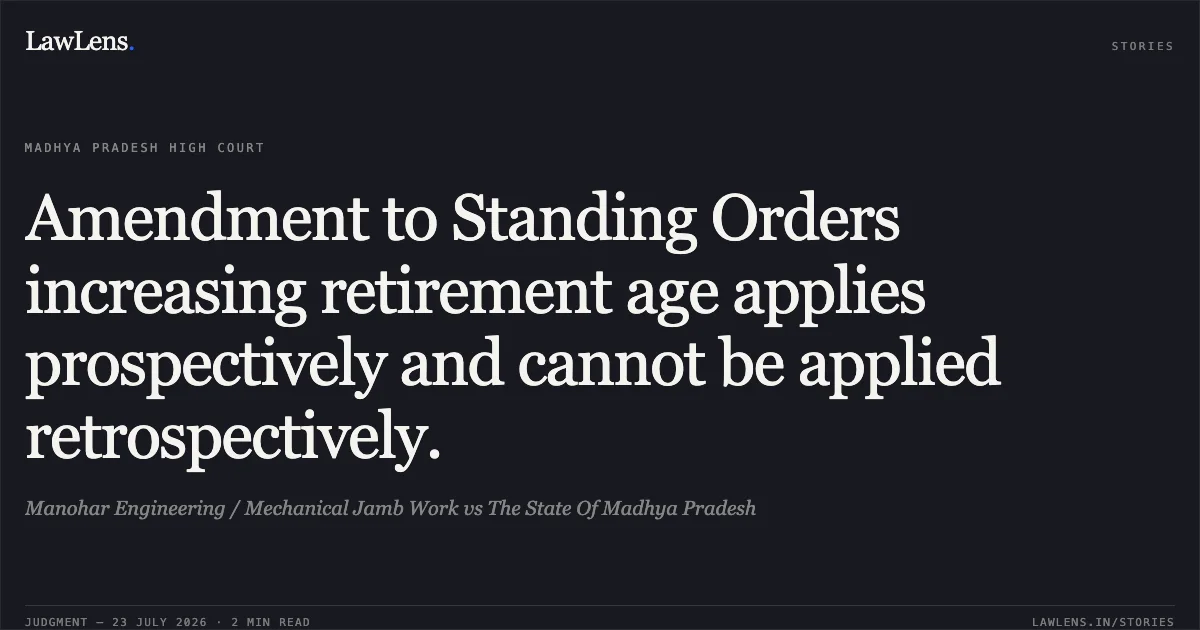
Source reference: p. 32. Whether the amendment to the standing orders (extending retirement age from 58 to 60 years) published on 28.06.2014 could be applied retrospectively
Source reference: p. 2, 43. Whether the quantum of back wages awarded (75% and 50%) was rational and justified
Source reference: p. 4Law Applied
Where two conflicting records (filled by the employer) exist for an illiterate employee, the entry beneficial to the workman prevails.
Source reference: p. 3Every statute or amendment is prospective unless express words or necessary implication indicate retrospective operation, as established in Sitaram v. State of Madhya Pradesh (AIR 1980 MP 4).
Source reference: p. 5While retirement age amendments apply prospectively, back wages should be restricted if the employer acted bona fide under existing certified standing orders, according to Tata International Limited v. State of M.P. and others (2018 SCC OnLine MP 1222).
Source reference: p. 4-6Reasoning
The High Court affirmed the Labour Court's finding on the date of birth (03.05.1958), reasoning that since the employer failed to conduct medical evidence (like an ossification test) and both conflicting records were filled by the employer themselves, the version beneficial to the illiterate workman must be accepted.
Source reference: p. 3The Court held that amendments regulate future conduct unless specifically backdated; thus, the Labour Court erred in its legal interpretation by applying the 2014 standing order amendment retrospectively.
Source reference: p. 4The Court found the 75% back wage award to be irrational and excessive because the employer acted bona fide based on the initial records provided.
Source reference: p. 4-6Holding
The High Court upheld the date of birth as 03.05.1958 but set aside the Labour Court’s finding regarding the retrospective application of standing orders.
The award was modified such that the respondent No. 4 is entitled to a uniform 50% back wages for all four years (instead of 75% for the first two); the petition was disposed of with these modifications.
Source reference: p. 4, 6Acts & Sections Cited
3 provisions across 3 statutes referred to in this judgment. Linked provisions open on LawLens.
Industrial Disputes Act, 19471
the Act (unresolved)1
Amending Act, 1961 (unresolved)1
Original Court PDF
Manohar Engineering / Mechanical Jamb WorkvsThe State Of Madhya Pradesh
Click to open original judgment
Original judgment, available to read, download and summarize on LawLens.in