Facts
The respondent/plaintiff society instituted O.S. No. 62 of 2012 before the District Munsif Court, Coonoor, seeking recovery of vacant possession of approximately 2.45 acres, damages for unauthorised occupation, and costs.
Source reference: paras. 1–2; pp. 3–4The plaintiff alleged that the property had been leased to the defendant society on 1 February 1988 for an annual rent of ₹12 and that the lease expired in 2008, after which the defendant failed to vacate.
Source reference: paras. 1–2; pp. 3–4The defendant denied the lease, disputed the plaintiff’s title, and claimed entitlement based on possession of the original title deeds and its welfare activities.
Source reference: para. 3; p. 4During the pendency of the suit, the plaintiff society’s President/Chairman, A. Masilamani, died on 29 April 2020.
Source reference: para. 4; p. 4The plaintiff filed I.A. No. 3 of 2020 under Order VI Rule 17 CPC, seeking to substitute D. Samuel Raj, stated to have been elected as the new President/Chairman by a meeting dated 17 June 2020 and authorised to continue the litigation.
Source reference: para. 4; p. 4The defendant opposed the application, contending that the application should have been filed under Order XXII Rule 10 CPC and that Samuel Raj had not been validly elected and had allegedly been removed from the society’s membership.
Source reference: paras. 5, 7; pp. 5–6The District Munsif allowed the amendment, holding that the validity of Samuel Raj’s election was a matter for the competent Registrar/forum and that the dispute did not prevent amendment of the plaint.
Source reference: para. 6; p. 5The defendant challenged that order under Article 227 of the Constitution.
Source reference: p. 3Issues
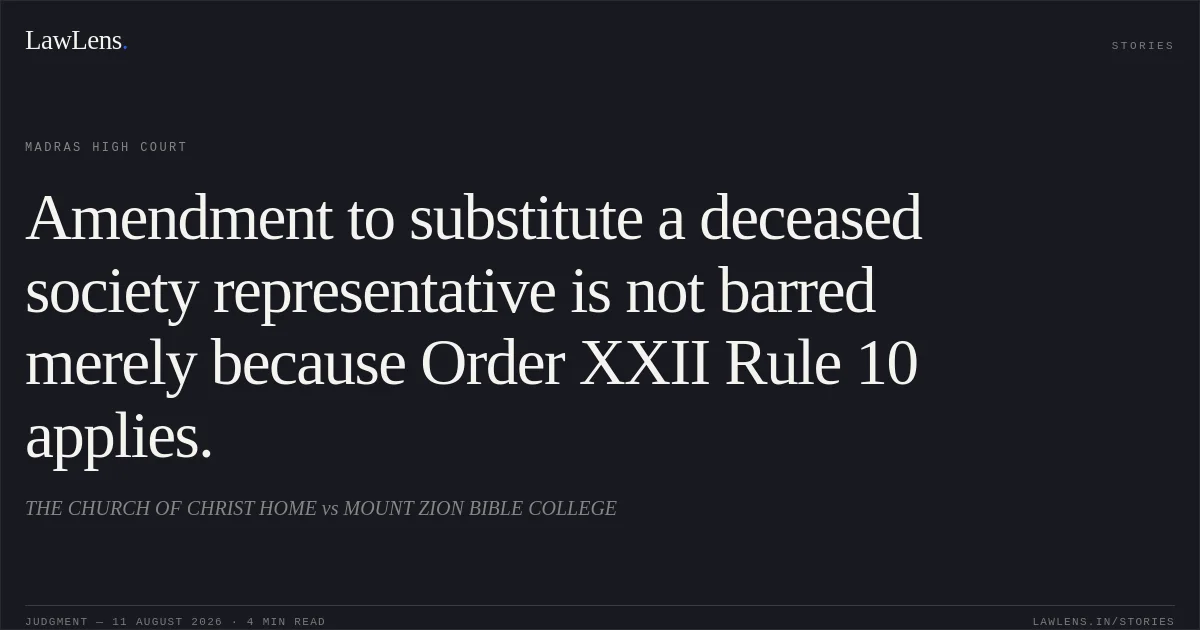
1. Whether an application under Order VI Rule 17 CPC seeking amendment of the plaint to reflect the death of the former President/representative and appointment of his successor could be rejected solely because the plaintiff had not proceeded under Order XXII Rule 10 CPC.
Source reference: para. 11; p. 82. Whether the alleged invalid election, removal from membership, or lack of recognition of D. Samuel Raj disentitled him from representing the plaintiff society and continuing the suit.
Source reference: para. 13; pp. 8–9Law Applied
Order VI Rule 17 CPC permits amendment of pleadings where necessary for determining the real questions in controversy, subject to the principles governing procedural fairness and avoidance of prejudice.
Source reference: para. 11; p. 8Order XXII Rule 10 CPC concerns continuation of proceedings where an interest in the subject matter of the suit has devolved during its pendency; however, the court held that the choice of procedural provision should not result in unnecessary multiplicity or delay where the amendment merely records a subsequent change in the society’s representative.
Source reference: para. 11; p. 8Procedural law is intended to advance justice rather than obstruct adjudication, and an amendment that introduces neither a new cause of action nor a change in the nature or character of the suit may be allowed.
Source reference: para. 12; p. 8Questions concerning the validity of the election or appointment of a society office-bearer, and compliance with the society’s bye-laws, may be adjudicated before the appropriate statutory or competent forum and need not be conclusively determined in an interlocutory amendment application.
Source reference: para. 13; p. 9The High Court’s supervisory jurisdiction under Article 227 does not warrant interference merely because another procedural course may have been available, absent material illegality or jurisdictional error.
Source reference: p. 3; para. 14Reasoning
The proposed amendment did not alter the plaintiff’s cause of action, reliefs, or the nature of the possession suit; it only recorded the death of Masilamani and the alleged appointment of Samuel Raj as the society’s successor representative.
Source reference: paras. 11–12; p. 8Requiring the plaintiff first to file an application under Order XXII Rule 10 CPC and thereafter a separate amendment application would create avoidable procedural delay and multiplicity of proceedings.
Source reference: paras. 11–12; p. 8The death certificate, minutes of the General Body Meeting, and society resolution supported the plaintiff’s assertion that Samuel Raj had been appointed and authorised to represent the society.
Source reference: para. 13; p. 9Although the defendant disputed the genuineness of the signatures, compliance with the bye-laws, and Samuel Raj’s membership status, those issues concerned the validity of his election and could be decided in appropriate proceedings; they did not justify rejection of the amendment at that stage.
Source reference: paras. 7, 13; pp. 6, 9Accordingly, the trial court had acted within its jurisdiction in allowing the amendment, and no supervisory interference was warranted.
Source reference: para. 14; p. 9Holding
The High Court answered both issues against the revision petitioner.
It held that the plaintiff’s invocation of Order VI Rule 17 CPC, rather than Order XXII Rule 10 CPC, was not by itself a ground to reject the amendment, and that the disputed validity of Samuel Raj’s election or membership could not be conclusively determined in the amendment proceedings.
Source reference: paras. 11–13; pp. 8–9The Civil Revision Petition was dismissed, the order dated 20 January 2023 in I.A. No. 3 of 2020 in O.S. No. 62 of 2012 was upheld, no costs were awarded, and the connected miscellaneous petitions were closed.
Source reference: para. 14; p. 9Original Court PDF
THE CHURCH OF CHRIST HOMEvsMOUNT ZION BIBLE COLLEGE
Click to open original judgment
Original judgment, available to read, download and summarize on LawLens.in