Facts
The petitioners, plaintiffs in a suit seeking a declaration of co-ownership over certain lands, applied to amend their plaint to seek partition and a share of the sale consideration for one of the lands sold by the defendants during the suit.
Source reference: para. 3–4The trial court rejected the application, reasoning that the reliefs could have been claimed when the suit was instituted and that issues had been framed and the plaintiffs’ evidence completed.
Source reference: para. 3–4The petitioners challenged that order under Article 227 of the Constitution.
Source reference: para. 3–4, 7Issues
Whether the trial court erred in rejecting the plaintiffs’ amendment application seeking partition and a share of sale proceeds.
Source reference: para. 7–9Whether the proposed amendment should be refused because the trial had commenced, the reliefs could have been sought earlier, or the claim for sale proceeds might be time-barred.
Source reference: para. 8–10Law Applied
Order VI Rule 17 of the Code of Civil Procedure, 1908 permits amendments necessary to determine the real questions in controversy; after commencement of trial, its proviso requires the applicant to establish that, despite due diligence, the matter could not have been raised earlier.
Source reference: para. 8Relying on Mohinder Kumar Mehra v. Roop Rani Mehra (2018) 2 SCC 132 and Life Insurance Corporation of India v. Sanjeev Builders Pvt. Ltd. (2022) 16 SCC 1, the Court stated that amendments should generally be allowed if they facilitate effective adjudication or avoid multiplicity of proceedings, unless, among other things, they introduce a time-barred claim that defeats an accrued right, change the nature of the suit, are mala fide, or cause injustice or prejudice.
Source reference: para. 8, 11Where limitation is arguable, it may be left for determination at trial.
Source reference: para. 8, 11Reasoning
The proposed reliefs arose in the context of the existing dispute over the plaintiffs’ claimed co-ownership; partition and recovery of a share of the sale consideration would enable the controversy to be resolved in the same suit and avoid another proceeding.
Source reference: para. 9, 12The trial court had not found that the amendment was time-barred or that it would prejudice the defendants.
Source reference: para. 9–13The defendants could respond to the amended pleading, cross-examine the plaintiffs on the amendment, and lead evidence; they could also raise limitation in their amended written statement.
Source reference: para. 9–13The Court therefore considered that the amendment could be allowed while preserving the defendants’ defences and the trial court’s ability to frame additional issues.
Source reference: para. 9–13Holding
The Court held that the trial court committed an error of law by refusing the amendment.
It allowed the petition, quashed the order dated 4 January 2022, and allowed the application below Exhibit 59.
Source reference: para. 12–16The petitioners were directed to file the amended plaint within 15 days of receiving the order, and the respondents to file their amended written statement within 15 days of receiving the amended plaint.
Source reference: para. 12–16The respondents may raise limitation and other defences; the trial court may frame additional issues and, if required, examine the plaintiffs on the amendment.
Source reference: para. 12–16Original Court PDF
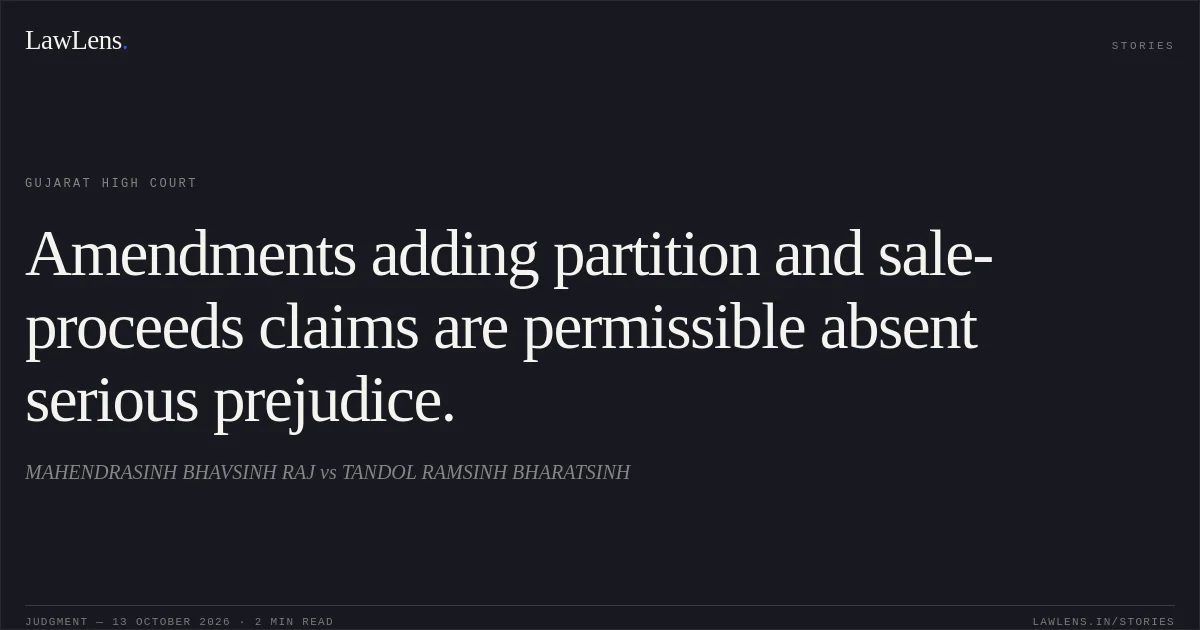
MAHENDRASINH BHAVSINH RAJvsTANDOL RAMSINH BHARATSINH
Click to open original judgment
Original judgment, available to read, download and summarize on LawLens.in
![Authorities must individually assess similarly situated employees’ eligibility for benefits under an affirmed precedent.. Swapan Das vs POSTS. CAT - ['Kolkata']. LawLens](/stories/thumbnails/authorities-must-individually-assess-similarly-situated-employees-eligibility-for-benefits-79605d4f38f347acb73daa832fe2a358.webp)
![Competent authority must reconsider the compassionate allowance claim, including limitation, by a reasoned order.. VINAY KUMAR vs DEPTT OF POSTS. CAT - ['Allahabad']. LawLens](/stories/thumbnails/competent-authority-must-reconsider-the-compassionate-allowance-claim-including-limitation-ca3eb833b95c48bba16e267d27ef2dca.webp)