Facts
The plaintiff filed a suit for declaration of title and permanent injunction concerning a shop, alleging an oral agreement to purchase it for ₹5 lakh and payment in instalments.
Source reference: para. 4–6, 11Before evidence commenced, he applied under Order VI Rule 17 CPC to amend the plaint to seek specific performance.
Source reference: para. 4–6, 11The proposed amendments included pleading an agreement dated 7 May 2019, revised payment particulars, termination of the tenancy, changes to valuation and court fee, and deletion of the State as a party.
Source reference: para. 4–6, 11The trial court rejected the application on the ground that the amendments would change the nature of the suit.
Source reference: para. 4–6, 11The plaintiff challenged that order under Article 227 of the Constitution.
Source reference: para. 4–6, 11Issues
1. Whether the proposed amendments were necessary and permissible under Order VI Rule 17 CPC, or instead changed the nature of the suit by introducing a new case.
Source reference: para. 8, 11–122. Whether the trial court’s rejection of the amendment application disclosed a jurisdictional error or perversity warranting interference under Article 227 of the Constitution.
Source reference: para. 14–17Law Applied
Order VI Rule 17 CPC permits amendments necessary to determine the real controversy, ordinarily requiring a liberal approach—particularly before trial—where the opposing party suffers no irremediable prejudice.
Source reference: para. 8However, an amendment may be refused where it introduces a time-barred claim, changes the nature of the suit, raises a new cause of action foreign to the original pleadings, or deprives the other side of a valid defence; an amendment confined to relief based on facts already pleaded will ordinarily be allowed (LIC v. Sanjeev Builders (P) Ltd., (2022) 16 SCC 1, as set out at para. 8).
Source reference: para. 8Asian Hotels (North) Ltd. v. Alok Kumar Lodha, (2022) 8 SCC 145, likewise cautions against amendments that change the suit’s nature.
Source reference: para. 9T.L. Muddukrishana v. Lalitha Ramchandra Rao, (1997) 2 SCC 611, establishes that limitation for specific performance runs from the date fixed for performance and, in the circumstances considered there, supported refusal of an amendment introducing that relief after limitation had expired.
Source reference: para. 10, 13Article 227 confers limited supervisory jurisdiction, not appellate authority to reappreciate or substitute the subordinate court’s decision; a possible view is ordinarily not disturbed.
Source reference: para. 15–16Reasoning
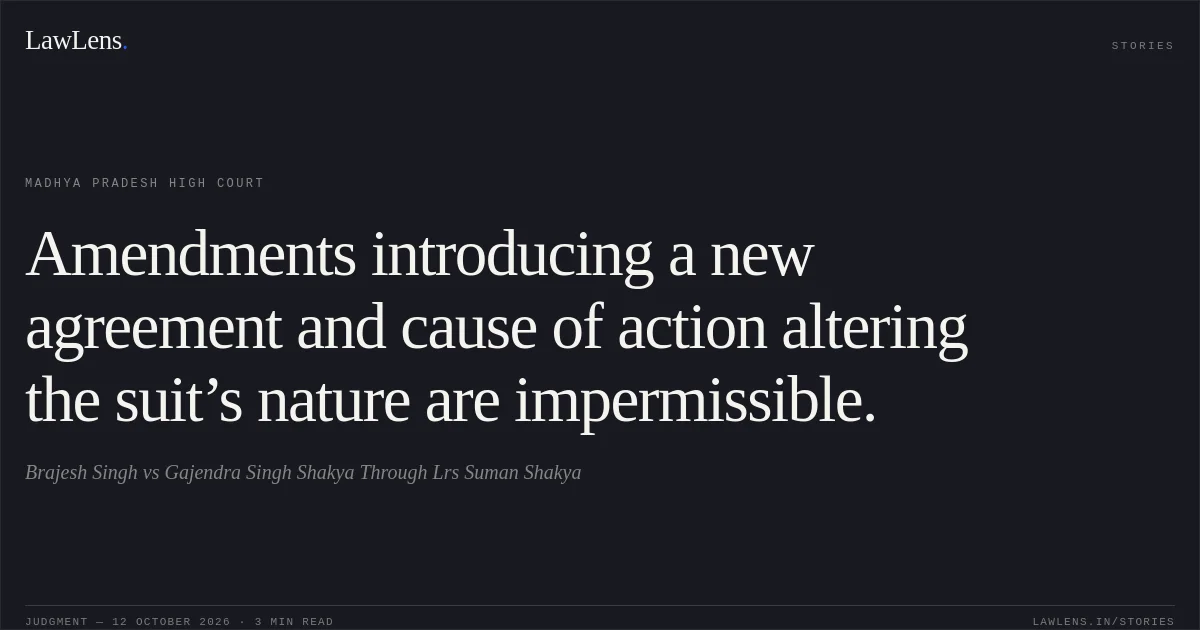
The Court found that the proposed amendments went beyond changing the relief clause: they introduced a 2019 agreement, new payment particulars and a new cause of action, none of which had a foundation in the original plaint.
Source reference: para. 11The alleged facts were within the plaintiff’s knowledge when the suit was filed, and no subsequent event or other explanation for their omission was identified.
Source reference: para. 12The Court also noted inconsistent pleaded or asserted dates for performance and concluded that allowing the amendments would change the suit’s basic nature and unsettle the defendants’ available defences.
Source reference: para. 13Applying the principles in Sanjeev Builders and Asian Hotels, it held that the trial court’s refusal was justified; no jurisdictional error or perversity warranted Article 227 intervention.
Source reference: para. 14–17Holding
The High Court held that the trial court rightly rejected the application under Order VI Rule 17 CPC and dismissed the miscellaneous petition as devoid of merit.
It made no order as to costs, closed any pending applications, vacated the stay of proceedings in the suit, and directed that a copy of the order be sent to the trial court.
Source reference: para. 18–20Original Court PDF
Brajesh SinghvsGajendra Singh Shakya Through Lrs Suman Shakya
Click to open original judgment
Original judgment, available to read, download and summarize on LawLens.in