Facts
The petitioner/plaintiff instituted a suit for declaration and permanent injunction before the Third Civil Judge, Junior Division, Vidisha.
Source reference: para. 1After framing of issues, but before commencement of the plaintiff’s evidence, the petitioner filed an application under Order VI Rule 17 of the Code of Civil Procedure, 1908, seeking to incorporate formal averments in paragraph 2 of the plaint and correct typographical errors in paragraph 4.
Source reference: para. 1–2The trial court partly allowed the application but rejected the amendments relating to paragraphs 2 and 4, observing that they could create complications and might alter the nature of the plaint and written statement.
Source reference: para. 1–3The petitioner challenged that order under Article 227 of the Constitution of India.
Source reference: para. 1Issues
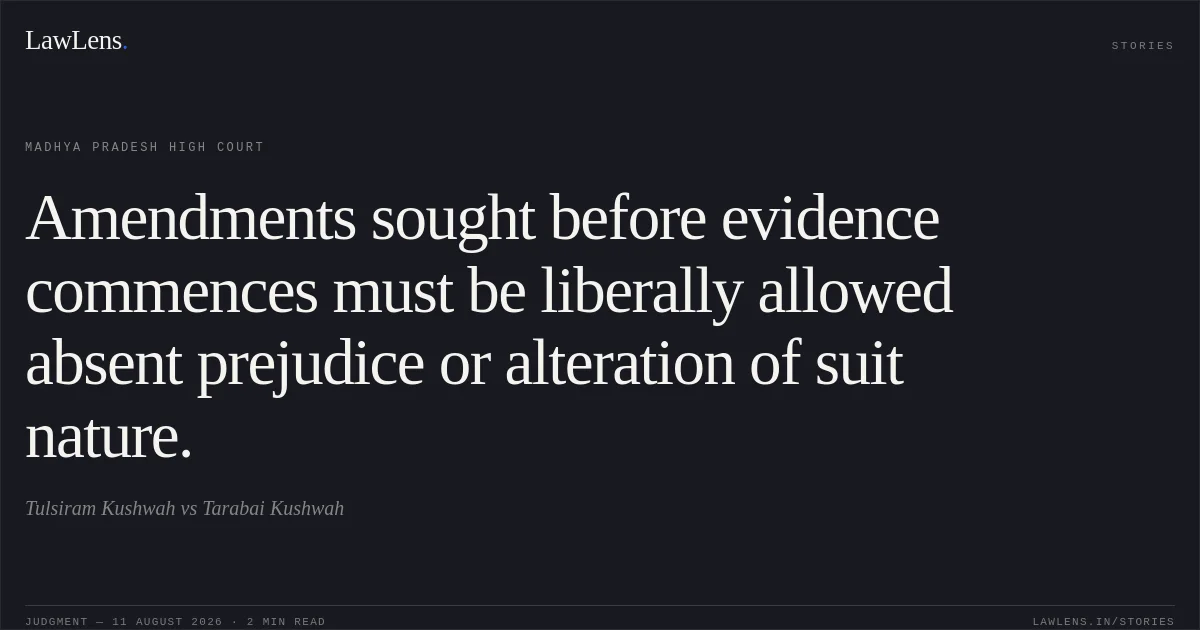
Whether the trial court erred in partly rejecting the petitioner’s application under Order VI Rule 17 CPC when the proposed amendments were formal in nature and the plaintiff’s evidence had not yet commenced?
Source reference: para. 2, 5–6Whether the proposed amendments would change the nature of the suit or cause prejudice to the respondents so as to justify their rejection?
Source reference: para. 2–3, 6Law Applied
The Court applied Article 227 of the Constitution of India and Order VI Rule 17 CPC, which permits amendments necessary for determining the real questions in controversy.
Source reference: para. 5Relying on LIC v. Sanjeev Builders (P) Ltd., (2022) 16 SCC 1, the Court reiterated that amendments should ordinarily be liberally allowed where they assist the effective adjudication of the dispute, avoid multiplicity of proceedings, rectify material particulars, or introduce only an additional approach, provided they do not cause injustice, introduce a time-barred claim, withdraw a binding admission, change the nature of the suit, or deprive the opposite party of a valid defence.
Source reference: para. 5The Supreme Court further held that courts should adopt a liberal approach where the amendment is sought before commencement of trial and the opposite party has an opportunity to meet the amended case.
Source reference: para. 5Reasoning
The High Court noted that although issues had been framed, the plaintiff’s evidence had not commenced, and therefore the application was made before the effective commencement of trial.
Source reference: para. 5–6The proposed amendments were found to be formal in character and did not introduce a new cause of action or alter the nature of the suit.
Source reference: para. 6Applying the principles in LIC v. Sanjeev Builders, the Court held that the respondents would suffer no irreparable prejudice because they could seek consequential amendment of their written statement and would have an adequate opportunity to contest the amended pleadings.
Source reference: para. 6The trial court therefore adopted an unduly restrictive approach in rejecting the amendments on the basis of possible future complications.
Source reference: para. 2, 6Holding
The High Court held that the trial court was not justified in partly rejecting the application under Order VI Rule 17 CPC.
The order dated 12.05.2026 was set aside to the extent that it rejected the amendments proposed in paragraphs 2 and 4 of the plaint, and the amendment application was allowed in its entirety.
Source reference: para. 7The respondents were granted liberty to seek consequential amendment of their written statement, if advised.
Source reference: para. 8The miscellaneous petition was accordingly allowed, and any pending applications were disposed of.
Source reference: para. 9–10Original Court PDF
Tulsiram KushwahvsTarabai Kushwah
Click to open original judgment
Original judgment, available to read, download and summarize on LawLens.in