Facts
The petitioner (husband) and respondent no. 2 (wife) were married on December 28, 2021
Source reference: para 3Following marital discord, the wife filed an FIR (No. 124/2023) at Mahila Thana, Raipur, alleging physical and mental harassment, demands for property, habitual intoxication, assault, and unnatural intercourse
Source reference: para 3Upon completion of the investigation, a Final Report was filed against the petitioner under Sections 498-A and 377 of the IPC, and the Judicial Magistrate First Class, Raipur, took cognizance on August 9, 2024
Source reference: para 3During the pendency of the proceedings, the parties amicably settled their disputes and obtained a decree of divorce by mutual consent under Section 13B of the Hindu Marriage Act on August 8, 2024
Source reference: para 4, 5The wife subsequently filed an affidavit dated March 3, 2026, stating that she had no objection to the quashing of the criminal proceedings
Source reference: para 4, 6Issues
1. Whether the High Court, in the exercise of its inherent powers under Section 528 of the Bharatiya Nagarik Suraksha Sanhita (BNSS), 2023, should quash criminal proceedings involving non-compoundable offences arising out of a matrimonial dispute that has been settled between the parties?
Source reference: para 2, 8, 10Law Applied
The Court exercised its inherent jurisdiction under Section 528 of the BNSS, 2023 (corresponding to Section 482 of the CrPC)
Source reference: para 2It relied on the principles established in Gian Singh v. State of Punjab (2012) 10 SCC 303, which distinguish between the compounding of offences under Section 320 of the Code and the High Court's inherent power to quash proceedings to prevent the abuse of the process of law or to secure the ends of justice
Source reference: para 8The Court further applied the doctrine that while heinous crimes like murder or rape should not be quashed, cases with an "overwhelmingly and pre-dominatingly civil flavour," such as matrimonial or family disputes, may be quashed if a settlement renders the possibility of conviction remote and bleak
Source reference: para 8Reasoning
The Court observed that the criminal case originated from a personal matrimonial dispute that had transitioned into a full and final settlement
Source reference: para 4, 10It noted that the parties had already secured a mutual consent divorce and that the complainant (respondent no. 2) had formally expressed her unwillingness to support the prosecution through an affidavit
Source reference: para 10The Court reasoned that since the parties had resolved their differences, the likelihood of the complainant testifying in favor of the prosecution was minimal, making the chances of conviction remote
Source reference: para 9Consequently, the Court determined that continuing the criminal proceedings would be an "exercise in futility," causing unnecessary harassment to the petitioner and amounting to an abuse of the judicial process
Source reference: para 10, 11Holding
The High Court allowed the petition and quashed FIR No. 124/2023 and all consequential proceedings in Criminal Case No. 14209/2024 pending before the Judicial Magistrate First Class, Raipur
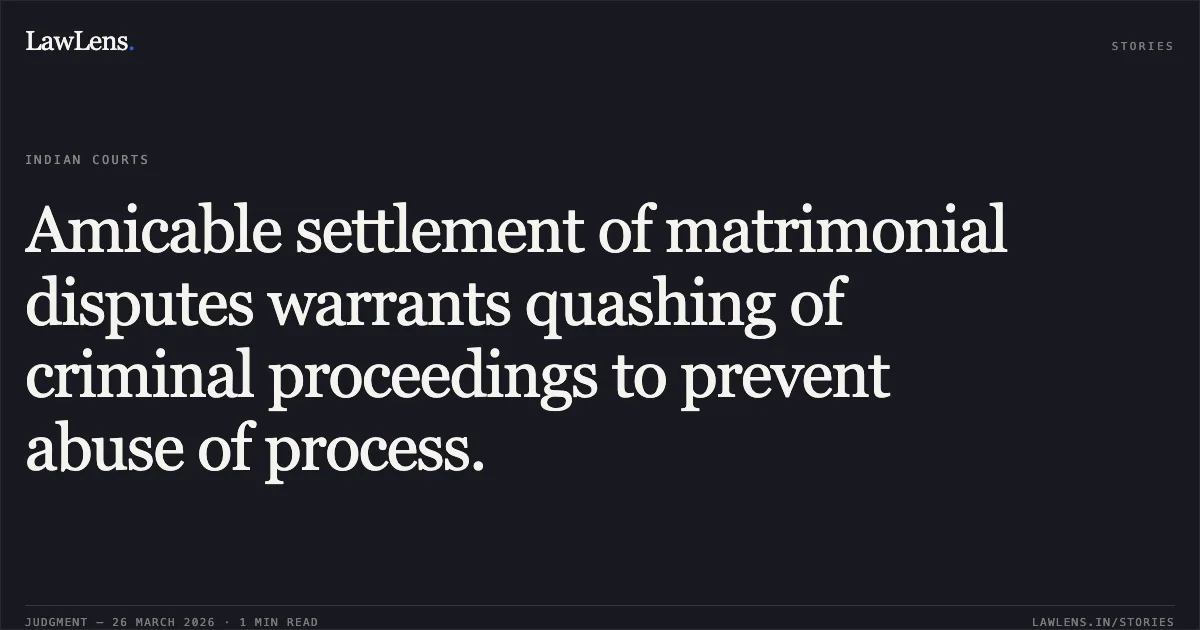
The Court held that in matrimonial disputes where the wrong is private in nature and the parties have resolved their entire dispute, the ends of justice are best served by putting an end to the criminal case
Source reference: para 8, 11The quashing was made subject to the fulfillment of the terms of the compromise entered into between the parties
Source reference: para 11Acts & Sections Cited
3 provisions across 2 statutes referred to in this judgment. Each provision opens on LawLens.
Indian Penal Code, 18602
Bharatiya Nagarik Suraksha Sanhita, 20231
Original Court PDF
HARSH GANGWANIvsTHE STATE OF CHHATTISGARH
Click to open original judgment
Original judgment, available to read, download and summarize on LawLens.in