Facts
The petitioner-father challenged the order dated 14.10.2025 passed by the Additional Principal Judge, Family Court, Kinnaur at Rampur Bushehar, awarding his minor daughter, Trisha, maintenance of ₹10,000 per month from 22.11.2022, the date of filing of the Section 125 Cr.P.C. petition.
Source reference: p.1, p.5The original petition had been filed by the petitioner’s wife and minor daughter claiming ₹20,000 per month, but the wife subsequently withdrew her claim.
Source reference: p.2The daughter, then studying in the fifth standard, claimed maintenance through her mother, who stated that she had left employment in 2022 due to health reasons and had no independent income.
Source reference: p.2–4The mother proved monthly school expenses of ₹3,000 towards transportation and ₹1,840 towards tuition fees.
Source reference: p.4The petitioner admitted that he had not paid maintenance to the child, but asserted that he was unemployed, had no immovable property, was required to support his aged parents, and was willing to take custody of the daughter.
Source reference: p.4, p.6–7During mutual-consent divorce proceedings, the petitioner had also undertaken to continue paying interim maintenance and to abide by the final decision in the pending Section 125 Cr.P.C. proceedings.
Source reference: p.8–10Issues
1. Whether the petitioner’s alleged unemployment and asserted financial liabilities absolved him of his statutory obligation to maintain his minor daughter under Section 125 Cr.P.C.?
Source reference: p.6–7, p.11–132. Whether the award of ₹10,000 per month as maintenance, payable from the date of filing of the petition, was excessive, unreasonable, or otherwise liable to interference in revisional jurisdiction under Section 19(4) of the Family Courts Act?
Source reference: p.5–7, p.13–173. Whether the petitioner could resile from the undertaking given during the mutual-consent divorce proceedings to pay maintenance in accordance with the final outcome of the Section 125 Cr.P.C. proceedings?
Source reference: p.8–10, p.14–15Law Applied
The Court applied Section 125 Cr.P.C., which imposes a statutory obligation upon a parent to maintain a minor child unable to maintain herself.
Source reference: p.11–13It also applied Section 19(4) of the Family Courts Act, under which revisional interference is justified only where the Family Court’s order suffers from illegality, impropriety, or procedural irregularity.
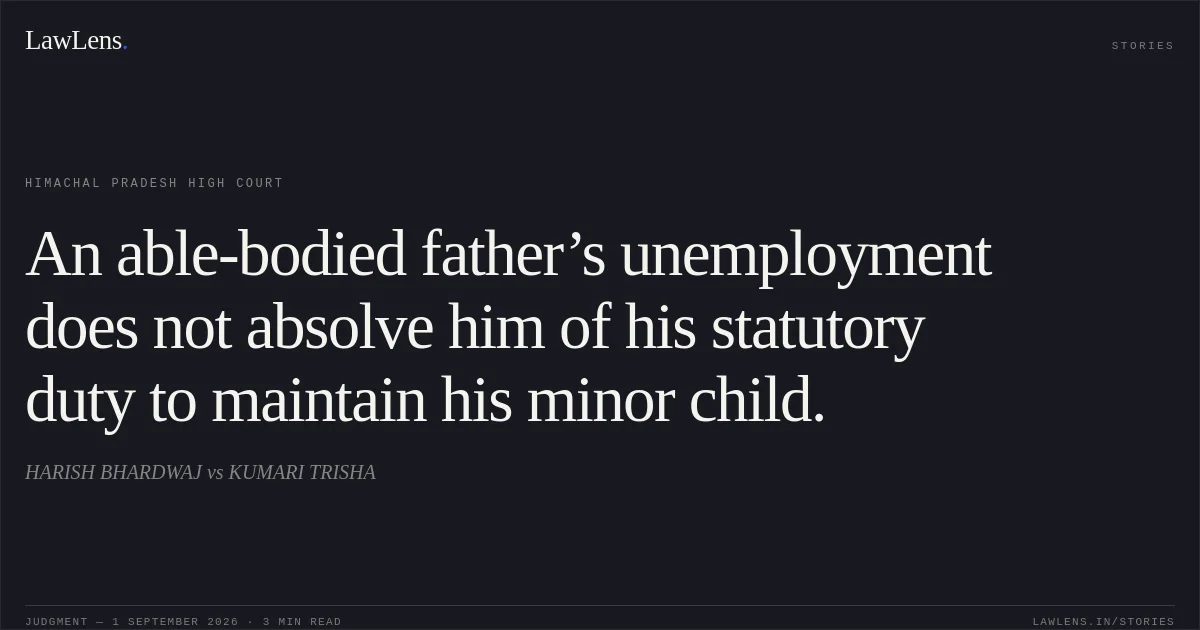
Source reference: p.17Relying on Anju Garg v. Deepak Kumar Garg, 2022 SCC OnLine SC 1314, the Court held that an able-bodied father cannot avoid his obligation to maintain his wife or minor child merely by pleading unemployment and must make efforts to earn, including through physical labour.
Source reference: p.12–13The Court further relied on Shamima Farooqui v. Shahid Khan, (2015) 5 SCC 705, for the principle that a revisional court should not interfere merely because another view is possible, absent illegality, impropriety, or irregularity.
Source reference: p.17Chandrashekar v. Swapnil, (2021) 12 SCC 624, was distinguished because it concerned reduction of maintenance after a substantial lump-sum payment, while Seema Kumari v. Rajesh Kumar, Criminal Revision No. 430 of 2019, was held factually distinguishable.
Source reference: p.15–16Reasoning
The Court found that the petitioner had admitted non-payment of maintenance and had produced no evidence of bodily disability or other incapacity preventing him from earning.
Source reference: p.11–12His unemployment therefore did not extinguish his legal duty towards his growing minor daughter.
Source reference: p.11–12The child’s educational expenses alone were approximately ₹4,840 per month, apart from food, clothing, medical care, and other day-to-day needs; the mother’s unrebutted affidavits indicated total monthly expenses exceeding ₹15,000.
Source reference: p.12–14Considering the child’s age, educational requirements, growing needs, inflation, and the parties’ status, the award of ₹10,000 per month was held fair, just, reasonable, and proportionate.
Source reference: p.13–14The petitioner’s undertaking in the divorce proceedings further reinforced his liability, as he had expressly agreed to abide by the final determination under Section 125 Cr.P.C.; having obtained the benefit of that arrangement, he could not resile from it after the final order was passed.
Source reference: p.14–15Since no illegality, impropriety, or procedural irregularity was established, the limited revisional jurisdiction under Section 19(4) was not attracted.
Source reference: p.16–17Holding
The High Court dismissed the revision petition and upheld the Family Court’s order dated 14.10.2025 awarding ₹10,000 per month to the minor daughter from 22.11.2022.
The petitioner was directed to release the maintenance amount, after adjustment of amounts already granted in the Family Court or any other proceedings, within six weeks from 01.09.2026.
Source reference: p.18–19The parties were directed to bear their own costs, and all pending miscellaneous applications were disposed of.
Source reference: p.19Acts & Sections Cited
2 provisions across 2 statutes referred to in this judgment. Each provision opens on LawLens.
Code of Criminal Procedure, 19731
Family Courts Act, 19841
Original Court PDF
HARISH BHARDWAJvsKUMARI TRISHA
Click to open original judgment
Original judgment, available to read, download and summarize on LawLens.in