Facts
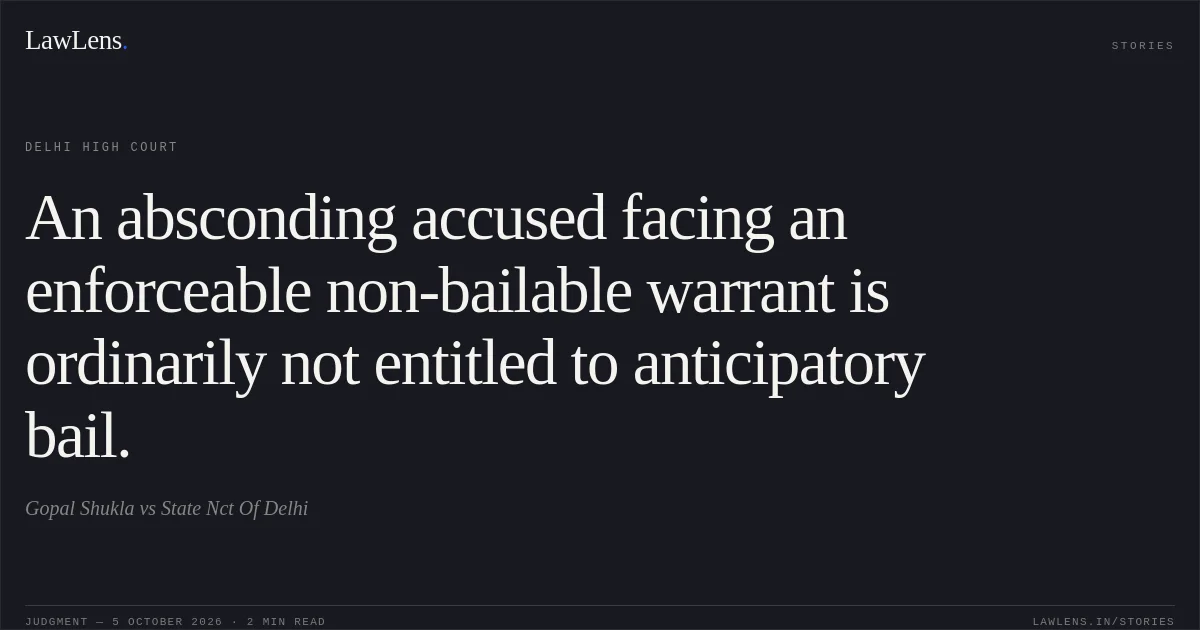
The applicant sought anticipatory bail under Section 482 of the Bharatiya Nagarik Suraksha Sanhita, 2023, in FIR No. 327/2026, registered under Section 64(2)(m) of the Bharatiya Nyaya Sanhita, 2023 and Section 6 of the POCSO Act
Source reference: p. 1The applicant asserted that the victim had asked him to take her to Punjab to visit her sister and denied the allegations
Source reference: pp. 2–3The prosecution relied on the victim’s statement under Section 183 BNSS, alleging that the applicant took her to Punjab and sexually assaulted her repeatedly before returning her to Delhi
Source reference: p. 3The Court noted that the applicant had not joined the investigation despite notices, that non-bailable warrants had been issued, and that proceedings to declare him a proclaimed offender had commenced
Source reference: pp. 4–5Issues
Whether the applicant was entitled to anticipatory bail in light of the victim’s categorical allegations of repeated sexual assault and the State’s submission that custodial interrogation was required
Source reference: pp. 3–5Whether anticipatory bail could be granted when non-bailable warrants remained in force and proceedings to declare the applicant a proclaimed offender were underway
Source reference: pp. 4–7Law Applied
Section 482 BNSS provides for anticipatory bail
Source reference: p. 1The Court relied on Srikant Upadhyay v. State of Bihar, (2024) 12 SCC 382, for the principles that anticipatory bail is an extraordinary discretionary remedy, not the rule; that a person against whom an arrest warrant or proclamation has been issued is generally not entitled to invoke that remedy; and that a person continuously defying court orders and absconding is not entitled to anticipatory bail, subject to the court’s power to grant relief in extreme, exceptional cases in the interests of justice
Source reference: pp. 5–7The Court also noted that an issued warrant remains in force until cancelled by the issuing court or executed
Source reference: pp. 5–6Reasoning
The Court considered the victim’s statement to be categorical as to multiple sexual assaults and noted the applicant’s failure to join the investigation, the outstanding non-bailable warrant, and the pending proceedings to declare him a proclaimed offender
Source reference: pp. 3–5Applying Srikant Upadhyay, it held that the warrant remained enforceable and that the applicant had not shown it had been cancelled or the proclamation proceedings dropped
Source reference: pp. 6–7In those circumstances, the Court found no basis to exercise its exceptional anticipatory-bail jurisdiction
Source reference: p. 7Holding
The Court answered against the applicant, holding that no ground for anticipatory bail had been made out
The petition was dismissed
Source reference: p. 8Acts & Sections Cited
13 provisions across 5 statutes referred to in this judgment. Each provision opens on LawLens.
Bharatiya Nagarik Suraksha Sanhita, 20232
Bharatiya Nyaya Sanhita, 20231
Protection of Children from Sexual Offences Act, 20121
Code of Criminal Procedure, 19735
Indian Penal Code, 18604
Original Court PDF
Gopal ShuklavsState Nct Of Delhi
Click to open original judgment
Original judgment, available to read, download and summarize on LawLens.in