Facts
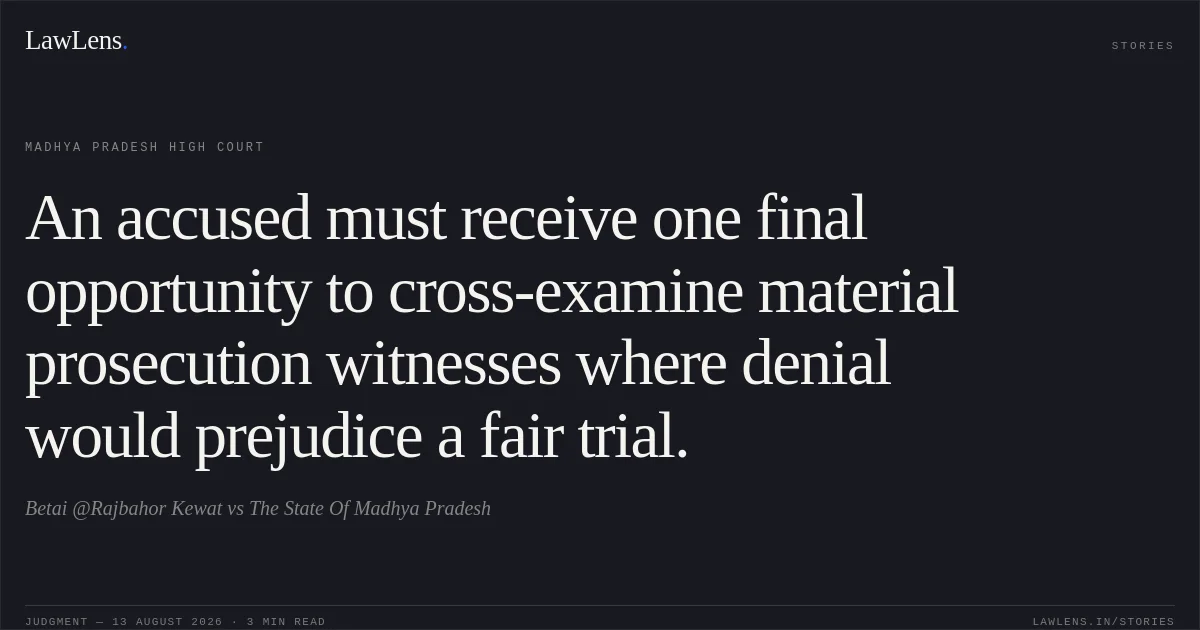
The applicants, accused in Sessions Trial No. 50/2022 arising from Crime No. 89/2020 registered at Police Station Tala, District Satna, for offences under Sections 294, 323, 506, 34 and 326 of the IPC, challenged the order dated 29 October 2025 by which the trial court rejected their application to recall prosecution witnesses A.W.-1 Shivnarayan and A.W.-2 Suhani and closed their right to cross-examine them.
Source reference: para. 1The witnesses were examined-in-chief on 22 July 2024, but their cross-examination could not be conducted. The applicants attributed the omission to the illness and subsequent non-availability of their senior defence counsel, as well as paucity of court time on certain later dates when the witnesses were present.
Source reference: para. 2The State opposed the petition, contending that the applicants had already been granted sufficient opportunities and that repeated adjournments would delay the trial.
Source reference: para. 4Issues
Whether the applicants should be granted one final opportunity to recall and cross-examine A.W.-1 Shivnarayan and A.W.-2 Suhani despite the trial court having closed their right of cross-examination.
Source reference: paras. 1–4Whether, in the circumstances of the case, refusal to recall the material prosecution witnesses resulted in prejudice to the applicants and warranted interference under Section 482 of the Code of Criminal Procedure, corresponding to Section 528 of the Bharatiya Nagarik Suraksha Sanhita, 2023.
Source reference: paras. 1, 5–7Law Applied
The Court applied the principle that the right of cross-examination is a valuable safeguard in a criminal trial and an essential component of the accused’s right to a fair trial under Article 21 of the Constitution, as cross-examination enables the defence to test the veracity, credibility and reliability of prosecution witnesses.
Source reference: para. 5It also applied the discretionary power to recall witnesses under criminal procedure, while recognising that such power must not be used to encourage dilatory tactics or unnecessarily prolong the trial.
Source reference: para. 5The Court further relied on the general Supreme Court principle that procedural laws are handmaids of justice and that an accused should ordinarily receive a reasonable opportunity to effectively defend himself, particularly where recalling the witnesses would not cause irreparable prejudice to the prosecution.
Source reference: para. 7Reasoning
The Court found that the applicants’ failure to cross-examine the witnesses was attributed to the illness and non-availability of their senior defence counsel and, on some occasions, insufficient court time; there was no material indicating a deliberate attempt to delay the proceedings.
Source reference: para. 6Since A.W.-1 and A.W.-2 were material prosecution witnesses, permanently denying their cross-examination could prejudice the defence and undermine the fairness of the trial. Although the Court acknowledged the need to prevent repeated adjournments and trial delays, it considered that the interests of justice would be better served by granting one strictly final opportunity, subject to conditions, rather than foreclosing the applicants’ defence.
Source reference: paras. 5–7Holding
The petition was allowed. The order dated 29 October 2025 was set aside insofar as it rejected the recall application and closed the applicants’ right to cross-examine A.W.-1 Shivnarayan and A.W.-2 Suhani.
The trial court was directed to recall both witnesses and provide the applicants one final opportunity to cross-examine them. The applicants were required to complete the cross-examination on the date fixed without seeking unnecessary adjournment; failing this, the trial court was authorised to proceed in accordance with law.
Source reference: para. 9Acts & Sections Cited
7 provisions across 3 statutes referred to in this judgment. Each provision opens on LawLens.
Code of Criminal Procedure, 19731
Bharatiya Nagarik Suraksha Sanhita, 20231
Indian Penal Code, 18605
Original Court PDF
Betai @Rajbahor KewatvsThe State Of Madhya Pradesh
Click to open original judgment
Original judgment, available to read, download and summarize on LawLens.in