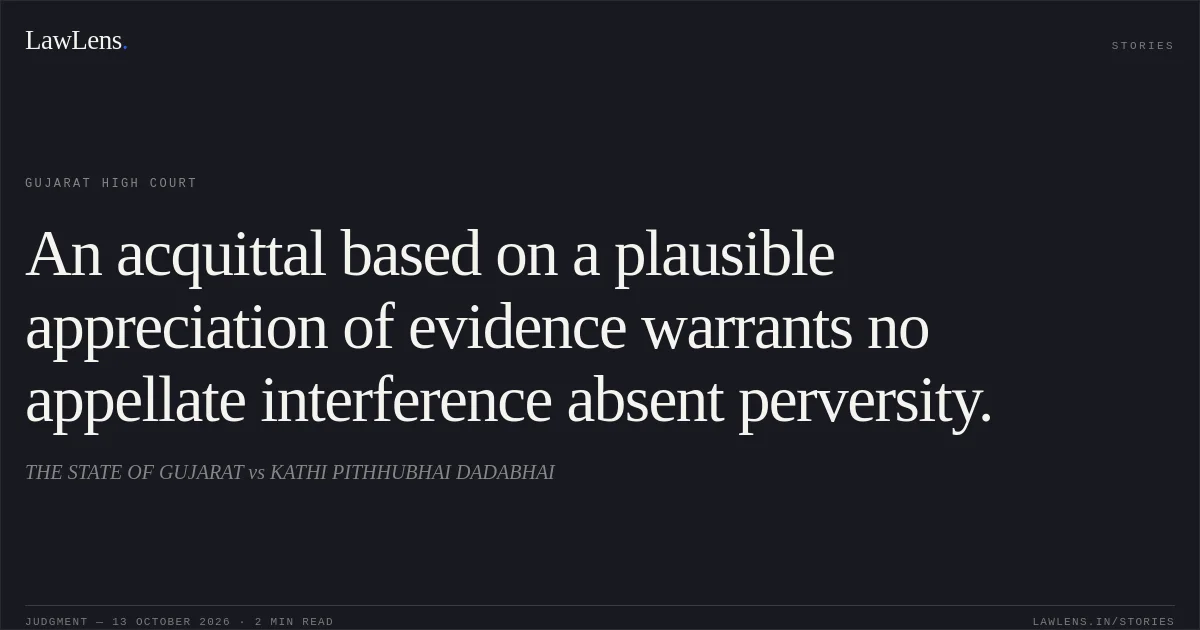
Facts
On 25 October 1990, Kailashgiri Jamnagiri was found dead near the village water tank.
Source reference: p. 2–4, 7–9The prosecution alleged that the accused and others had assaulted him following a dispute over water.
Source reference: p. 2–4, 7–9The complainant had no personal knowledge of the assault and lodged the complaint on information attributed to the deceased’s daughter, Anusuyaben. The alleged eyewitness, Kailashben, did not support the prosecution; Anusuyaben testified that she had not seen the assault.
Source reference: p. 2–4, 7–9The Sessions Court acquitted the accused under Sections 302 read with 114 IPC and Section 135 read with Section 37(1) of the Bombay Police Act. The State appealed under Section 378 CrPC.
Source reference: p. 2–4, 7–9Issues
Whether the prosecution produced cogent evidence connecting the respondent-accused with the homicide.
Source reference: p. 7Whether the trial court’s acquittal was perverse or otherwise warranted interference by the appellate court.
Source reference: p. 10–11Whether the charge under Section 135 read with Section 37(1) of the Bombay Police Act could stand without proof of a notification prohibiting the carrying of arms.
Source reference: p. 9Law Applied
The prosecution must establish the accused’s guilt through admissible, cogent evidence; hearsay evidence is generally excluded because second-hand statements lack the reliability of direct evidence, as explained in Kalyan Kumar Gogoi v. Ashutosh Agnihotri, 2007 (4) GLT 374.
Source reference: p. 10In an appeal against acquittal, the appellate court may interfere in exceptional cases where the judgment is perverse or compelling circumstances justify intervention; it should not substitute another possible view for a reasonable view supporting acquittal, which reinforces the presumption of innocence. The Court relied on Tulasareddi @ Mudakappa & Anr. v. State of Karnataka & Ors., 2026 INSC 67.
Source reference: p. 10The prosecution also had to prove the notification prohibiting the carrying of arms to sustain the charge under Section 135 read with Section 37(1) of the Bombay Police Act.
Source reference: p. 9Reasoning
The Court found no reliable substantive evidence linking the accused to the killing. The complainant’s account was hearsay, and the alleged eyewitness was hostile; the Investigating Officer was not examined, so the relevant prior statements and panchnamas were not duly proved.
Source reference: p. 7–9Anusuyaben had not witnessed the assault, and her claim that she saw the accused leaving armed was an improvement not recorded in the complaint; her evidence therefore did not cure the evidentiary gap.
Source reference: p. 8The forensic and serological material could not independently establish guilt without substantive evidence connecting the accused to the offence, and the circumstances did not form a complete chain.
Source reference: p. 9The prosecution also failed to prove the notification necessary for the Bombay Police Act charge.
Source reference: p. 9The acquittal was a reasonable view of the evidence, not a perverse one, and therefore did not warrant appellate interference.
Source reference: p. 10–11Holding
The Court held that the prosecution had not proved the respondent-accused’s involvement in the homicide or established the statutory basis for the Bombay Police Act charge.
Finding no perversity or other ground to interfere with the acquittal, it dismissed the State’s appeal and confirmed the Sessions Court’s judgment and order dated 17 April 2004.
Source reference: p. 9–11Acts & Sections Cited
5 provisions across 2 statutes referred to in this judgment. Each provision opens on LawLens.
Indian Penal Code, 18602
Code of Criminal Procedure, 19733
Original Court PDF
THE STATE OF GUJARATvsKATHI PITHHUBHAI DADABHAI
Click to open original judgment
Original judgment, available to read, download and summarize on LawLens.in
![Authorities must individually assess similarly situated employees’ eligibility for benefits under an affirmed precedent.. Swapan Das vs POSTS. CAT - ['Kolkata']. LawLens](/stories/thumbnails/authorities-must-individually-assess-similarly-situated-employees-eligibility-for-benefits-79605d4f38f347acb73daa832fe2a358.webp)
![Competent authority must reconsider the compassionate allowance claim, including limitation, by a reasoned order.. VINAY KUMAR vs DEPTT OF POSTS. CAT - ['Allahabad']. LawLens](/stories/thumbnails/competent-authority-must-reconsider-the-compassionate-allowance-claim-including-limitation-ca3eb833b95c48bba16e267d27ef2dca.webp)