Facts
The applicant, father of the deceased Naresh, challenged the Sessions Court’s acquittal of three accused charged under Sections 302, 201 read with Sections 34 and 120B of the Indian Penal Code (IPC), arising from Naresh’s homicidal death and the disposal of his body in a water body.
Source reference: pp. 1–4, paras. 3, 5–11The prosecution relied on circumstantial evidence, including alleged last-seen evidence, motive, the accused’s conduct, recovery of weapons and clothes, and forensic evidence.
Source reference: p. 10, para. 18The complainant sought leave to appeal and admission of the acquittal appeal.
Source reference: p. 1, para. 1Issues
Whether the trial court was justified in acquitting the accused where the prosecution case rested on circumstantial evidence.
Source reference: p. 7, para. 14Whether the complainant had established grounds for leave to appeal and interference with the acquittal.
Source reference: pp. 7, 14–15, paras. 16, 23Law Applied
The Court applied the principles governing circumstantial evidence stated in Sharad Birdhichand Sarda v. State of Maharashtra, (1984) 4 SCC 116: each circumstance must be fully established, consistent only with guilt, conclusive in nature, and form a complete chain excluding every reasonable hypothesis other than the accused’s guilt.
Source reference: pp. 8–10, para. 17It also applied the rule that an acquittal should not be disturbed routinely: the appellate court must respect the reinforced presumption of innocence and interfere where the judgment is perverse or compelling circumstances warrant intervention; where another view is reasonably possible, interference should be avoided.
Source reference: p. 7, para. 16The prosecution was required to prove the charged offences under Sections 302, 201, 34 and 120B IPC beyond reasonable doubt.
Source reference: pp. 2–4, paras. 3, 6–11The Court considered Section 27 of the Evidence Act in assessing whether the alleged recoveries were made pursuant to disclosures by the accused.
Source reference: p. 13, para. 21(4)Reasoning
The Court held that the prosecution had not established a complete chain of circumstances.
Source reference: no citationIt rejected the last-seen evidence because the witness was the deceased’s cousin, the complainant’s FIR did not mention the alleged information despite the witness’s claim that he had conveyed it, and the Court regarded the witness as a got-up witness.
Source reference: pp. 11–12, para. 21(1)The alleged motive was not proved by witness evidence, and the complainant had stated in the FIR that the deceased had no known enmity.
Source reference: p. 12, para. 21(2)The accused’s alleged absence from the village was not established; one accused was arrested in the village and there was no evidence that the others were hiding.
Source reference: p. 13, para. 21(3)The weapons and clothes were produced by family members, not recovered at the instance of the accused, and the recovery evidence was inadequately supported; accordingly, it did not establish the necessary link, while the forensic evidence could not independently complete the chain.
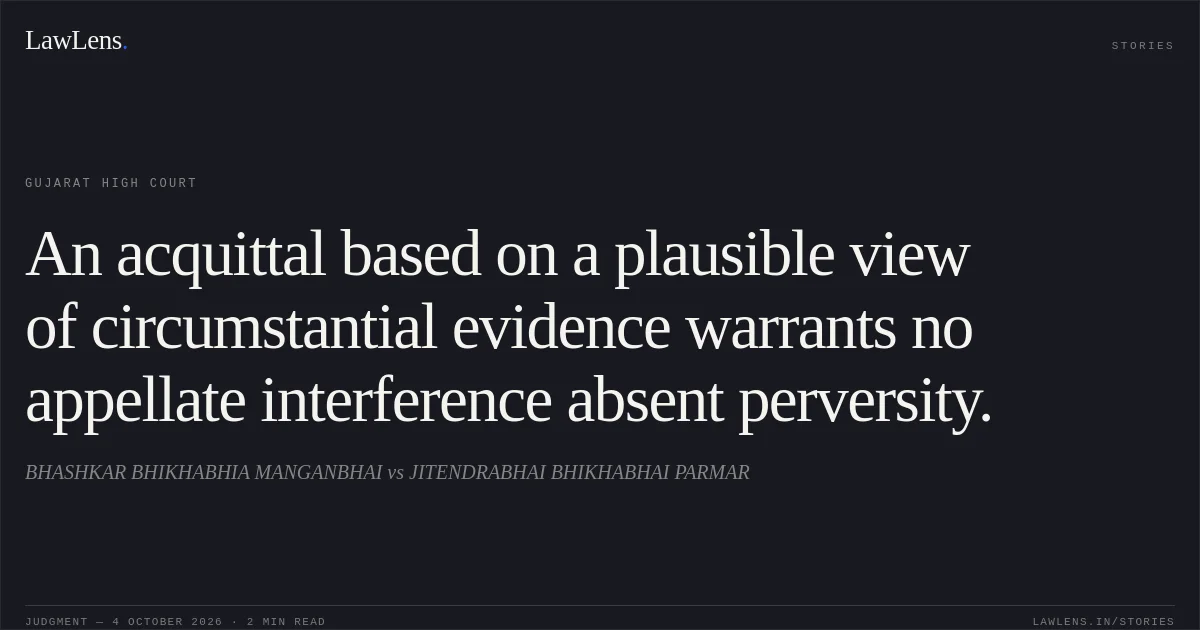
Source reference: pp. 13–14, para. 21(4)The trial court’s acquittal was therefore a plausible view and not perverse.
Source reference: p. 14, para. 23Holding
The Court answered that the trial court was justified in acquitting the accused and found no basis to interfere with that decision.
It refused leave to appeal and dismissed both the application and the acquittal appeal.
Source reference: p. 15, para. 23Acts & Sections Cited
4 provisions across 2 statutes referred to in this judgment. Each provision opens on LawLens.
Indian Penal Code, 18603
Code of Criminal Procedure, 19731
Original Court PDF
BHASHKAR BHIKHABHIA MANGANBHAIvsJITENDRABHAI BHIKHABHAI PARMAR
Click to open original judgment
Original judgment, available to read, download and summarize on LawLens.in