Facts
The petitioner, a retired Junior Engineer, was accused of demanding and accepting a bribe of ₹5,000 on 28 August 2001.
Source reference: para. 2–5Departmental proceedings were entrusted to the Upa-Lokayukta in 2009, and charges were framed in 2011.
Source reference: para. 2–5The enquiry report, submitted on 20 December 2017, found the charges proved; the Upa-Lokayukta recommended compulsory retirement and permanent withholding of 50% of pension.
Source reference: para. 2–5After the petitioner responded to a second show-cause notice, the disciplinary authority ordered permanent withholding of 25% of his pension on 3 February 2021.
Source reference: para. 2–5He challenged the enquiry report, recommendation and punishment order, alleging, among other things, unexplained delay
Source reference: para. 2–5Issues
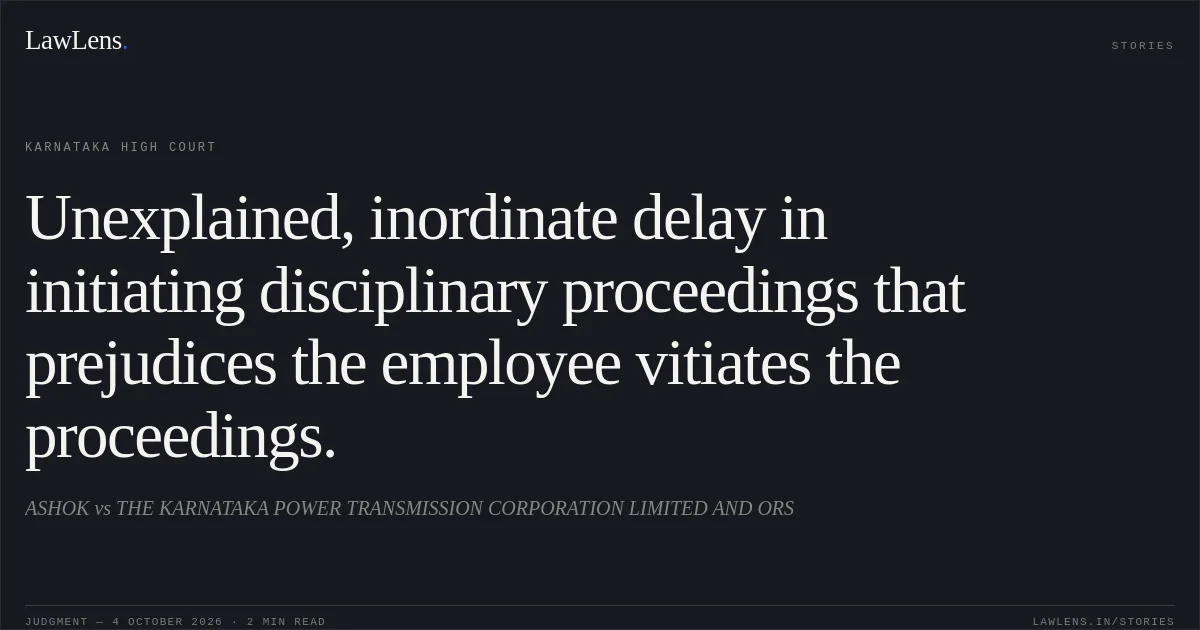
Whether the delay in initiating and concluding the disciplinary proceedings, in the absence of an adequate explanation, vitiated the proceedings
Source reference: para. 7Whether the disciplinary authority’s order permanently withholding 25% of the petitioner’s pension was liable to be set aside on that basis
Source reference: paras. 11–13, 18Law Applied
There is no fixed rule that delay invariably invalidates disciplinary proceedings; the court must assess the circumstances, including the nature and complexity of the charge, the cause of delay, prejudice to the employee, and the employer’s diligence. Unexplained abnormal delay may vitiate proceedings where it prejudices the employee, unless the employee caused the delay or the employer provides a proper explanation (State of Andhra Pradesh v. N. Radhakishan, (1998) 4 SCC 154, para. 19, quoted at para. 14).
Source reference: para. 14In Prem Nath Bali v. Registrar, High Court of Delhi, (2015) 16 SCC 415, the Supreme Court emphasized prompt completion of departmental enquiries, ordinarily within six months and, where unavoidable, within a reasonably extended period not exceeding one year (quoted at para. 15).
Source reference: para. 15The Court also referred to the Karnataka Government circular dated 4 October 2021, which prescribed timelines for stages of disciplinary proceedings
Source reference: para. 16The charge alleged misconduct under Rule 3 of the KEB Employees (Conduct) Regulations, 1988
Source reference: para. 9Reasoning
The alleged incident occurred in 2001, but charges were framed only in 2011—more than ten years later. The enquiry report and Upa-Lokayukta recommendation followed in 2017, yet the disciplinary authority did not issue its punishment order until February 2021, over four years after the recommendation; the Court found no explanation for that further delay
Source reference: paras. 12–13Applying the principles in N. Radhakishan and Prem Nath Bali, the Court considered the delay in initiating and pursuing the proceedings prejudicial to the petitioner’s ability to defend himself and found no basis to attribute the delay to him or excuse it
Source reference: paras. 13–17It therefore held that intervention was warranted without examining the merits of the charge
Source reference: paras. 8, 18Holding
The Court answered the delay issue in the affirmative and allowed the writ petition as prayed.
It set aside the disciplinary authority’s order dated 3 February 2021 and, under the reliefs granted, quashed the challenged enquiry report and Upa-Lokayukta recommendation and directed release of the permanently withheld 25% pension amount
Source reference: paras. 8, 18–19Original Court PDF
ASHOKvsTHE KARNATAKA POWER TRANSMISSION CORPORATION LIMITED AND ORS
Click to open original judgment
Original judgment, available to read, download and summarize on LawLens.in