Facts
The Tamil Nadu Uniformed Services Recruitment Board issued a notification for recruitment to the posts of Grade-II Police Constable/Jail Warden for the 2022 recruitment year.
Source reference: para. 3R. Dinesh applied for the post of Jail Warden, qualified in the required tests, and was provisionally selected after certificate verification.
Source reference: para. 3In his application, he disclosed Crime No. 129 of 2017, registered in connection with the 2017 Jallikattu agitation for offences under the Indian Penal Code and Sections 3 and 4 of the Tamil Nadu Property (Prevention of Damage and Loss) Act, 1992.
Source reference: para. 3.1The criminal case culminated in S.C. No. 373 of 2021, in which Dinesh and the other accused were acquitted on 19 April 2022 after trial.
Source reference: paras. 3.1, 12The first appellant rejected Dinesh’s candidature by relying on G.O. Ms. No. 1410, Home (Pri-II) Department, dated 17 October 2008, treating an acquittal based on benefit of doubt as involvement in a criminal case.
Source reference: paras. 3.2, 8The learned Single Judge quashed the rejection order, held that Dinesh’s acquittal amounted to an honourable acquittal, and directed his appointment as Jail Warden within twelve weeks.
Source reference: para. 4Issues
Whether an acquittal recorded on the ground of benefit of doubt can nevertheless qualify as an “honourable acquittal” for the purposes of appointment to a disciplined uniformed service, where the acquittal resulted from a complete absence of evidence connecting the accused with the alleged offences.
Source reference: paras. 8–13Whether, in the facts of the case, Dinesh was required to be treated as a person “not involved in a criminal case” under G.O. Ms. No. 1410, Home (Pri-II) Department, and was therefore entitled to consideration for appointment as Jail Warden.
Source reference: para. 15Whether the learned Single Judge was justified in quashing the rejection order and directing Dinesh’s appointment.
Source reference: paras. 4, 15–16Law Applied
The Court applied G.O. Ms. No. 1410, Home (Pri-II) Department, dated 17 October 2008, which disqualifies a person involved in a criminal case from appointment to constabulary service and ordinarily treats acquittal or discharge on benefit of doubt, or because the complainant turned hostile, as involvement in a criminal case; however, an honourable acquittal constitutes an exception.
Source reference: para. 8Relying on Inspector General of Police v. S. Samuthiram, (2013) 1 SCC 598, as quoted in Commissioner of Police v. Mehar Singh, (2013) 7 SCC 685, the Court held that “honourable acquittal” is not a statutory expression but may apply where, after full consideration of the prosecution case, the prosecution fails completely to establish the charges.
Source reference: para. 10In service jurisprudence, an acquittal based on a clear absence of evidence, rather than on a technicality, compromise, or prosecutorial lapse such as non-examination of material witnesses, may be treated as an honourable acquittal.
Source reference: para. 11The Court also considered G.O. Ms. No. 99, Home (Courts-IV) Department, dated 20 February 2021, under which the State had decided to withdraw 308 cases arising from the 2017 Jallikattu protests.
Source reference: para. 14Reasoning
The Court examined the evidence in S.C. No. 373 of 2021 and noted that 24 prosecution witnesses had been examined, but none identified Dinesh or any of the other accused as participating in the alleged offences.
Source reference: para. 13The acquittal was therefore not attributable to a compromise, a procedural or technical defect, or the prosecution’s failure to examine a material witness; it resulted from the complete absence of evidence connecting the accused to the offences.
Source reference: para. 13Although the Sessions Court used the expression “benefit of doubt,” the substance of its decision satisfied the test for an honourable acquittal under the principles governing service jurisprudence.
Source reference: paras. 10–13The Court further considered that the case arose from the Jallikattu agitation, for which the Government had adopted a policy of withdrawing numerous cases, and that Dinesh had candidly disclosed the criminal case in his recruitment application after being acquitted several months earlier.
Source reference: paras. 12, 14–15On this cumulative assessment, the authorities had incorrectly treated him as disqualified under G.O. Ms. No. 1410.
Source reference: para. 15Holding
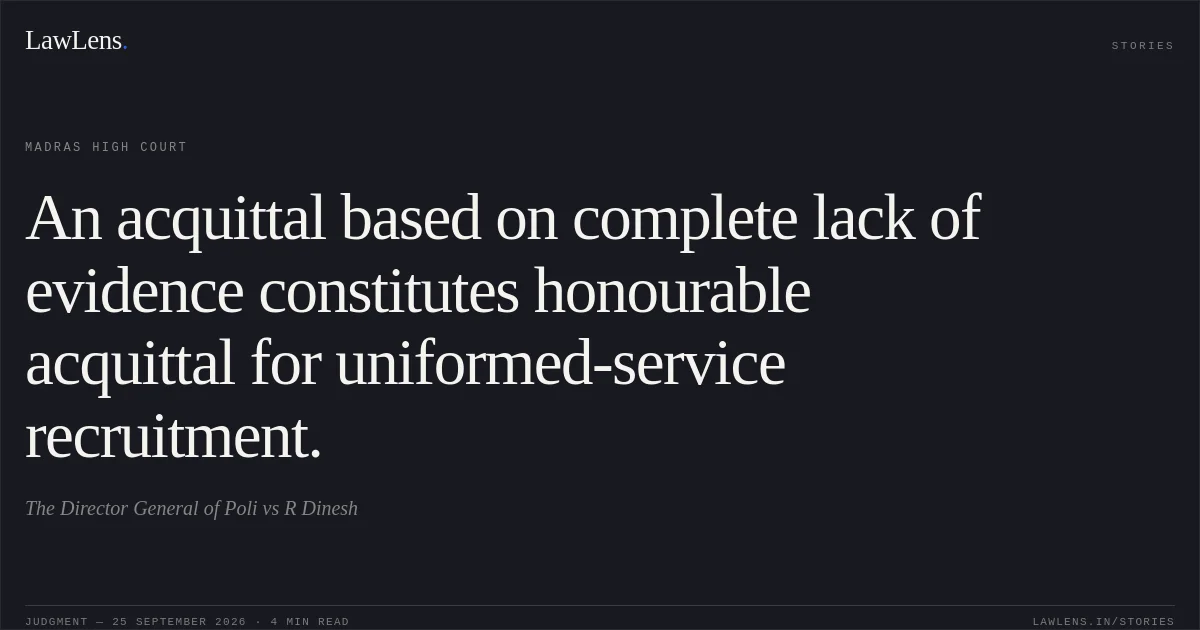
The Court held that Dinesh’s acquittal, though formally based on benefit of doubt, was an honourable acquittal because there was no evidence whatsoever connecting him with the alleged offences.
He was therefore to be treated as a person not involved in a criminal case for the purposes of G.O. Ms. No. 1410.
Source reference: para. 15The writ appeal was dismissed as devoid of merit, the Single Judge’s order quashing the rejection order was affirmed, and the first appellant was directed to appoint Dinesh as Jail Warden within twelve weeks.
Source reference: para. 16No order as to costs was made, and the connected civil miscellaneous petition was closed.
Source reference: para. 16Acts & Sections Cited
7 provisions across 1 statute referred to in this judgment. Each provision opens on LawLens.
Indian Penal Code, 18607
Original Court PDF
The Director General of PolivsR Dinesh
Click to open original judgment
Original judgment, available to read, download and summarize on LawLens.in