Facts
The deceased, daughter of the complainant, was married to Respondent No. 2 approximately two years before the incident. On 5 August 1996, she allegedly consumed acid and later died during treatment on 17 August 1996.
Source reference: pp. 1–3; paras 2–3.2The prosecution alleged that her husband, parents-in-law and other relatives subjected her to cruelty and harassment in connection with dowry demands. An FIR was registered and, after investigation, the accused were charged under Sections 498A and 114 IPC and, in substance, for abetment of suicide under Section 306 IPC.
Source reference: pp. 1–3; paras 2–3.2The prosecution examined 13 witnesses and relied principally on a dying declaration recorded by an Executive Magistrate; the defence examined two witnesses and produced a written chit allegedly stating that the in-laws were innocent and that the deceased had consumed acid herself.
Source reference: pp. 20–22; para 7.18The Sessions Court acquitted all accused on 6 September 1999, leading the State to prefer an appeal under Section 378(1) and (3) CrPC.
Source reference: p. 1; para 1Issues
Whether the trial court’s acquittal was perverse, illegal, or based on a misappreciation or omission of material evidence so as to warrant interference in an appeal against acquittal under Section 378 CrPC.
Source reference: pp. 5–10; paras 6.1–6.3Whether the prosecution proved beyond reasonable doubt that the accused subjected the deceased to cruelty or harassment in connection with a dowry demand, thereby attracting Sections 498A and 114 IPC.
Source reference: pp. 11–16; paras 7.2–7.7Whether the dying declaration at Exhibit 30 was voluntary, truthful, reliable and recorded when the deceased was conscious, oriented and mentally fit to make a statement.
Source reference: pp. 11, 17–23; paras 7.1, 7.9–8.2Whether the prosecution established the ingredients of abetment under Sections 107 and 306 IPC, including instigation, aid or conspiracy resulting in the deceased’s suicide.
Source reference: pp. 16–20; paras 7.7–7.8, 7.16–7.17Law Applied
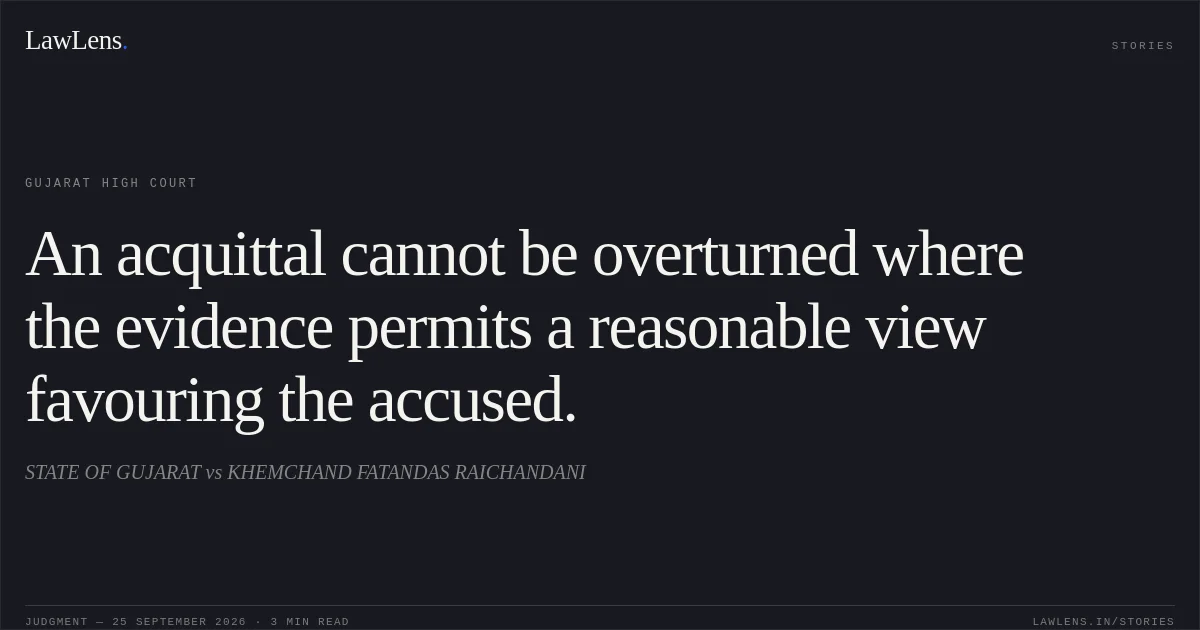
An appellate court has full power to reappreciate evidence in an appeal against acquittal, but the accused enjoy a double presumption of innocence; where two reasonable views are possible, the view favourable to the accused must prevail. Interference is justified only where the acquittal is perverse, rests on a material misreading or omission of evidence, or where guilt is the only reasonable conclusion.
Source reference: pp. 5–10; para 6.1, relying on Chandrappa v. State of Karnataka, Rajesh Prasad v. State of Bihar, H.D. Sundara v. State of Karnataka, and Constable 907 Surendra Singh v. State of UttarakhandSection 498A IPC requires proof of wilful conduct likely to drive the woman to suicide or cause grave injury, or harassment connected with an unlawful demand for property or valuable security.
Source reference: pp. 11–13; para 7.3Abetment under Sections 107 and 306 IPC requires proof of instigation, intentional aid or conspiracy. The court held that statutory presumptions relating to suicide or dowry death cannot be invoked in the absence of foundational, cogent evidence of cruelty or harassment.
Source reference: pp. 14–16; paras 7.6–7.7, relying on Ram Pyarey v. State of Uttar PradeshA dying declaration may independently sustain a conviction only when it is voluntary, coherent, truthful and inspires full confidence; medical certification is not invariably indispensable, but the declarant’s capacity and mental fitness must otherwise be established.
Source reference: pp. 11, 17–23; paras 7.1, 7.9–8.1Reasoning
The High Court found that the allegations in the FIR and the testimony of the complainant and relatives were general and omnibus, with no specific dowry demand, act of cruelty, or incident immediately preceding the suicide. The witnesses also admitted that no dowry demand had been made at the time of engagement or marriage, and no independent neighbour supported the allegation of continuing harassment.
Source reference: pp. 11–16; paras 7.2–7.5The dying declaration was treated as unreliable because the medical evidence showed that the deceased had extensive internal mouth burns, ulcers, difficulty speaking and, at relevant times, could respond only by “yes” or “no”; this contradicted the Executive Magistrate’s assertion that she spoke normally and was fully oriented.
Source reference: pp. 17–20; paras 7.9–7.16The Court also noted a serious discrepancy in the timing of the doctor’s endorsement and commencement of the declaration, as well as the defence evidence and Exhibit 69 suggesting that the deceased had exonerated her in-laws.
Source reference: pp. 20–23; paras 7.17–8.2In the absence of reliable proof of cruelty, dowry-related harassment, instigation or aid, the statutory presumption could not be applied and the trial court’s view remained a reasonably possible view.
Source reference: pp. 14–16, 23–24; paras 7.6–8.8Holding
The High Court answered the issues against the State. It held that the prosecution failed to prove beyond reasonable doubt the offences under Sections 498A/114 and 306 IPC, and that the dying declaration did not inspire sufficient confidence to form the basis of conviction.
The acquittal was neither perverse nor illegal, and no ground for appellate interference was established.
Source reference: pp. 23–25; paras 8.4–9The State’s appeal was accordingly dismissed, and the records and proceedings were directed to be returned to the trial court.
Source reference: pp. 23–25; paras 8.4–9Acts & Sections Cited
5 provisions across 2 statutes referred to in this judgment. Each provision opens on LawLens.
Code of Criminal Procedure, 19731
Indian Penal Code, 18604
Original Court PDF
STATE OF GUJARATvsKHEMCHAND FATANDAS RAICHANDANI
Click to open original judgment
Original judgment, available to read, download and summarize on LawLens.in