Facts
The petitioner, Accused No.1 in Crime No.331 of 2022, was prosecuted for offences under Sections 294(b), 323, 355 and 506(ii) of the IPC and Section 4 of the Tamil Nadu Prohibition of Harassment of Women Act, 2002.
Source reference: paras. 1–4; pp. 1–3After the police filed the final report, cognizance was taken in C.C.No.438 of 2022 and copies were furnished to the petitioner on 28 December 2022.
Source reference: paras. 1–4; pp. 1–3On 6 January 2023, he filed a discharge petition under Section 239 Cr.P.C.; it was returned on the same day for effecting service on the Public Prosecutor.
Source reference: paras. 1–4; pp. 1–3On that date, charges were framed, read over and explained to him, and he pleaded not guilty.
Source reference: paras. 1–4; pp. 1–3The petition was re-presented on 19 January 2023 and again returned on 27 January 2023 as not maintainable since charges had already been framed.
Source reference: paras. 1–4; pp. 1–3It was ultimately numbered as Crl.M.P.No.2008 of 2023 on 27 February 2023.
Source reference: paras. 1–4; pp. 1–3The Magistrate dismissed it as not maintainable, and the Principal Sessions Judge dismissed the petitioner’s revision.
Source reference: paras. 1–4; pp. 1–3The petitioner thereafter invoked Section 528 of the BNSS before the High Court.
Source reference: paras. 1–4; pp. 1–3Issues
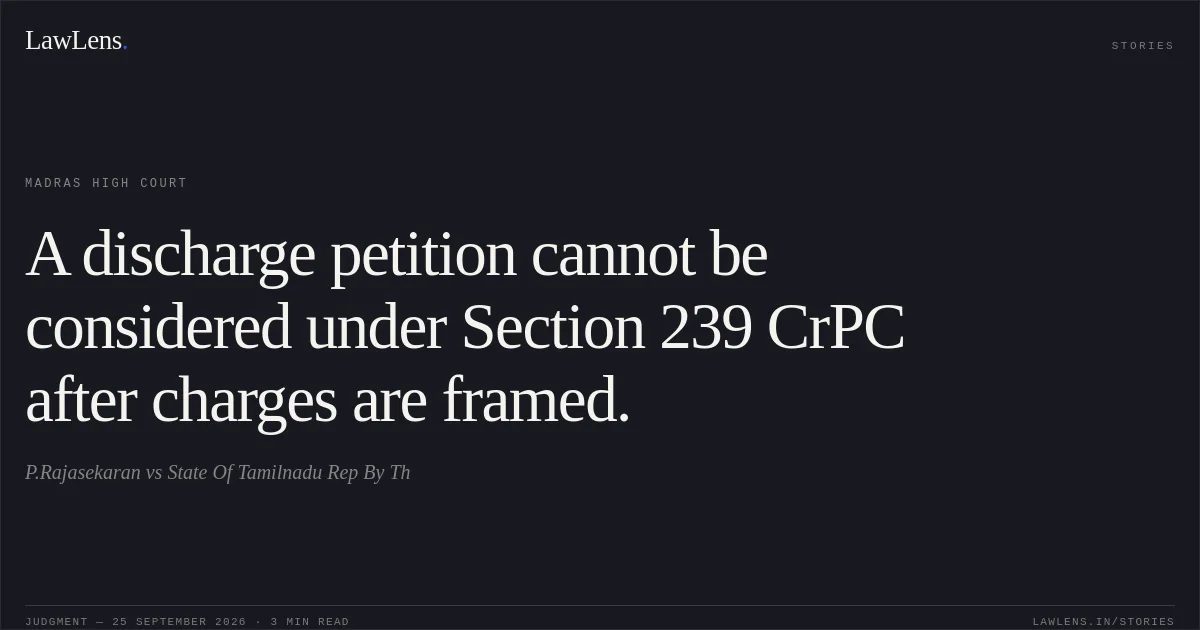
Whether a discharge petition under Section 239 Cr.P.C., which had been returned for curing a procedural defect and was re-presented only after charges had been framed, could thereafter be considered on merits.
Source reference: paras. 5–11; pp. 3–6Whether the trial Court was precluded from framing charges under Section 240 Cr.P.C. merely because the accused had earlier presented, but no longer had pending on the Court’s file, a discharge petition.
Source reference: paras. 9–11; pp. 4–6Whether the orders rejecting the discharge petition as not maintainable warranted interference under Section 528 of the BNSS.
Source reference: paras. 1, 4 and 12; pp. 1–2, 6Law Applied
The Court applied Section 239 Cr.P.C., which permits discharge of an accused in a warrant case instituted on a police report where the charge is groundless, and Section 240 Cr.P.C., which requires the Magistrate to frame charges when there is ground for presuming that the accused has committed an offence.
Source reference: paras. 10–11; pp. 5–6The governing principle applied was that a trial Court is precluded from framing charges only when a discharge petition is actually pending before it; once charges have been framed, the accused cannot ordinarily revive or seek adjudication of a discharge petition that was not pending on the date of framing charges.
Source reference: paras. 10–11; pp. 5–6The Court also applied the procedural principle that an accused who participated in charge-framing proceedings without objection, pleaded not guilty, and did not challenge the framing of charges cannot subsequently seek to reopen that stage.
Source reference: paras. 10–11; pp. 5–6Reasoning
The petitioner’s discharge petition was returned on 6 January 2023 and therefore was not pending on the trial Court’s file when charges were framed.
Source reference: paras. 9–11; pp. 4–6The petitioner participated in the charge-framing proceedings, answered the Court’s questions and pleaded not guilty, but did not inform the Court that he claimed a right to have the returned petition considered before charges were framed.
Source reference: paras. 9–11; pp. 4–6The petition was re-presented only on 19 January 2023, nearly two weeks after framing of charges, and the petitioner did not challenge the charge order itself.
Source reference: paras. 9–11; pp. 4–6Applying Sections 239 and 240 Cr.P.C., the High Court held that the trial Court was not barred from framing charges because no discharge petition was pending before it at that time.
Source reference: paras. 9–11; pp. 4–6Permitting the petitioner to seek discharge after charges had been framed would impermissibly “put the clock back” and reopen a procedural stage in which he had already participated without objection.
Source reference: paras. 9–11; pp. 4–6Holding
The High Court held that the discharge petition, having been returned and re-presented only after charges were framed, was not maintainable at that stage.
Since the petitioner had participated in the framing of charges and had not challenged the charge order, the trial Court and the Revisional Court correctly rejected the petition.
Source reference: paras. 12–13; p. 6The Criminal Original Petition was dismissed, the connected miscellaneous petition was closed, and the petitioner’s personal appearance before the trial Court was dispensed with unless specifically directed otherwise.
Source reference: paras. 12–13; p. 6Acts & Sections Cited
7 provisions across 3 statutes referred to in this judgment. Each provision opens on LawLens.
Bharatiya Nagarik Suraksha Sanhita, 20231
Indian Penal Code, 18604
Code of Criminal Procedure, 19732
Original Court PDF
P.RajasekaranvsState Of Tamilnadu Rep By Th
Click to open original judgment
Original judgment, available to read, download and summarize on LawLens.in