Facts
The respondent was selected for appointment as Examiner (Skill) after successfully completing the recruitment process and was appointed on 18 March 2013.
Source reference: p.3, para. 3During recruitment, he submitted a provisional ITI certificate and an experience certificate dated 7 June 2012.
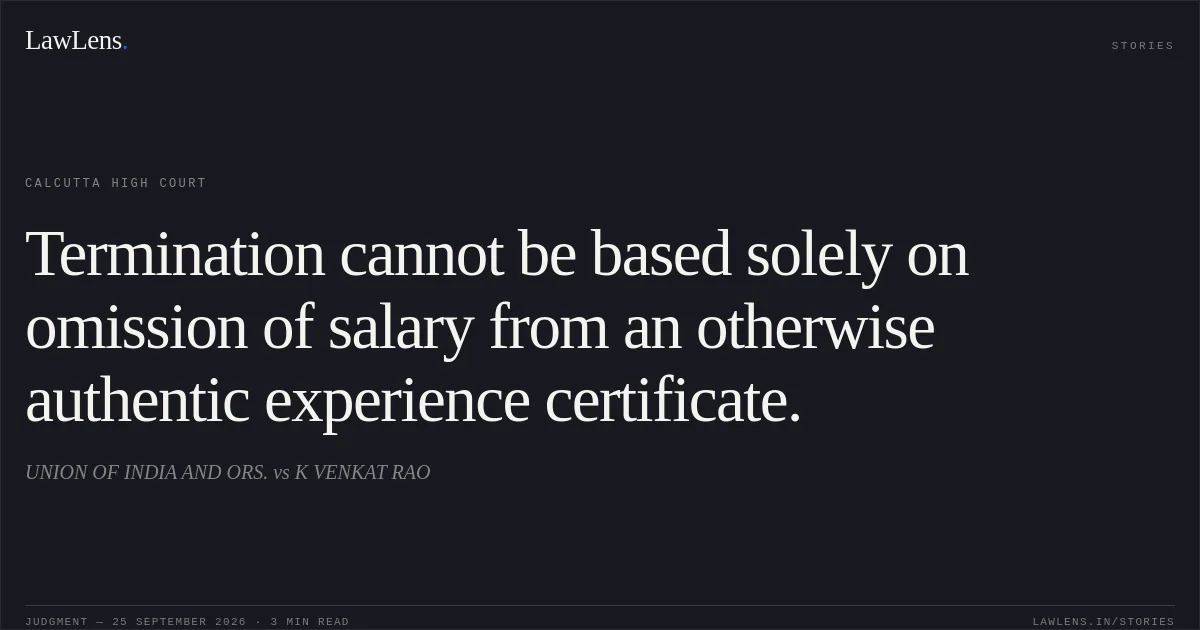
Source reference: p.3, para. 3Shortly before completion of his probation, the employer terminated his services on 14 March 2015 on the ground that he lacked the requisite qualification and experience, particularly because his experience certificate did not mention the salary drawn.
Source reference: p.3, para. 3; p.4, para. 4The respondent subsequently produced another certificate dated 18 March 2015 from the same factory, recording that he had worked as a Fitter in the Mechanic Department from 1 April 2010 to 1 May 2012 and had drawn a fortnightly salary of Rs. 1,550.
Source reference: p.4, para. 5The Central Administrative Tribunal, in O.A. No. 350/00634/2015, quashed the termination order and directed reinstatement with all consequential benefits within four months.
Source reference: p.2, para. 2The Union of India and its authorities challenged that order before the High Court.
Source reference: no citationThe Tribunal’s direction had not been implemented when the writ petition was heard.
Source reference: p.2, para. 2Issues
Whether the respondent’s termination was justified on the ground that the experience certificate submitted during recruitment did not mention the salary drawn.
Source reference: p.3–5, paras. 3–6Whether the subsequent experience certificate, which specified the respondent’s salary, established that he lacked the requisite qualification or experience at the time of selection and appointment.
Source reference: p.3–5, paras. 3–6Whether the Tribunal’s order directing reinstatement with consequential benefits suffered from any legal or factual error warranting interference under writ jurisdiction.
Source reference: p.5, para. 7Law Applied
The Court applied the principle that termination cannot be sustained where the employee’s eligibility and experience are established through authentic and materially consistent documents, and where the alleged deficiency is merely a non-substantive omission not required by the recruitment advertisement.
Source reference: p.4–5, paras. 4–7The Court further applied the rule that judicial review of a Tribunal’s decision is not warranted in the absence of a demonstrable error of law or fact.
Source reference: p.4–5, paras. 4–7No specific statutory provision or judicial precedent was cited in the judgment; the Court’s reasoning was based on the authenticity, consistency, and substantive adequacy of the respondent’s qualification and experience certificates.
Source reference: p.4–5, paras. 4–7Reasoning
The Court found that the respondent’s selection process, eligibility assessment, and appointment were not disputed.
Source reference: p.3, para. 3The ITI certificate was genuine, and the experience certificate dated 7 June 2012 was issued by the same factory in which the respondent had worked as a Fitter for approximately three years—substantially exceeding the one year’s experience required by the advertisement.
Source reference: p.4–5, paras. 4–5The later certificate dated 18 March 2015 merely added the fortnightly salary of Rs. 1,550 and was otherwise materially identical to the earlier certificate; it did not contradict or invalidate the earlier document.
Source reference: p.5, paras. 5–6Since the advertisement did not require candidates to disclose their salary in the experience certificate, the omission was not substantive enough to establish ineligibility or justify termination.
Source reference: p.5, para. 6The Court therefore held that the Tribunal had correctly appreciated the evidence and had committed no error warranting interference.
Source reference: no citationHolding
The High Court answered the issues in favour of the respondent.
It held that the omission of salary particulars from the original experience certificate did not negate the respondent’s requisite experience or justify termination, particularly when the later certificate from the same employer confirmed the relevant employment and salary details.
Source reference: p.5, paras. 5–6The writ petition was dismissed, the Tribunal’s order was upheld, and the Rule was discharged.
Source reference: p.5, para. 7Original Court PDF
UNION OF INDIA AND ORS.vsK VENKAT RAO
Click to open original judgment
Original judgment, available to read, download and summarize on LawLens.in