Facts
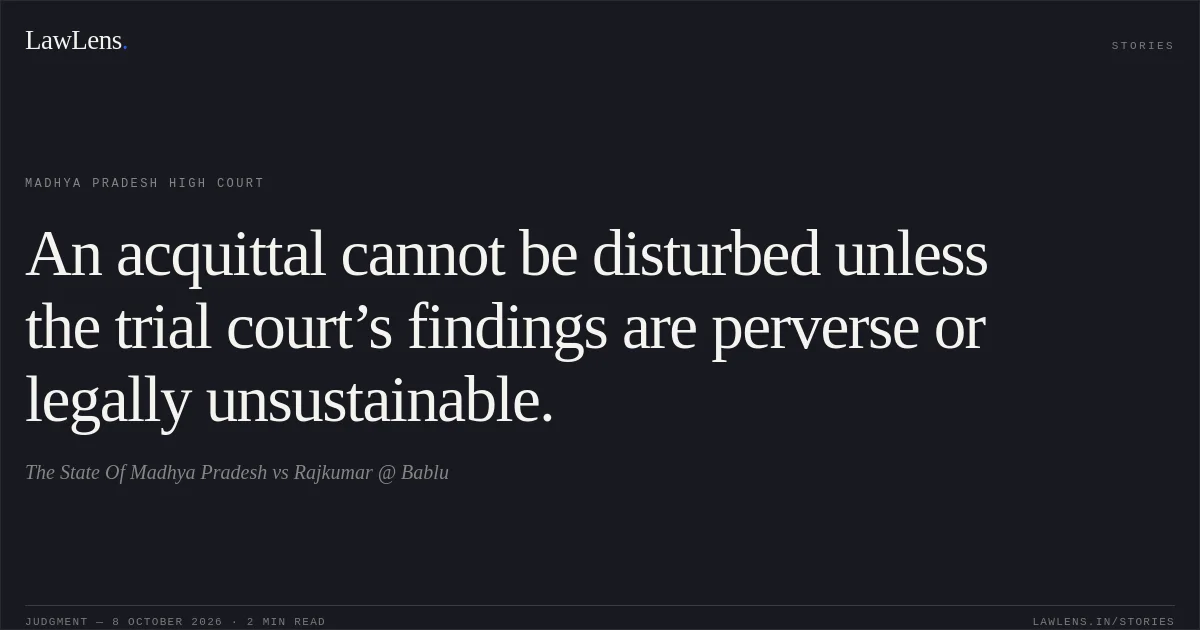
The State sought leave to appeal under Section 378(III) read with Section 378(1) of the Cr.P.C. against the acquittal of the respondents of offences under Sections 3 and 4 of the Dowry Prohibition Act, Section 498-A and Section 306 of the IPC, including the respective abetment/common-intention alternatives.
Source reference: para. 1The State also sought condonation of a 132-day delay, attributing it to delays in processing and forwarding the proposal for appeal.
Source reference: para. 2–3The deceased’s parents supported the prosecution, but her brother and maternal uncle did not; her elder sister and brother-in-law, who lived in the same village, were not called as prosecution witnesses.
Source reference: para. 6–9The trial court found the prosecution evidence on the material point unreliable and acquitted the respondents on the benefit of doubt.
Source reference: para. 10Issues
Whether the State showed sufficient grounds to condone the 132-day delay in filing the petition for leave to appeal.
Source reference: para. 2–5Whether the trial court’s acquittal disclosed an illegality or perversity warranting appellate interference.
Source reference: para. 6–15Law Applied
Section 378(III) read with Section 378(1) of the Cr.P.C. provides the procedural basis for the State’s application for leave to appeal against acquittal.
Source reference: para. 1In considering an acquittal, the appellate court may reassess the evidence, but should not disturb the acquittal unless the trial court’s findings are palpably wrong, manifestly erroneous, demonstrably unsustainable, or perverse; where two reasonable views are possible, the view favouring the accused should prevail.
Source reference: para. 11–13The accused also benefit from a double presumption of innocence, strengthened by the acquittal.
Source reference: para. 13The Court relied on Ramesh Babulal Doshi v. State of Gujarat, (1996) 9 SCC 225; Ajit Savant Majagvai v. State of Karnataka, (1997) 7 SCC 110; and Nikhil Chandra Mondal v. State of W.B., (2023) 6 SCC 605, including its reference to Rajesh Prasad v. State of Bihar, (2022) 3 SCC 471.
Source reference: para. 11–13Reasoning
The Court condoned the delay for the reasons stated in the State’s application.
Source reference: para. 5On the merits, it noted that, although the deceased’s parents supported the prosecution, her brother and maternal uncle did not, and the elder sister and brother-in-law were not examined.
Source reference: para. 9The trial court had assessed the relatives’ evidence and other testimony, found the material prosecution evidence unreliable, and given cogent reasons for extending the benefit of doubt.
Source reference: para. 10Applying the principles governing appeals against acquittal, the High Court found no illegality or perversity warranting interference.
Source reference: para. 11–14Holding
The Court allowed the application to condone the 132-day delay.
The Court dismissed the State’s petition for leave to appeal, finding the acquittal not fit for appellate interference.
Source reference: para. 15Acts & Sections Cited
6 provisions across 3 statutes referred to in this judgment. Each provision opens on LawLens.
Dowry Prohibition Act, 19613
Indian Penal Code, 18602
Code of Criminal Procedure, 19731
Original Court PDF
The State Of Madhya PradeshvsRajkumar @ Bablu
Click to open original judgment
Original judgment, available to read, download and summarize on LawLens.in