Facts
The State appealed under Section 378 of the Code of Criminal Procedure, 1973, against the Sessions Court’s acquittal of the respondents of offences under Sections 302, 498A and 504 read with Section 114 of the Indian Penal Code
Source reference: p.1The prosecution alleged that the deceased’s in-laws harassed her and that, on the day of the incident, they restrained her while one of them poured kerosene and set her alight
Source reference: pp.2–3The deceased’s dying declaration to an Executive Magistrate attributed the burning to her in-laws, but the history recorded at the hospital described the burns as accidental, caused by stove flames. The complaint and a later statement also differed as to the role of the jethani
Source reference: pp.4–6The deceased’s father did not support the prosecution case. The trial court acquitted the accused, and the State challenged that decision
Source reference: p.3; p.1Issues
1. Whether the evidence, including the dying declaration and complaint, established the respondents’ guilt beyond reasonable doubt and warranted setting aside their acquittal
Source reference: pp.4–62. Whether the trial court’s acquittal was a possible view on the evidence, such that the appellate court should not interfere
Source reference: pp.6–9Law Applied
Section 378 CrPC empowers an appellate court to review and reappreciate evidence in an appeal against acquittal.
Source reference: no citationUnder Chandrappa v. State of Karnataka, an acquittal reinforces the presumption of innocence, and where two reasonable views are possible, the appellate court should not disturb the trial court’s conclusion
Source reference: pp.7–8H.D. Sundara v. State of Karnataka restates that an appellate court may interfere only where the evidence permits no conclusion other than guilt beyond reasonable doubt
Source reference: pp.8–9The charges at trial arose under Sections 302, 498A and 504 read with Section 114 IPC
Source reference: p.1The Court also cited Bhagwan Sahai v. State of Rajasthan for the principle that a failure by the prosecution to explain the genesis and circumstances of an occurrence may support granting the accused the benefit of doubt
Source reference: p.7Reasoning
The Court found material inconsistencies between the dying declaration implicating the in-laws and the contemporaneous hospital history recording accidental burns from stove flames; the complaint and subsequent statement also varied on the jethani’s role
Source reference: pp.4–6The father did not corroborate the prosecution account, and the Court considered that the prosecution had not satisfactorily proved the alleged manner of burning
Source reference: pp.3, 6In light of these conflicts, the trial court’s decision to give the accused the benefit of doubt was a reasonable view of the evidence. Applying the principles governing appeals against acquittal, the High Court found no basis to substitute another view
Source reference: pp.6–9Holding
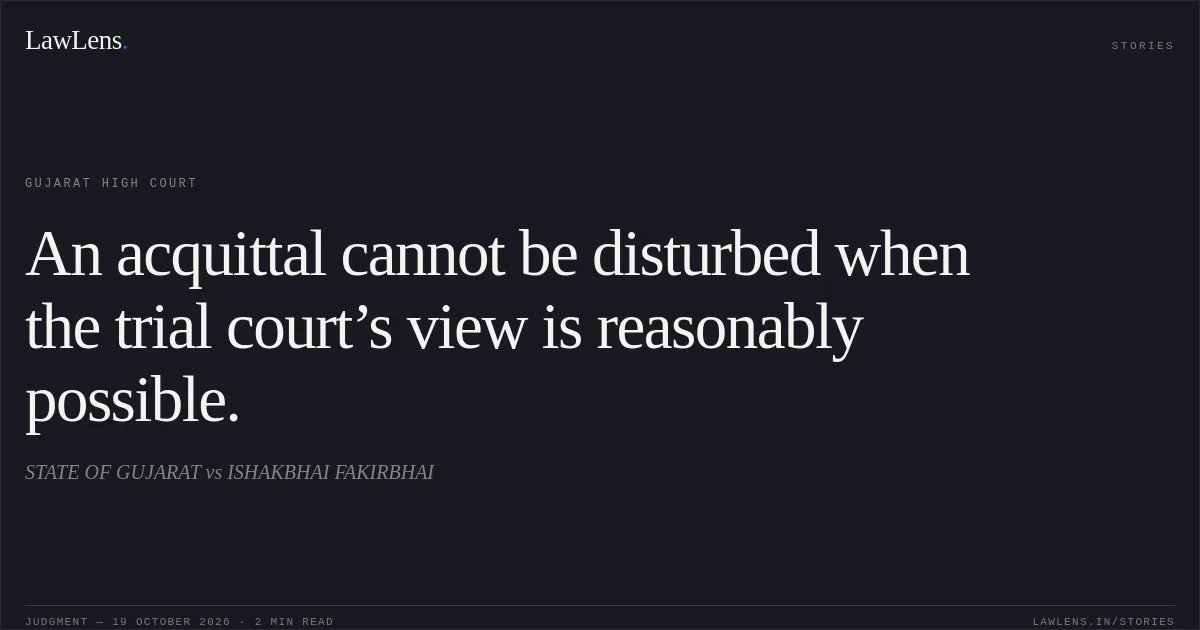
The Court held that the trial court’s acquittal was supported by a possible view of the evidence and that the prosecution had not established a basis for appellate interference
The State’s criminal appeal was dismissed, and the record and proceedings were ordered to be returned to the trial court
Source reference: p.10Acts & Sections Cited
4 provisions across 2 statutes referred to in this judgment. Each provision opens on LawLens.
Code of Criminal Procedure, 19731
Indian Penal Code, 18603
Original Court PDF
STATE OF GUJARATvsISHAKBHAI FAKIRBHAI
Click to open original judgment
Original judgment, available to read, download and summarize on LawLens.in