Facts
The Income Tax Officer alleged that M/s. Gupta General Stores and its partners failed to deduct and remit tax on interest credited to several parties, contrary to Section 194-A of the Income Tax Act, 1961, and accepted cash loans in breach of Section 269-SS.
Source reference: pp. 3–6; paras. 4–6The complaint charged them under Sections 276-B and 276-DD read with Section 278-B.
Source reference: pp. 3–6; paras. 4–6The trial court acquitted the accused, finding that statutory requirements for prosecution had not been complied with and noting that an application to compound the offences remained pending.
Source reference: pp. 3–6; paras. 4–6The Income Tax Officer appealed after obtaining leave. During the appeal, respondents 2 and 4 died, and the appeal abated as to them; the Court considered the appeal only against the surviving respondents.
Source reference: pp. 1–3; paras. 1, 3Issues
Whether the trial court’s acquittal, including its conclusion that statutory requirements governing prosecution had not been complied with, warranted appellate interference.
Source reference: pp. 5–9; paras. 6–9Whether the acquittal could be reversed where the trial court’s assessment of the evidence was a possible view and was not shown to be perverse or unreasonable.
Source reference: pp. 7–15; paras. 9–11Law Applied
Sections 194-A and 269-SS of the Income Tax Act prescribe, respectively, obligations concerning deduction of tax at source on interest and restrictions on accepting loans or deposits in cash; Sections 276-B and 276-DD provide for punishment for the alleged contraventions, while Section 278-B addresses offences by companies and persons responsible for their business.
Source reference: pp. 3–6; paras. 4, 6The trial court relied on Sections 278-AA and 279 in assessing compliance with prosecution requirements and the pending compounding application.
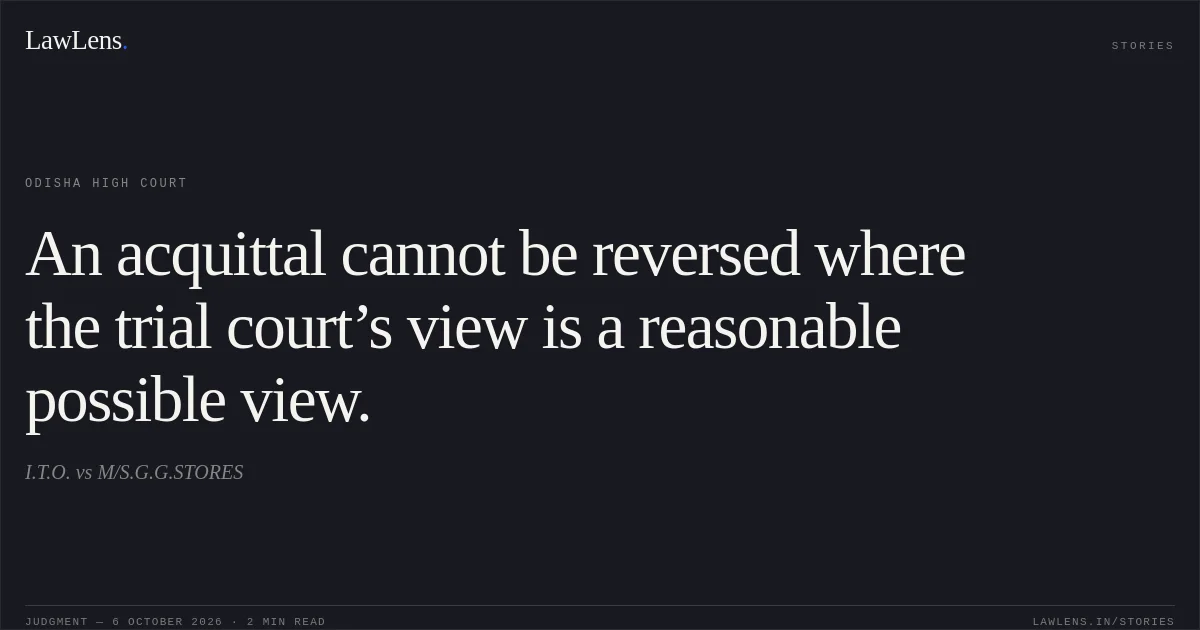
Source reference: pp. 3–6; paras. 4, 6On an appeal against acquittal under Section 378 CrPC, the appellate court may reassess the evidence, but the acquittal reinforces the presumption of innocence; where the trial court’s view is reasonably possible, it should not be displaced merely because another view is available.
Source reference: pp. 8–14; paras. 10–11Interference is warranted where the acquittal is perverse, impossible, clearly unreasonable, or rests on a material misreading or omission of evidence.
Source reference: pp. 8–14; paras. 10–11The Court relied on Tulasareddi @ Mudakappa v. State of Karnataka, 2026 INSC 67; Ballu v. State of Madhya Pradesh, (2024) 12 SCC 202; H.R. Sundara v. State of Karnataka, 2023 INSC 858; and Mallappa v. State of Karnataka, 2024 INSC 104.
Source reference: pp. 8–14; paras. 10–11Reasoning
The Court treated the central question as whether the trial court’s acquittal could be disturbed, rather than independently determining each alleged tax contravention.
Source reference: pp. 5–9, 14–15; paras. 6, 9–11It considered the trial court’s reasoning on non-compliance with statutory requirements and the pending compounding application, and concluded that its assessment was neither perverse nor wholly unreasonable.
Source reference: pp. 5–9, 14–15; paras. 6, 9–11Applying the reinforced-presumption-of-innocence standard, the Court held that the possibility of another view did not justify reversing the acquittal.
Source reference: pp. 14–15; para. 11It also noted that more than three decades had passed since the acquittal and found no compelling reason to unsettle it.
Source reference: pp. 14–15; para. 11Holding
The Court dismissed the criminal appeal against the surviving respondents, finding no legal or factual basis to interfere with the acquittal.
The appeal had already abated insofar as it concerned respondents 2 and 4, who had died during its pendency.
Source reference: p. 3; para. 3Acts & Sections Cited
3 provisions across 1 statute referred to in this judgment. Each provision opens on LawLens.
Code of Criminal Procedure, 19733
Original Court PDF
I.T.O.vsM/S.G.G.STORES
Click to open original judgment
Original judgment, available to read, download and summarize on LawLens.in