Facts
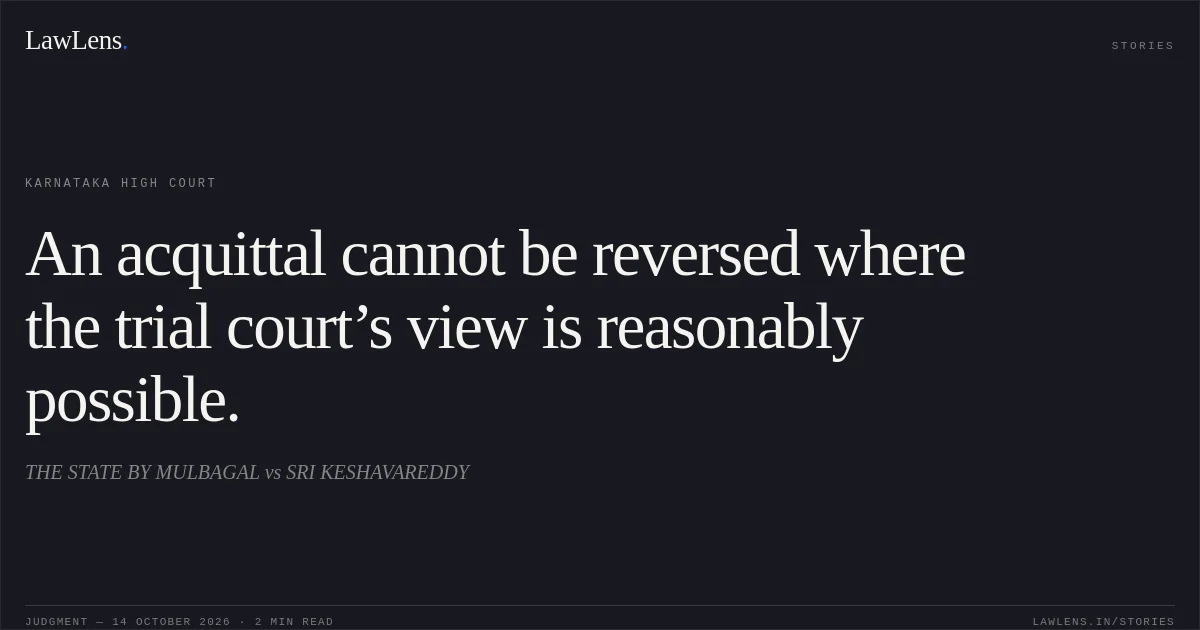
The State appealed the acquittal of six accused by the II Additional District and Sessions Judge, Kolar, in Spl.C.C. No. 9/2013.
Source reference: pp. 2–5, 14–18; paras 3–8, 16–17The prosecution alleged that, during a Gram Panchayat election dispute on 14 December 2012, the accused formed an unlawful assembly, assaulted and threatened the complainant and his father, abused them by reference to caste, and damaged the complainant’s car.
Source reference: pp. 2–5; paras 3–8The accused were charged under Sections 143, 147, 148, 323, 427, 504, 506 read with Section 149 of the IPC, and Sections 3(1)(vii) and 3(1)(x) of the SC/ST (Prevention of Atrocities) Act, 1989.
Source reference: pp. 2–4; para 3The trial court acquitted them, finding material inconsistencies in the prosecution evidence and that the charges were not proved beyond reasonable doubt.
Source reference: pp. 14–18; paras 16–17Issues
1. Whether the State had established grounds to interfere with the trial court’s judgment of acquittal
Source reference: p. 7; para 112. Whether the evidence established the accused persons’ guilt beyond reasonable doubt, such that the acquittal could be reversed
Source reference: pp. 7–9; para 12Law Applied
The appeal was brought under Section 378 of the Code of Criminal Procedure, which permits an appeal against acquittal.
Source reference: pp. 7–9; para 12The High Court applied the principles that an acquittal reinforces the presumption of innocence; an appellate court may reappreciate the evidence but should not reverse an acquittal merely because another view is possible; and interference is warranted where the acquittal is perverse, materially misreads or omits evidence, or where the evidence permits only a conclusion of guilt beyond reasonable doubt.
Source reference: pp. 7–9; para 12The Court relied on Constable 907 Surendra Singh v. State of Uttarakhand, (2025) 5 SCC 433; Babu Sahebgouda Rudragoudar v. State of Karnataka, (2024) 8 SCC 149; Chandrappa v. State of Karnataka, (2007) 4 SCC 415; and H.D. Sundara v. State of Karnataka, (2023) 9 SCC 581.
Source reference: pp. 7–9; para 12The charged offences were under the IPC and Sections 3(1)(vii) and 3(1)(x) of the SC/ST (Prevention of Atrocities) Act, 1989.
Source reference: pp. 2–4; para 3Reasoning
The High Court found the trial court’s assessment of the evidence to be a possible view and identified no legal or factual error warranting appellate intervention.
Source reference: p. 18; para 18The complainant’s account was materially inconsistent with his father’s evidence and with the accounts of the other witnesses; some witnesses had not seen the incident, and one turned hostile.
Source reference: pp. 10–14; paras 9–13The complaint was lodged three days after the alleged occurrence without an adequate explanation, and no medical evidence was produced to support the alleged assault.
Source reference: pp. 16–17; paras 16–17The evidence also disclosed political rivalry connected with the Panchayat election, which the trial court considered alongside the contradictions and inconsistencies.
Source reference: p. 17; para 17In light of these matters, the High Court held that the acquittal was not perverse and that the standard for reversing it was not met.
Source reference: pp. 18–19; paras 18–19Holding
The High Court answered the issue of interference in the negative and dismissed the State’s appeal.
The trial court’s acquittal of all six accused therefore remained undisturbed.
Source reference: p. 18; para 18; p. 19; para 19Acts & Sections Cited
11 provisions across 3 statutes referred to in this judgment. Each provision opens on LawLens.
Code of Criminal Procedure, 19732
Indian Penal Code, 18608
Scheduled Castes and the Scheduled Tribes (Prevention of Atrocities) Act, 19891
Original Court PDF
THE STATE BY MULBAGALvsSRI KESHAVAREDDY
Click to open original judgment
Original judgment, available to read, download and summarize on LawLens.in