01Facts
The prosecution alleged that the respondent, an FDA in the District Treasury, demanded and accepted ₹2,000 from the complainant, a Kannada Educator, in connection with processing arrears of salary increments.
pp. 2–5 · ¶ 1–5, 11The Lokayukta conducted a trap and charged the respondent under Sections 7, 13(1)(d) and 13(2) of the Prevention of Corruption Act, 1988. The Trial Court acquitted him, finding material inconsistencies in the prosecution evidence and doubt about his role in processing the bill. The Lokayukta appealed against the acquittal
pp. 2–5 · ¶ 1–5, 1102Issues
i.Whether the Lokayukta had established grounds to interfere with the Trial Court’s judgment of acquittal?
p. 6 · ¶ 8ii.What order should be made in the appeal?
p. 6 · ¶ 803Law Applied
The alleged offences were governed by Sections 7, 13(1)(d) and 13(2) of the Prevention of Corruption Act, 1988.
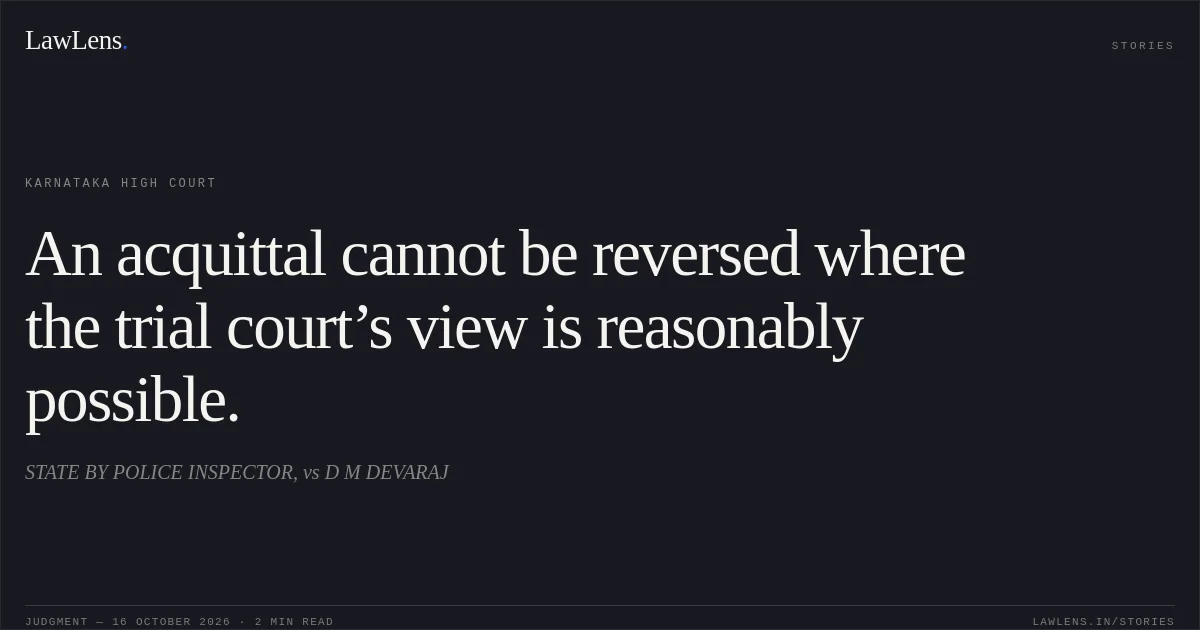
pp. 6–8 · ¶ 10In an appeal against acquittal under Section 378 of the Code of Criminal Procedure, the appellate court may reappreciate the evidence, but the acquittal reinforces the presumption of innocence. Where the Trial Court’s view is a possible view on the evidence, it cannot be displaced merely because another view is possible; interference is warranted where the acquittal is perverse, material evidence has been misread or omitted, and the evidence permits no reasonable conclusion other than guilt. The Court relied on Constable 907 Surendra Singh v. State of Uttarakhand, (2025) 5 SCC 433; Babu Sahebgouda Rudragoudar v. State of Karnataka, (2024) 8 SCC 149; Chandrappa v. State of Karnataka, (2007) 4 SCC 415; and H.D. Sundara v. State of Karnataka, (2023) 9 SCC 581
pp. 6–8 · ¶ 10Provisions in the judgment · 5 · Linked ones open on LawLens
Code of Criminal Procedure, 1973 Section 313Section 378
Prevention of Corruption Act, 1988 Section 7Section 13Section 20
04Reasoning
Applying the appellate standard, the Court found no legal or factual error in the Trial Court’s assessment. The complainant, shadow witness and other panch witness gave materially inconsistent accounts concerning the demand, trap and mahazars; the panch witnesses also signed the trap and entrustment mahazars at the Lokayukta office rather than at the scene.
pp. 13–18 · ¶ 11The evidence further cast doubt on the respondent’s role in the bill, including testimony that he was not its case worker and had raised no objection to it. Taken together, these matters supported the Trial Court’s view that demand and acceptance of a bribe had not been proved beyond reasonable doubt; that view was a possible one and did not justify appellate interference
pp. 13–18 · ¶ 11 · p. 19 · ¶ 1205Holding
The Court answered the question of interference in the negative and dismissed the appeal.
p. 19 · ¶ 12–13The Trial Court’s acquittal of the respondent was left undisturbed
p. 19 · ¶ 12–13Original Court PDF
STATE BY POLICE INSPECTOR,vsD M DEVARAJ
Click to open original judgment
Original judgment, available to read, download and summarize on LawLens.in