Facts
On 6 October 1996, Gopaldas was allegedly assaulted by Mangilal with a lathi and by kicks and fists. Gopaldas sustained multiple injuries, including fractures.
Source reference: para. 3–6The trial court acquitted Mangilal of offences under Sections 323 and 325 IPC, relying on discrepancies in the witnesses’ accounts of the occurrence and their arrival at the scene.
Source reference: para. 3–6The State appealed under Section 378 CrPC after leave to appeal had been granted.
Source reference: para. 1Issues
1. Whether the trial court’s acquittal rested on a reasonable and legally sustainable appreciation of the evidence, warranting appellate deference.
Source reference: para. 9–122. Whether the discrepancies in the witnesses’ accounts undermined the injured witness’s testimony and left reasonable doubt about Mangilal’s participation in the assault.
Source reference: para. 34–38, 47–603. Whether the evidence proved the offence under Section 325 IPC and, if so, what order on sentence was appropriate.
Source reference: para. 76–90Law Applied
Under Section 378 CrPC, an appellate court may review and reappreciate the evidence in an appeal against acquittal, but must account for the reinforced presumption of innocence; it should interfere where the acquittal rests on a manifestly erroneous or legally untenable assessment, not merely because another view is possible, as explained in Chandrappa v. State of Karnataka, (2007) 4 SCC 415.
Source reference: para. 10–12The prosecution must prove guilt beyond reasonable doubt; a reasonable doubt must be rationally grounded in the evidence, and where evidence reasonably supports two views, the view favourable to the accused ordinarily prevails, as reflected in Section 3 of the Evidence Act, 1872, Vijayee Singh v. State of Uttar Pradesh, (1990) 3 SCC 190, and Kali Ram v. State of Himachal Pradesh, AIR 1973 SC 2773.
Source reference: para. 13–29Minor discrepancies and ordinary errors of perception or memory do not justify rejecting otherwise credible testimony unless they shake its basic version; evidence should be assessed as a whole, consistent with Leela Ram v. State of Haryana, (1999) 9 SCC 525, and Rammi alias Rameshwar v. State of M.P., (1999) 8 SCC 649.
Source reference: para. 30–34, 51Section 4 of the Probation of Offenders Act, 1958 permits release on probation of good conduct, while Section 5 permits an order for compensation.
Source reference: para. 90–93Reasoning
The High Court found that the trial court had fragmented the evidence and treated variations about the cattle, the reason for the quarrel, witnesses’ arrival, and the sequence of events as cumulatively destructive, although they did not displace the central account of the injured witness.
Source reference: para. 53–60, 71–75Gopaldas’s injuries established his presence and were corroborated by medical and radiological evidence, including fractures; his testimony attributed the assault to Mangilal.
Source reference: para. 39–46, 76–78The Court held that the discrepancies affected peripheral details rather than the identity or participation of the assailant, and did not constitute a reasonable alternative hypothesis.
Source reference: para. 57–60, 77–85Given the nature and age of the case, it ordered probation rather than substantive imprisonment.
Source reference: para. 90–95Holding
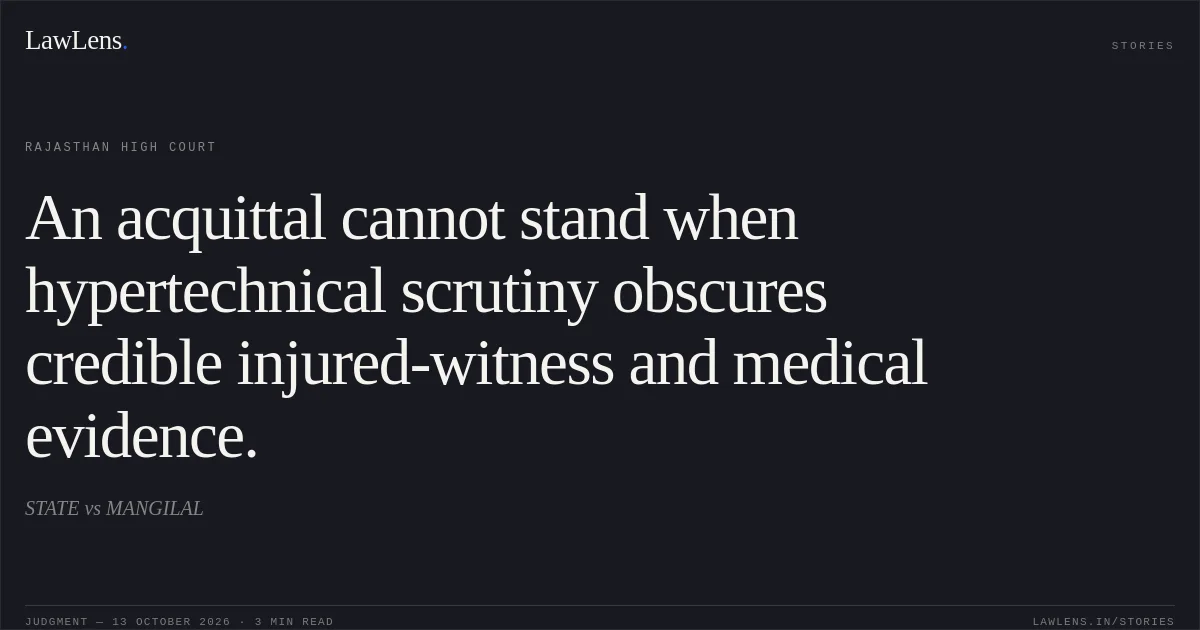
The appeal was partly allowed. The acquittal under Section 323 IPC was maintained, but the acquittal under Section 325 IPC was set aside and Mangilal was convicted under that section.
In lieu of substantive imprisonment, he was released on probation of good conduct for two years under Section 4 of the Probation of Offenders Act, directed to pay ₹50,000 compensation to Gopaldas under Section 5, and required to execute a ₹2,000 peace bond.
Source reference: para. 90–95Acts & Sections Cited
5 provisions across 3 statutes referred to in this judgment. Each provision opens on LawLens.
Code of Criminal Procedure, 19731
Indian Penal Code, 18602
Original Court PDF
STATEvsMANGILAL
Click to open original judgment
Original judgment, available to read, download and summarize on LawLens.in


