Facts
The appeals arose from the prosecution for the fatal shooting of Bharat Kumar Rai on 30 May 2013.
Source reference: pp. 2–6, 8–9The informant alleged that Kedar Rai and Shivji Rai restrained the deceased while Kanhaiya Rai shot him.
Source reference: pp. 2–6, 8–9The trial court acquitted Kedar Rai of the charges under Sections 304 IPC and 27 of the Arms Act, but convicted Kanhaiya Rai under those provisions and sentenced him to imprisonment already undergone, with fines
Source reference: pp. 2–6, 8–9Ravindra Rai appealed in one matter against the order concerning Kanhaiya Rai’s sentence and in the other against Kedar Rai’s acquittal
Source reference: p. 2The High Court considered the evidence, including the informant’s account, the other prosecution witnesses, medical evidence and the investigating officers’ testimony
Source reference: pp. 10–21Issues
1. Whether the trial court’s acquittal of Kedar Rai was based on a view of the evidence that warranted interference in an appeal against acquittal
Source reference: pp. 22–232. Whether the prosecution evidence and investigative circumstances provided grounds to interfere with the challenged order concerning Kanhaiya Rai’s sentence
Source reference: pp. 10, 22–23Law Applied
The prosecution case invoked Sections 302/34 IPC and Section 27 of the Arms Act; the trial court ultimately convicted Kanhaiya Rai under Section 304 IPC and Section 27 of the Arms Act
Source reference: pp. 2, 4–6In assessing the prosecution evidence, the Court applied the principle that delay in lodging an FIR is not, by itself, fatal, but may affect the prosecution case where witness credibility is doubtful; it relied on Chotkau v. State of U.P., (2023) 6 SCC 742, and the passage from Meharaj Singh v. State of U.P., (1994) 5 SCC 188, concerning prompt FIR registration and the risks of embellishment
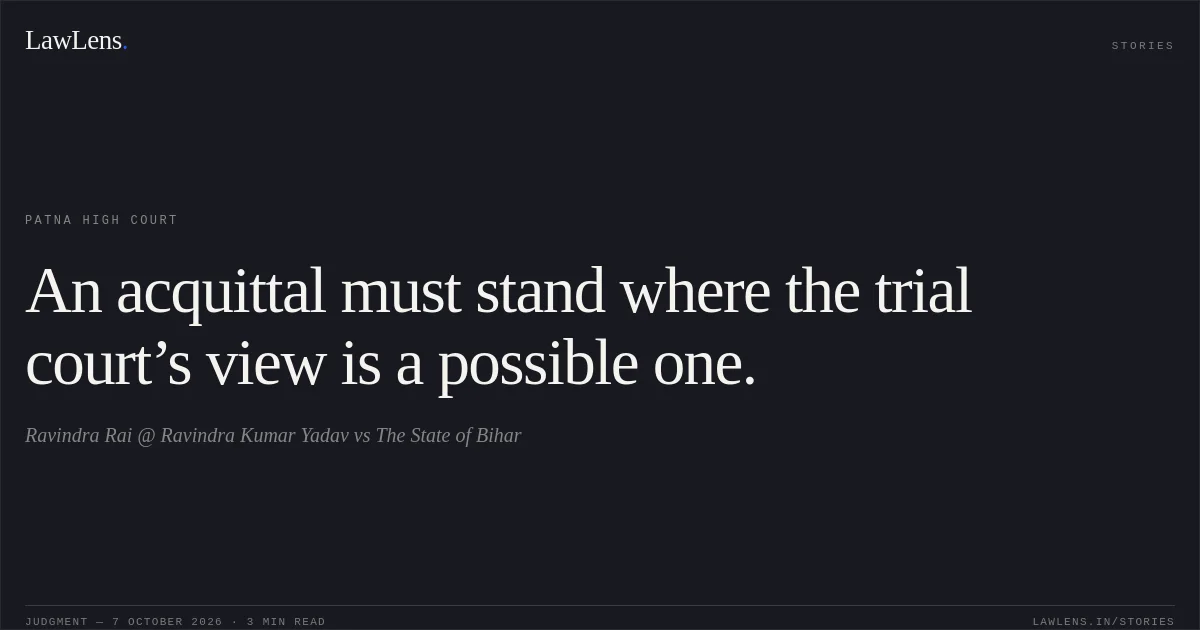
Source reference: pp. 12–14For the appeal against acquittal, the Court applied H.D. Sundara v. State of Karnataka, (2023) 9 SCC 581: an appellate court may reappreciate the evidence, but must not reverse an acquittal if the trial court’s view is a possible one; interference is justified only where the evidence permits no conclusion other than guilt beyond reasonable doubt
Source reference: pp. 22–23Reasoning
The Court found material reasons to doubt the prosecution account: the informant’s descriptions of the occurrence and where his statement was recorded were inconsistent; witnesses were connected to the parties and the admitted enmity required cautious assessment; and the timing and recording of statements, particularly that of PW-4, undermined their reliability
Source reference: pp. 10–12, 15–19The investigating evidence also disclosed no recorded finding of blood or recovery of an empty cartridge at the scene, and the alleged firearm was not seized
Source reference: pp. 18–19The Court therefore found no perversity in the trial court’s assessment or basis to disturb the acquittal under the principles governing appeals against acquittal
Source reference: pp. 21–23It expressly stated that it was not commenting on Kanhaiya Rai’s conviction or sentence, as he had not appealed
Source reference: p. 23Holding
The High Court dismissed both appeals, finding no merit in them and no ground to interfere with the acquittal of Kedar Rai
It made no determination on the merits of Kanhaiya Rai’s conviction or sentence, which remained outside the scope of its stated review
Source reference: p. 23The Court also directed that the failure to tag the appeals despite an earlier judicial order be brought to the Registrar General’s notice for appropriate administrative consideration
Source reference: pp. 23–24Acts & Sections Cited
8 provisions across 3 statutes referred to in this judgment. Each provision opens on LawLens.
Indian Penal Code, 18604
Arms Act, 19591
Code of Criminal Procedure, 19733
Original Court PDF
Ravindra Rai @ Ravindra Kumar YadavvsThe State of Bihar
Click to open original judgment
Original judgment, available to read, download and summarize on LawLens.in